Medical and Educational Disclaimer
This article addresses the question “is Modalert legal in the UK” for general educational and informational purposes only. It explains UK prescription requirements, medicine licensing, possession, importation and regulatory safeguards. It does not constitute medical or legal advice, confirm the authorisation of any particular Modalert product or supplier, or establish the legality of an individual transaction. Medicines legislation and regulatory guidance may change. Product-specific questions should be assessed against current MHRA records and applicable UK legislation.
Is Modalert legal in the UK? The answer depends on whether the question concerns prescription requirements, personal possession, sale, importation or the regulatory approval of the branded medicine.
Modafinil, the active ingredient in Modalert, is classified as a Prescription-Only Medicine (POM) in the United Kingdom. Consequently, its sale and supply must follow specific legal requirements. However, prescription-only status does not automatically make personal possession a criminal offence.
Another important distinction concerns the Modalert brand itself. Although the UK has authorised medicines containing modafinil, this does not mean every internationally marketed brand containing the same ingredient has UK marketing authorisation.
These differences are particularly relevant when researching Modalert through overseas suppliers or online medicine websites.
This guide explains UK prescription requirements, lawful supply, personal possession, importation, medicine licensing, pharmacy registration and advertising restrictions.
For a wider overview of modafinil’s clinical uses, safety considerations and UK prescription rules, see our complete Modalert guide.
Is Modalert Legal in the UK?
Modalert contains modafinil, a prescription medicine regulated under UK pharmaceutical legislation.
To understand its legal position, it is necessary to distinguish five separate issues:
- Prescription requirements: Modafinil is classified as a Prescription-Only Medicine in the UK.
- Personal possession: Modafinil is not classified as a controlled drug under the Misuse of Drugs Act 1971. Therefore, simple possession is legally distinct from possession of a controlled drug.
- Sale and supply: Suppliers must comply with prescription requirements and other applicable medicines regulations.
- Importation: Bringing medicines into the UK can involve additional rules, depending on the circumstances and the type of import.
- Product authorisation: The UK marketing authorisation status of the Modalert brand requires independent verification.
The Human Medicines Regulations 2012 provide the main legal framework governing the sale and supply of medicinal products.
However, the rules do not treat every activity involving a prescription medicine in the same way.
For example, personally possessing a medicine differs from selling it to another individual. Similarly, an authorised active ingredient does not automatically establish that a particular branded product has permission to enter the UK market.
Therefore, understanding whether Modalert is legal in the UK requires consideration of the product, supplier and activity involved.
Modalert vs Modafinil: Why the Legal Distinction Matters
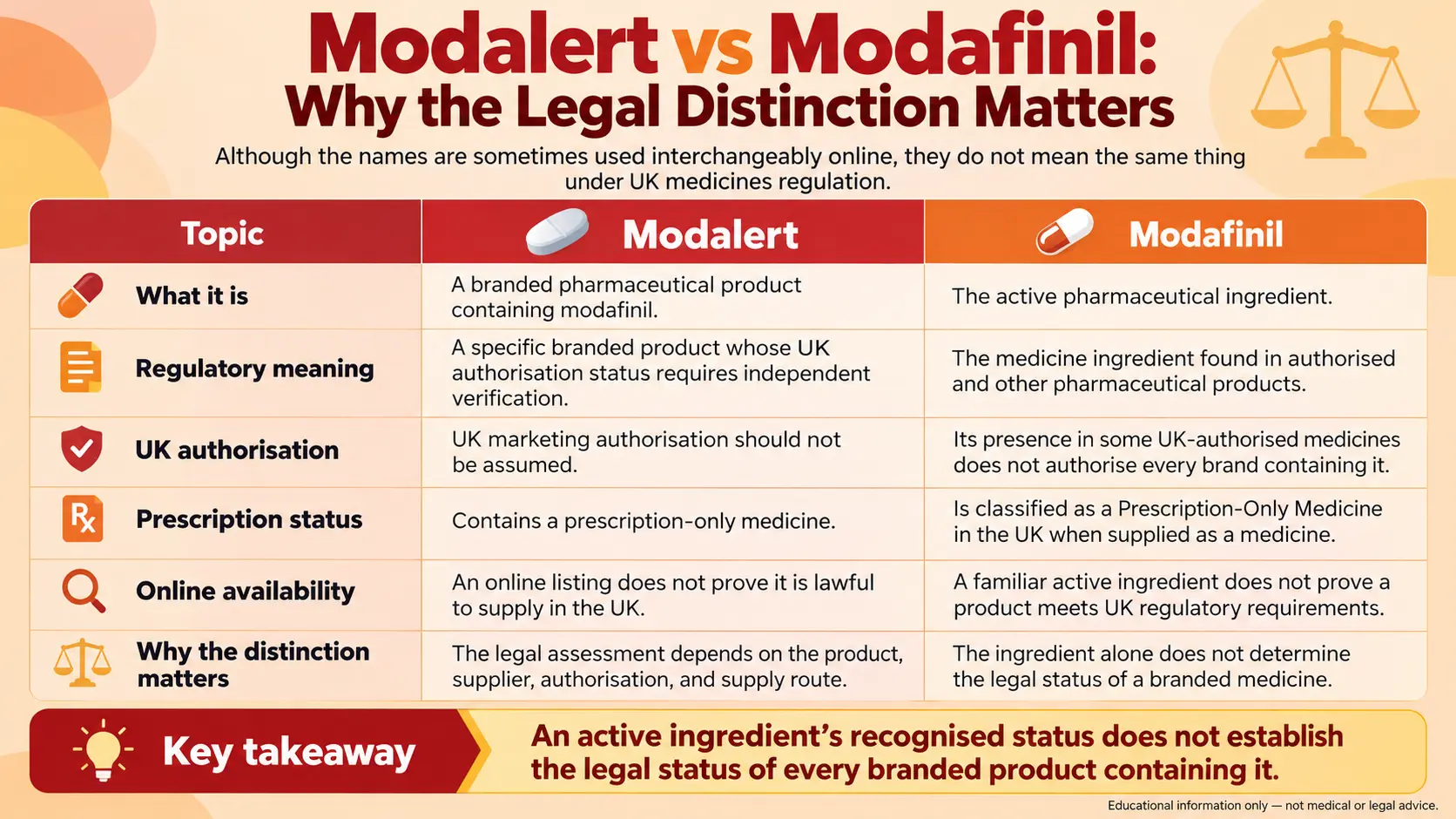
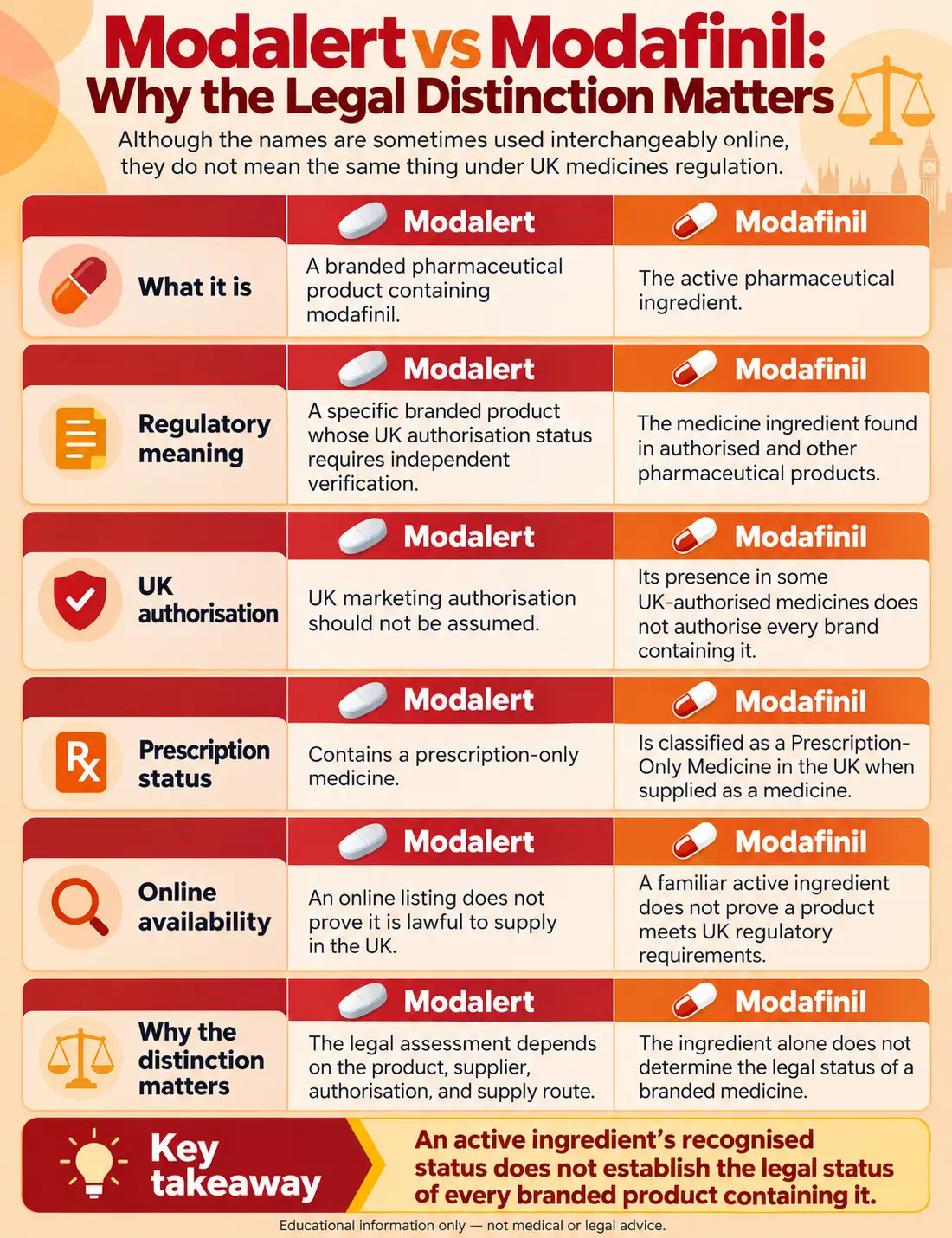
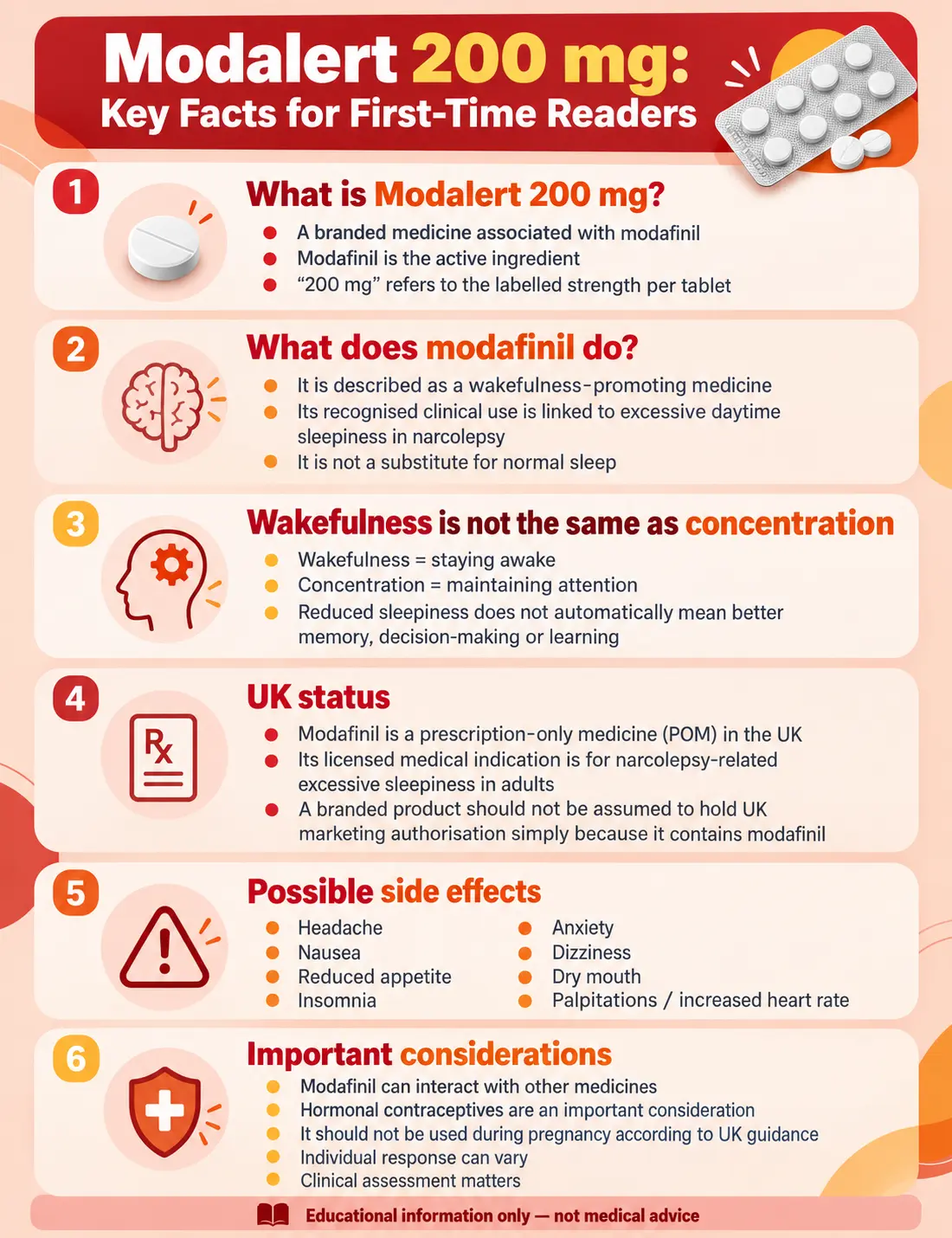
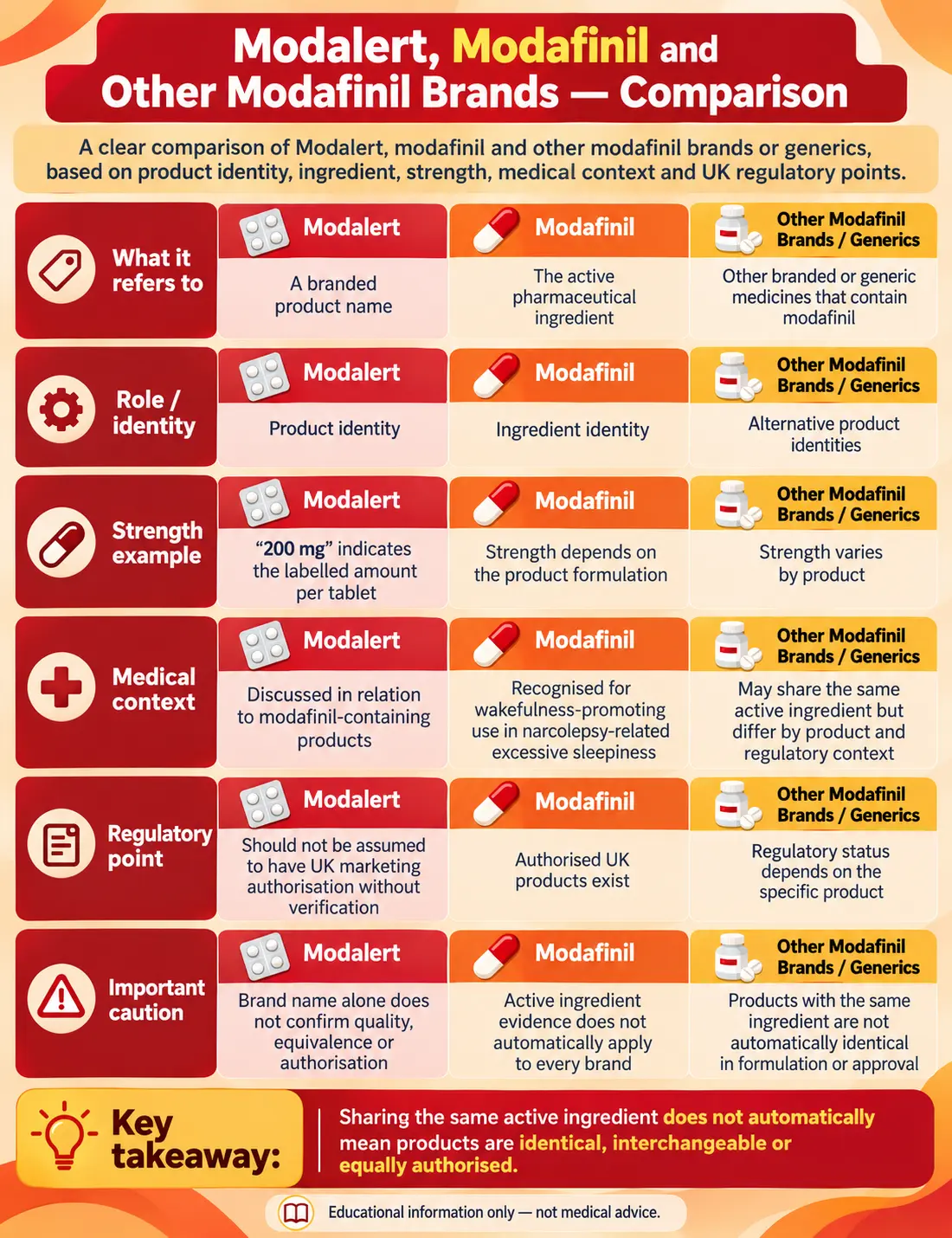
Modalert is a branded pharmaceutical product containing modafinil. Modafinil is the active pharmaceutical ingredient.
Although people sometimes use these names interchangeably, they refer to different aspects of a medicine.
An active ingredient may appear in products manufactured by several pharmaceutical companies. Each product can have its own manufacturer, formulation, licensing details and approved product information.
In the UK, marketing authorisation generally applies to an identifiable medicinal product. It does not automatically extend to every branded medicine containing the same substance.
For more background on the branded product, its active ingredient and important distinctions, see our Modalert 200 mg first-time guide.
For example, the authorisation of a generic modafinil tablet does not prove that Modalert has equivalent UK regulatory approval.
The Medicines and Healthcare products Regulatory Agency (MHRA) provides access to product information covering authorised medicines, including licensing documentation, patient information leaflets and summaries of product characteristics.
These records can help distinguish medicines with recognised UK authorisations from products marketed internationally.
Certain unlicensed medicines may also enter lawful supply arrangements under specific regulatory exemptions. However, those arrangements do not create unrestricted permission for commercial distribution.
Additionally, the absence of standard UK marketing authorisation does not automatically mean that every form of supply is unlawful. The relevant legal exemption and circumstances must be considered.
For readers researching “is Modalert legal in the UK”, the difference between an active ingredient and a specific branded medicine is therefore essential.
An active ingredient’s recognised status does not establish the legal status of every branded product containing it.
Is a Prescription Required for Modalert in the UK?
Yes. Modafinil is a prescription-only medicine in the UK, so ordinary retail sale and supply are subject to prescription requirements.
Nevertheless, prescription classification, product authorisation and personal possession remain separate legal matters.
Understanding these distinctions is essential when examining whether Modalert can lawfully enter the UK medicines supply chain.
What Does Prescription-Only Medicine Mean?
A Prescription-Only Medicine is a medicinal product whose retail sale or supply is restricted under UK medicines legislation.
Modafinil belongs to this category.
Regulation 214 of the Human Medicines Regulations 2012 establishes the general rule that a person may not sell or supply a prescription-only medicine except in accordance with a prescription issued by an appropriate practitioner, subject to specified exemptions.
The regulation therefore focuses on the conditions governing lawful supply.
However, two important distinctions remain.
First, prescription-only classification does not automatically determine whether simple possession is a criminal offence.
Second, the existence of a valid prescription does not independently establish that every branded version of a medicine has UK marketing authorisation.
Consequently, lawful supply may depend on both a valid prescription arrangement and compliance with other regulatory requirements.
Who Can Legally Prescribe Modafinil?
UK legislation recognises several categories of authorised prescribers.
These include registered medical practitioners and appropriately qualified independent or supplementary prescribers, acting within their professional and legal authority.
The precise scope of prescribing rights depends on professional qualifications, the type of prescribing authority and applicable legislation.
Modafinil’s licensed medical indication is also relevant.
The MHRA identifies modafinil as a treatment for excessive sleepiness associated with narcolepsy in adults. Its regulatory information reflects restrictions introduced following a European review of the medicine’s benefits and risks.
Prescribing outside an authorised indication is a separate professional and regulatory issue. It does not remove the medicine’s prescription-only classification.
Accordingly, a prescription represents a regulated prescribing decision. It does not provide unrestricted permission to obtain a medicine from any website or overseas supplier.
What Does UK Law Say About Sale and Supply?
Regulation 214 establishes the main prescription requirement for the sale and supply of prescription-only medicines.
However, a prescription alone does not remove other legal obligations.
Suppliers may also need to comply with requirements concerning:
- Pharmacy registration and professional supervision.
- Medicine marketing authorisation or applicable exemptions.
- Lawful sourcing and distribution.
- Product quality, identity and authenticity.
- Prescription validation and record-keeping.
- Relevant wholesale or importation permissions.
For example, a website that accepts prescriptions does not automatically qualify as a legally authorised UK pharmacy.
Similarly, an overseas company cannot establish lawful UK supply simply by claiming that its products are genuine.
These distinctions matter because a legitimate prescription and a legitimate supply chain are not necessarily the same thing.
Prescription verification forms an important part of lawful POM supply, but it does not establish complete regulatory compliance by itself.
Is It Legal to Possess Modalert in the UK?
Personal possession and commercial supply fall under different areas of UK medicines law.
Although modafinil is a Prescription-Only Medicine, it is not classified as a controlled drug under the Misuse of Drugs Act 1971.
As a result, simple personal possession of modafinil is not, by itself, generally a controlled-drug possession offence.
However, this distinction does not mean that every activity involving Modalert is lawful.
Several circumstances require separate consideration.
Personal possession
Holding a medicine for individual use differs legally from selling or supplying medicines to other people.
Prescription-only status does not automatically create a general criminal prohibition on simple possession.
Importation
The circumstances in which a medicine enters the UK may raise separate legal questions, particularly when overseas sellers, postal deliveries or commercial distribution arrangements are involved.
Distribution
Selling or supplying a prescription-only medicine to another person can trigger legal restrictions.
These restrictions may apply even when the medicine changes hands without payment.
Product authenticity
Medicines obtained outside recognised supply chains can raise questions about identity, manufacturer, licensing status and origin.
These issues remain distinct from whether personal possession constitutes a controlled-drug offence.
Therefore, when considering whether Modalert is legal in the UK, it is important not to confuse possession with lawful acquisition, importation or distribution.
The key distinction is that prescription-only classification primarily regulates medicine supply and related activities.
It neither makes simple possession automatically criminal nor provides unrestricted permission for importation or resale.
Can Modalert Be Imported Into the UK?
Importation introduces legal considerations beyond those involved in possessing a medicine already within the UK.
The applicable requirements may depend on the medicine, the source country, the importing party, the intended purpose and the method of transportation.
Therefore, personal carriage, international postal delivery and commercial importation should not be treated as identical activities.
For people researching “is Modalert legal in the UK”, importation is especially relevant because medicines sold internationally may operate under different national licensing systems.
Personal Importation and Regulatory Requirements
UK law distinguishes between several forms of medicine movement.
Personal carriage
Personal carriage involves an individual bringing medicines into the UK, often during international travel.
Relevant considerations may include the medicine’s legal classification, the circumstances of possession and any supporting prescription documentation.
However, rules concerning controlled medicines should not automatically be applied to modafinil, which has a different legal classification.
International postal delivery
Postal delivery involves a supplier dispatching medicines from another country.
Such arrangements may raise questions about the overseas seller’s authority, UK supply requirements, product authorisation, importation rules and customs procedures.
Furthermore, receiving an international parcel does not independently establish that every legal requirement has been met.
Commercial importation
Commercial importation operates under a more extensive regulatory framework.
The MHRA’s guidance on importing human medicines explains relevant licensing requirements for wholesalers and manufacturers importing authorised and unlicensed medicines.
This guidance primarily addresses business importation arrangements. It should not be interpreted as blanket permission for individual postal imports or personal purchases.
Certain unlicensed medicines may enter the UK through regulated arrangements designed to meet individual patient needs.
However, these exemptions are subject to specific conditions and do not provide general permission for unrestricted online sales.
Does an Overseas Prescription Change the Rules?
An overseas prescription may help establish that a medicine was prescribed to an individual.
Nevertheless, it does not automatically authorise an overseas business to sell or dispatch that medicine to a UK customer.
UK medicines law also contains provisions concerning prescriptions from recognised overseas health professionals, subject to defined conditions.
However, recognition of a prescription does not independently resolve all relevant requirements.
Other considerations include:
- The legal status of the supplying business.
- The applicable prescription recognition rules.
- The specific medicinal product.
- UK marketing authorisation or lawful exemptions.
- Importation and distribution requirements.
Consequently, the legal assessment depends on the prescription, supplier, product and supply arrangement.
An overseas prescription should not be viewed as universal proof that an international medicine transaction complies with UK law.
What Happens When Medicines Enter Through Customs?
Medicines entering the UK may be examined by customs officers or other relevant enforcement authorities.
Where questions arise about the medicine’s identity, origin or legal status, authorities may assess the shipment against applicable requirements.
Depending on the circumstances and available enforcement powers, goods may be detained, released, seized or become subject to further investigation.
The outcome does not depend solely on whether the active ingredient is classified as a controlled drug.
For example, product authorisation, supply arrangements and importation requirements can remain relevant even where the medicine is not controlled under the Misuse of Drugs Act 1971.
UK government guidance concerning travelling with medicines is relevant to personal carriage. However, it should not be treated as confirmation that overseas postal transactions follow the same rules.
Likewise, successful delivery of a parcel does not establish that the supplier complied with every applicable legal requirement.
How Can Consumers Verify an Online Pharmacy in the UK?
Online pharmacy registration is an important consumer safeguard when examining a medicine supplier’s legal status.
In Great Britain, pharmacies must register with the General Pharmaceutical Council (GPhC) to operate lawfully as registered pharmacy premises.
The GPhC maintains a public register covering pharmacy premises and pharmacy professionals in England, Scotland and Wales.
However, a pharmacy logo or registration claim displayed on a website does not independently establish legitimacy.
Regulatory verification involves comparing the supplier’s published details with information held by the relevant authority.
Important details include:
- Registered pharmacy name.
- Pharmacy registration number.
- Registered premises address.
- Responsible pharmacy professionals.
- Consistency between website details and official records.
The GPhC also publishes guidance concerning pharmacy services provided remotely, including online consultations, professional oversight and medicine supply arrangements.
These requirements help distinguish registered pharmacy services from websites that merely present themselves as pharmaceutical suppliers.
For anyone investigating whether Modalert is legal in the UK, pharmacy registration is an important part of the broader legal assessment.
However, registration must not be interpreted too broadly.
A registered pharmacy’s status does not automatically establish that every medicinal product offered through its website has UK marketing authorisation.
What About Northern Ireland?
Northern Ireland operates under a separate pharmacy regulatory framework.
The Pharmaceutical Society of Northern Ireland maintains the relevant registers for pharmacists and registered pharmacy premises.
Consequently, the GPhC register does not serve as the registration authority for every pharmacy operating throughout the United Kingdom.
Online medicine-selling rules may also differ between Great Britain and Northern Ireland.
Northern Ireland’s medicines framework includes requirements linked to the Windsor Framework and UK-wide regulatory arrangements.
Therefore, the appropriate pharmacy regulator depends on the supplier’s location and the activity under consideration.
Consumers should distinguish these regulatory systems rather than assuming that one registration framework applies identically across the UK.
Why Supplier Transparency Matters
A legitimate medicine supplier should provide clear information about its legal identity and operating arrangements.
However, a professional-looking website does not independently establish regulatory compliance.
For example, a UK-focused domain, British telephone number or localised website design does not prove that a company operates as a registered UK pharmacy.
Similarly, international shipping options do not establish that a product has permission for lawful supply within the UK.
Regulatory transparency also extends beyond contact details.
Claims about pharmacy registration, product authorisation, prescription procedures and professional supervision should be capable of independent verification.
The most reliable evidence comes from official regulatory records rather than marketing claims or customer testimonials.
Does Online Availability Mean Modalert Is Legal?
No. The presence of Modalert in an online catalogue does not establish its legal status in the UK.
International medicine websites may display pharmaceutical products intended for markets with regulatory systems different from those operating in the United Kingdom.
As a result, a medicine may appear on a website without sufficient evidence that its UK supply complies with applicable rules.
An online listing does not independently establish:
- Valid UK marketing authorisation.
- A lawful prescription and supply arrangement.
- Genuine manufacturing origin.
- Compliance with distribution standards.
- Registered pharmacy supervision.
- Appropriate professional oversight.
- Compliance with importation requirements.
A familiar active ingredient does not resolve these questions.
For example, a medicine containing modafinil may resemble another product authorised in the UK. Nevertheless, their licensing status and approved product details may differ.
The MHRA’s medicines information resources provide a recognised basis for checking relevant product documentation.
Where a supplier claims that a medicine has UK authorisation, that claim should correspond with identifiable regulatory records.
Product authenticity is another separate concern.
Professional packaging, batch information and manufacturer claims may appear convincing, but those features alone do not independently verify the medicine’s origin or lawful supply route.
The NHS and MHRA promote the use of legitimate medicine suppliers and warn about the risks associated with falsified and unauthorised medicinal products.
Ultimately, online availability should not be confused with regulatory permission.
UK Rules on Advertising Modalert and Other Prescription Medicines
UK law regulates not only the supply of prescription medicines but also how businesses advertise them to members of the public.
Regulation 284 of the Human Medicines Regulations 2012 generally prohibits advertisements to the public that are likely to lead to the use of prescription-only medicines, subject to specific statutory exceptions.
This restriction is particularly relevant to public-facing websites discussing modafinil or branded medicines such as Modalert.
However, genuine educational content and commercial promotion serve different purposes.
An article explaining legal classification, prescription requirements or pharmacy regulation can provide legitimate public information.
By contrast, the surrounding commercial context may change the regulatory assessment.
For example, content about a prescription medicine may take on a promotional character when accompanied by:
- Direct purchasing links.
- Product prices and ordering features.
- Discounts or limited-time offers.
- Claims encouraging medicine use.
- Persuasive product comparisons.
- Commercial calls to action.
The overall presentation matters, not simply whether individual sentences are factually accurate.
Furthermore, neutral wording does not automatically make a commercial message compliant.
A page may contain accurate regulatory information while still creating an advertisement through its links, layout or relationship with product listings.
An educational disclaimer also does not independently establish compliance with medicines advertising restrictions.
For UK-facing websites, the relationship between editorial content and commercial ordering pages therefore requires careful assessment.
This distinction is especially important when evaluating a website that combines pharmaceutical information with direct-to-consumer sales facilities.
What Should UK Readers Verify Before Relying on an Online Medicine Supplier?
When examining an online supplier, several regulatory checks can help establish whether its claims are supported by reliable evidence.
The following checklist focuses on legal identity, medicine licensing and pharmacy transparency.
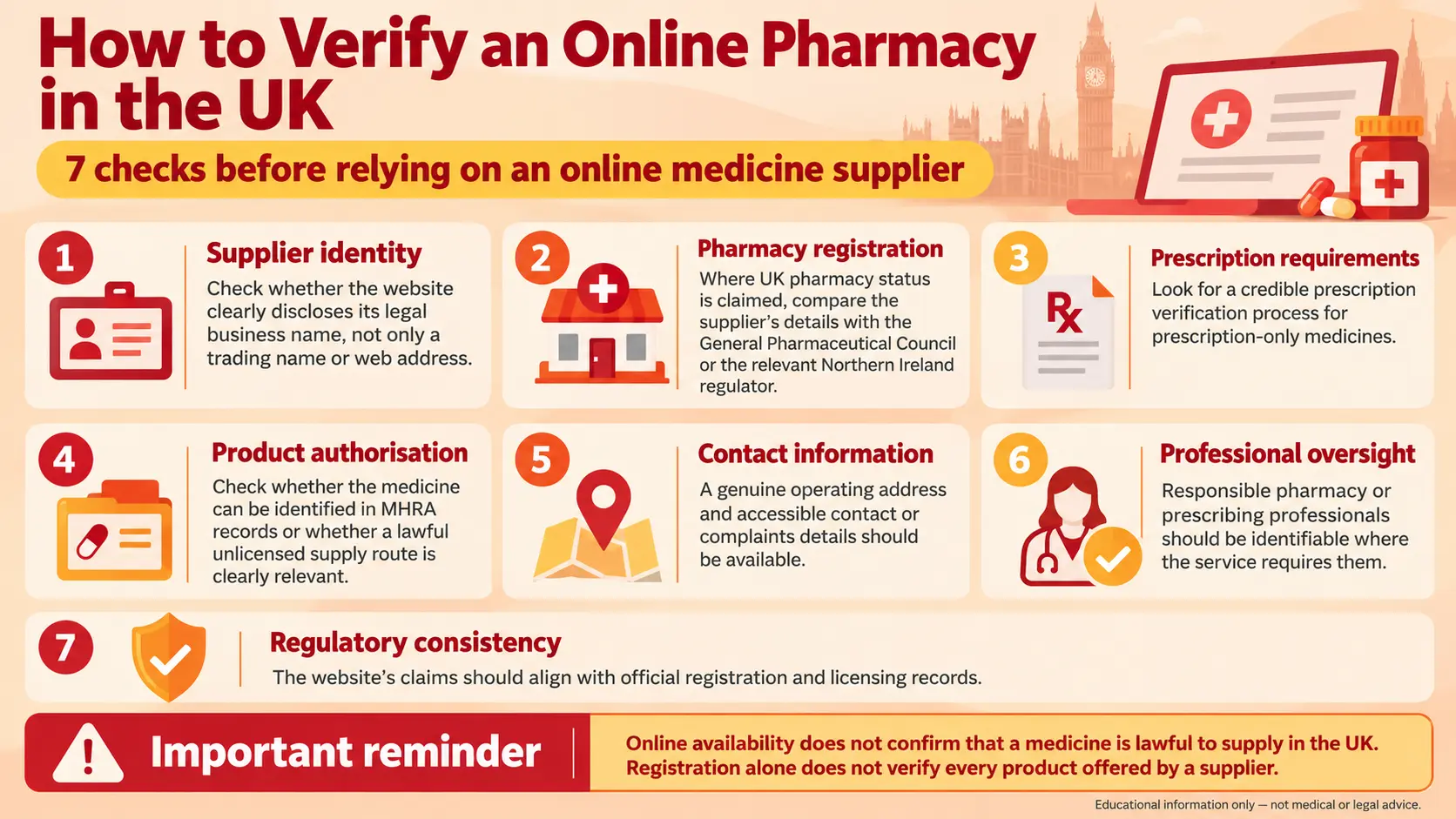
Regulatory verification checklist
- Supplier identity: Does the website disclose its legal business name rather than providing only a trading name or domain?
- Pharmacy registration: Where the supplier claims UK pharmacy status, do its details correspond with records held by the GPhC or the relevant Northern Ireland regulator?
- Prescription requirements: Does the supplier describe a credible process for validating prescriptions before supplying prescription-only medicines?
- Product authorisation: Can the medicine be identified through relevant MHRA records, or does a specific lawful arrangement for unlicensed supply apply?
- Contact information: Does the website provide a genuine operating address and accessible contact or complaints information?
- Professional oversight: Are the relevant pharmacy and prescribing professionals identifiable where the service requires their involvement?
- Regulatory consistency: Do the supplier’s claims agree with information from official registration and licensing records?
These checks address different aspects of compliance.
For example, a genuine pharmacy registration does not mean every product in its catalogue is authorised.
Likewise, a legitimate manufacturer does not guarantee that every overseas distribution arrangement complies with UK requirements.
A website may also display apparently credible information without establishing that its prescription procedures meet the relevant legal standards.
Where concerns arise about potentially unlawful medicine sales, the MHRA provides a service for reporting suspicious online medicine sellers.
The MHRA Yellow Card scheme also provides a route for reporting suspected defective or falsified medicines and medicine safety concerns.
Taken together, independent regulatory records offer a stronger basis for assessing medicine suppliers than online availability or customer reviews alone.
Regulatory checks are only part of medicine safety. Our Modalert side effects guide explains recognised adverse reactions, medical precautions and important warnings.

Key Takeaways: Is Modalert Legal in the UK?
The legal position of Modalert depends on the specific activity and regulatory requirements involved.
Modafinil is a Prescription-Only Medicine in the UK, but it is not classified as a controlled drug under the Misuse of Drugs Act 1971.
Therefore, simple personal possession differs from the lawful sale, supply or importation of the medicine.
Similarly, the UK authorisation of medicines containing modafinil does not automatically establish marketing authorisation for Modalert as a specific brand.
Overseas prescriptions and international shipping arrangements also require separate regulatory consideration.
Online pharmacy registration provides an important consumer safeguard. However, registration alone does not confirm the licensing status of every medicine offered by a supplier.
Additionally, public advertising of prescription-only medicines is subject to restrictions under the Human Medicines Regulations 2012.
These distinctions explain why the question “is Modalert legal in the UK” requires more than a simple statement about prescription status.
Understanding the different legal requirements provides a more accurate picture of Modalert UK regulations and the safeguards surrounding prescription medicines.
Frequently Asked Questions
Is Modalert Legal in the UK Without a Prescription?
Modafinil is a Prescription-Only Medicine in the UK. Its ordinary retail sale and supply must comply with prescription requirements under the Human Medicines Regulations 2012, subject to specified exemptions. However, prescription-only classification does not automatically make simple personal possession a criminal offence. The legality of obtaining Modalert also depends on the supplier, product authorisation and applicable supply arrangements.
Is Possessing Modalert Illegal in the UK?
Simple personal possession of modafinil is not generally an offence under the Misuse of Drugs Act 1971 because the substance is not classified as a controlled drug. However, possession differs from importation, distribution and commercial supply. Those activities may involve separate legal restrictions, and the circumstances of a particular transaction remain relevant when assessing regulatory compliance.
Can an Overseas Pharmacy Legally Supply Modalert to UK Customers?
An overseas pharmacy’s registration in its home country does not automatically authorise it to supply prescription medicines to UK customers. Relevant considerations include UK prescription requirements, product licensing, importation arrangements and the supplier’s legal status. Certain unlicensed medicine supply arrangements may operate under specific exemptions, but international shipping availability alone does not demonstrate that the necessary conditions have been satisfied.
Does Modalert Have UK Marketing Authorisation?
Modalert’s UK marketing authorisation status requires independent confirmation through current MHRA records. The existence of authorised UK medicines containing modafinil does not establish equivalent authorisation for the Modalert brand. Product-specific verification should consider the exact medicine, manufacturer and relevant licence information. Certain unlicensed medicine supply arrangements may also be lawful under specific regulatory exemptions, depending on the circumstances.
How Can UK Consumers Verify an Online Pharmacy?
Consumers can check pharmacies in England, Scotland and Wales through the General Pharmaceutical Council’s official register. Northern Ireland uses the Pharmaceutical Society of Northern Ireland. The supplier’s registered name, premises address and professional details should correspond with regulatory records. However, pharmacy registration does not independently confirm that every product offered has appropriate authorisation or that every supply arrangement meets legal requirements.
References and Further Reading
The following official sources provide further information about the UK legal and regulatory framework discussed in this article.
- The Human Medicines Regulations 2012 — Regulation 214: Sale or Supply of Prescription-Only Medicines
UK legislation governing the sale and supply of prescription-only medicines, including the general prescription requirement and relevant exemptions.
UK legislation restricting advertising to the public that is likely to lead to the use of prescription-only medicines, subject to statutory exceptions.
Official MHRA information concerning modafinil’s licensed indication and regulatory restrictions.
Official guidance on accessing medicine licensing information, patient information leaflets and product documentation.
Information concerning licensing arrangements for wholesalers and manufacturers importing authorised or unlicensed medicinal products.
Official registration resources for pharmacy premises and pharmacy professionals in England, Scotland and Wales.
Official professional and pharmacy premises registration resources relevant to Northern Ireland.
Additional Official Resources
- GOV.UK — Taking Medicines Into or Out of the UK — Government information concerning international travel with medicines and applicable requirements.
- MHRA — Supply Unlicensed Medicinal Products (Specials) — Regulatory guidance explaining the arrangements and responsibilities associated with supplying unlicensed medicines.
- MHRA — Report a Suspicious Online Medicine Seller — Official reporting service for websites or online sellers suspected of offering medicines unlawfully.
- UK Parliament — Written Answer on Modafinil’s Legal Status, 4 June 2013 — Parliamentary material addressing modafinil’s prescription-only classification and its distinction from controlled drugs.
Conclusion: Is Modalert Legal in the UK?
The answer to “is Modalert legal in the UK” depends on several distinct legal considerations rather than one general rule.
Modafinil is a prescription-only medicine, meaning its ordinary retail sale and supply must comply with UK prescription requirements. However, personal possession is a separate issue because modafinil is not classified as a controlled drug under the Misuse of Drugs Act 1971.
Importation, product licensing and pharmacy registration introduce additional requirements. Furthermore, the existence of UK-authorised modafinil medicines does not automatically establish that the Modalert brand holds the same marketing authorisation.
For UK readers, the central distinction is between the legal classification of a medicine and the legality of a particular product or supply arrangement. Official MHRA records, pharmacy registration information and current legislation provide the appropriate regulatory framework for understanding that difference.
Ultimately, whether Modalert is legal in the UK cannot be determined by online availability, an overseas prescription or the medicine’s active ingredient alone. A reliable assessment requires consideration of the product’s authorisation, the supplier’s legal status and the applicable UK medicines regulations.