
Educational and Medical Disclaimer
This article provides general educational information about Modalert and modafinil, not individual medical advice or a treatment recommendation. Modafinil is a Prescription-Only Medicine in the UK. Suitability requires an individual clinical assessment. An appropriately qualified healthcare professional can address treatment, interactions and adverse effects. Changes to prescribed treatment require professional guidance.
Modalert contains modafinil, a medicine that promotes wakefulness. In the UK, authorised modafinil products treat excessive sleepiness associated with narcolepsy in adults. However, evidence for improved concentration or general productivity is less certain than evidence for wakefulness. The medicine also has important side effects and interactions.
This guide examines its ingredient, research, sleep effects and UK legal position. It distinguishes the clinical evidence for modafinil from the authorisation of a particular branded product.
What Is Modalert?
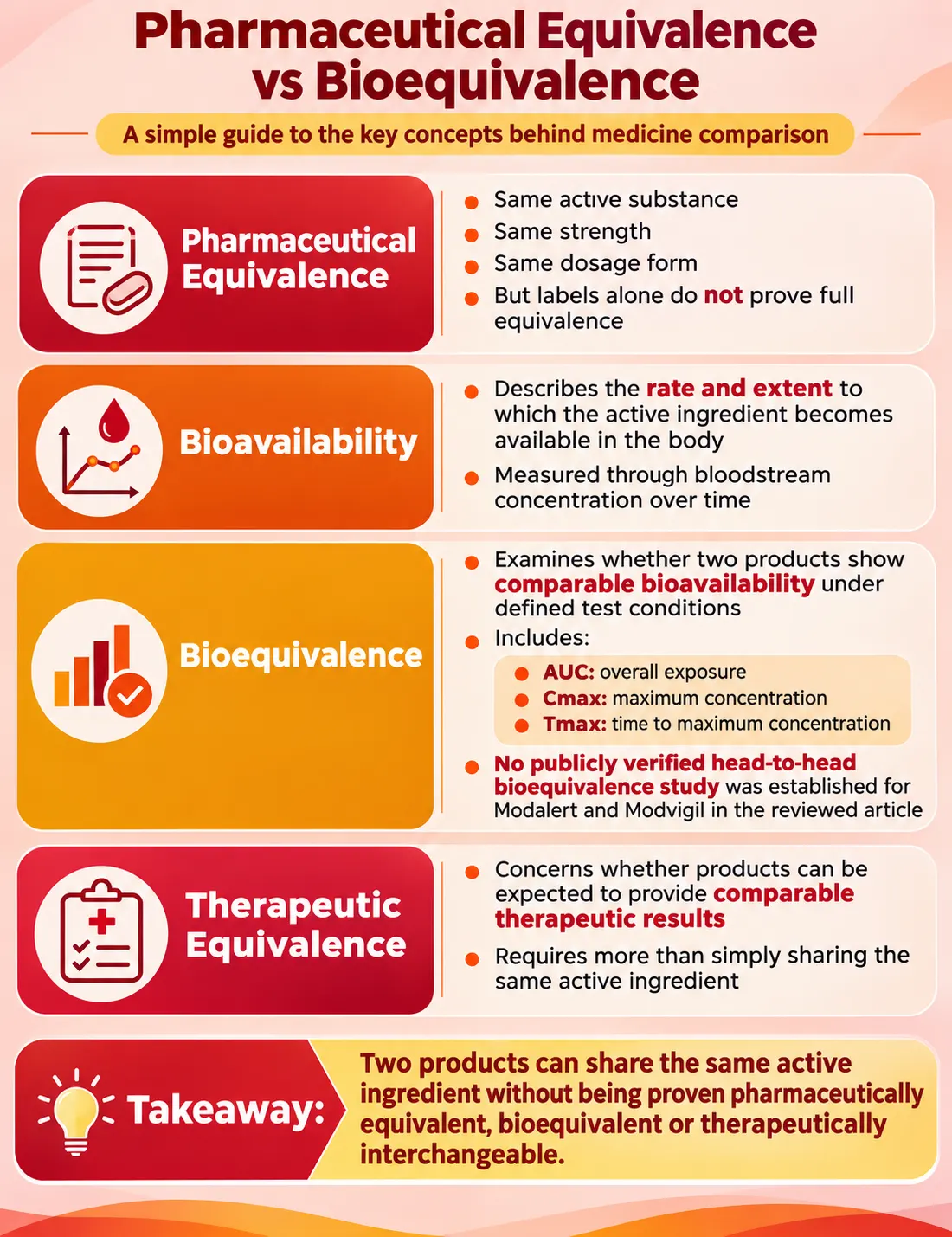
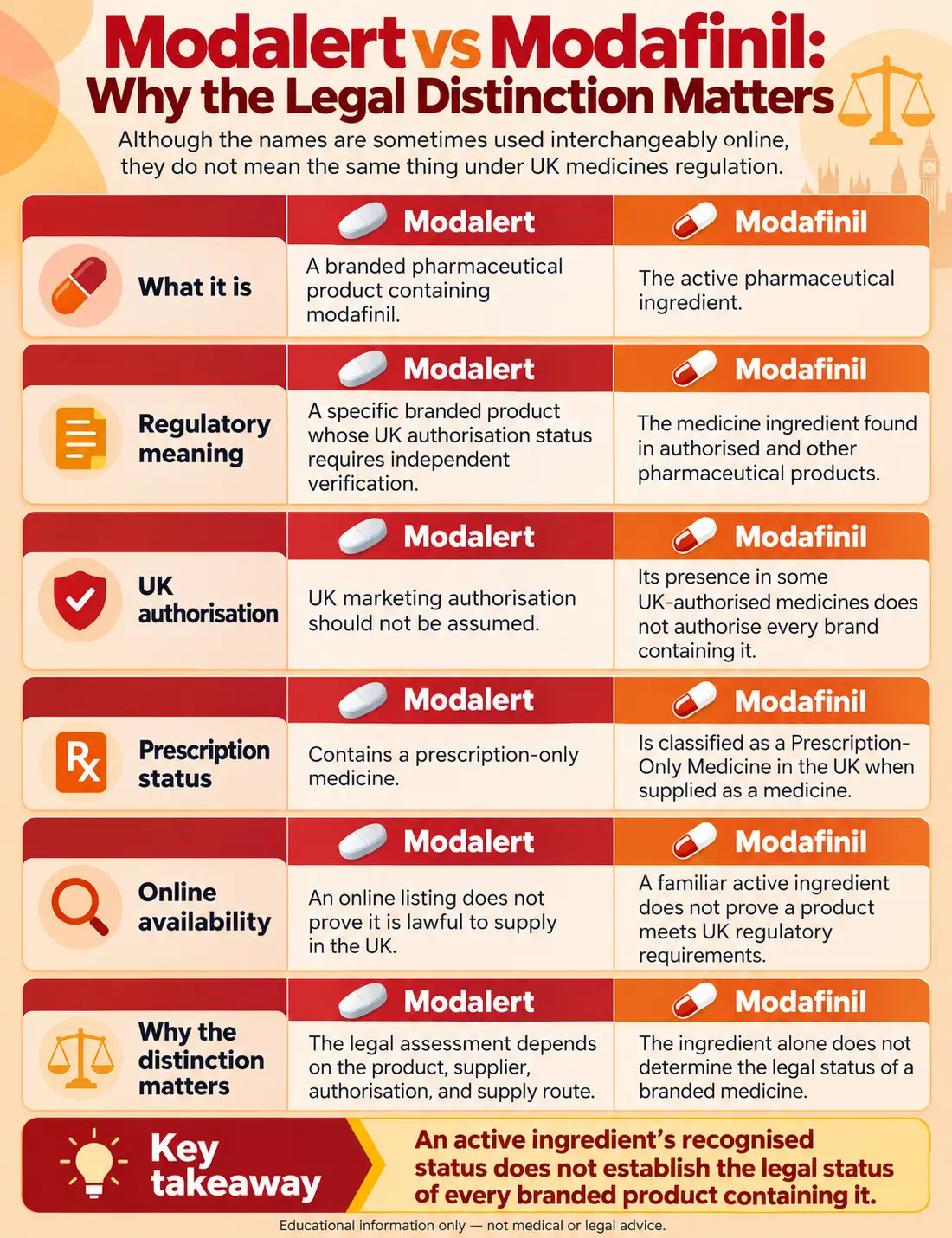
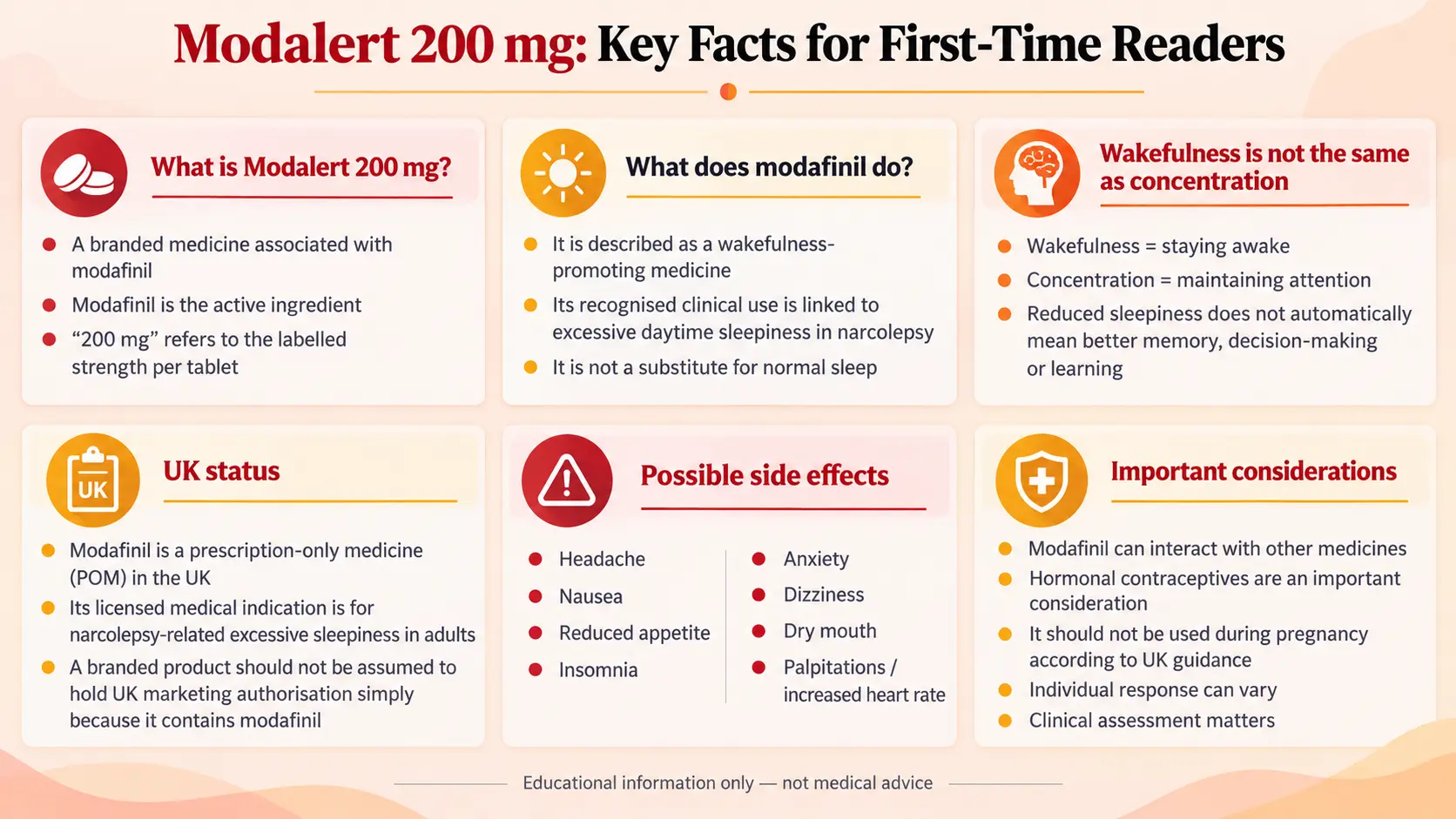
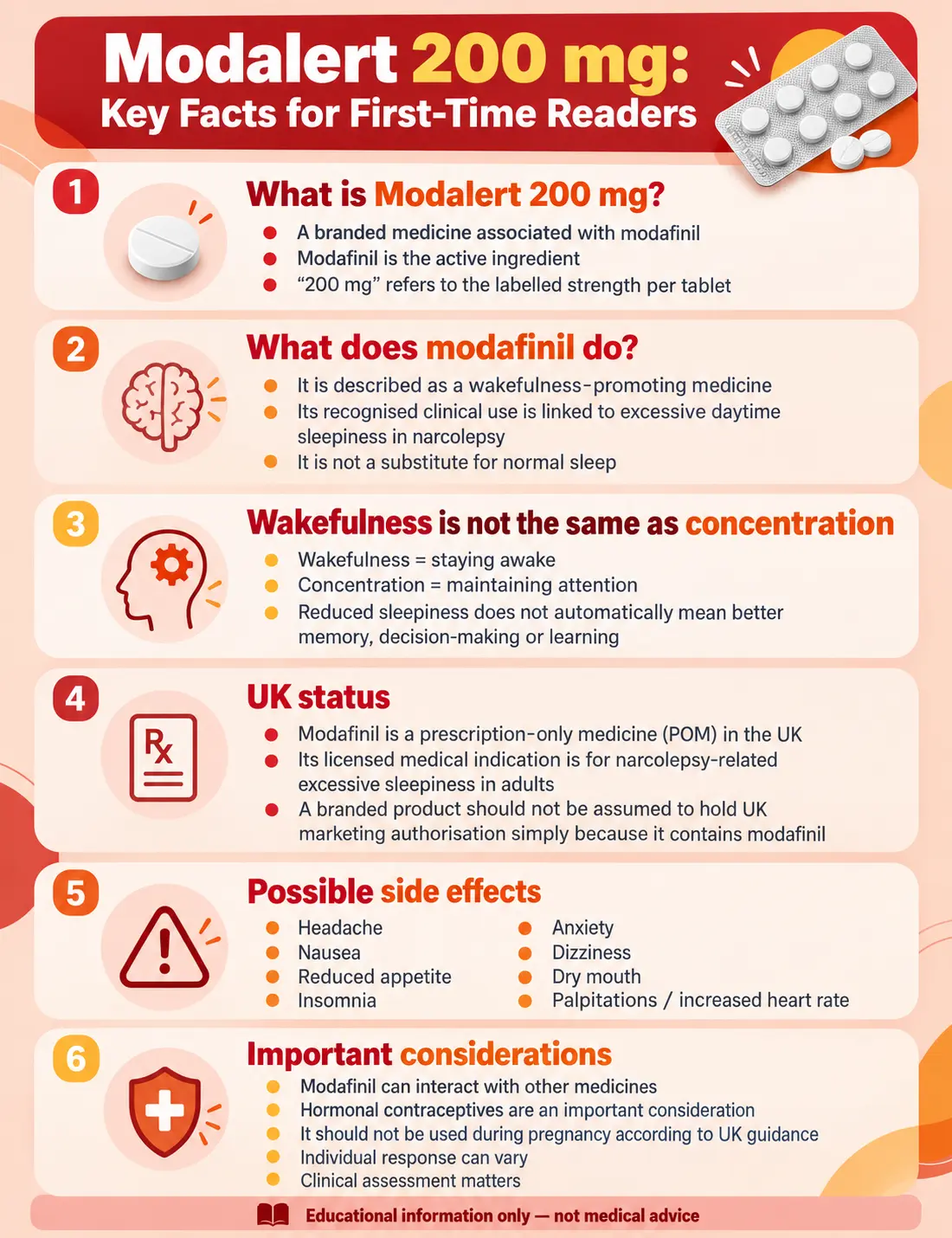
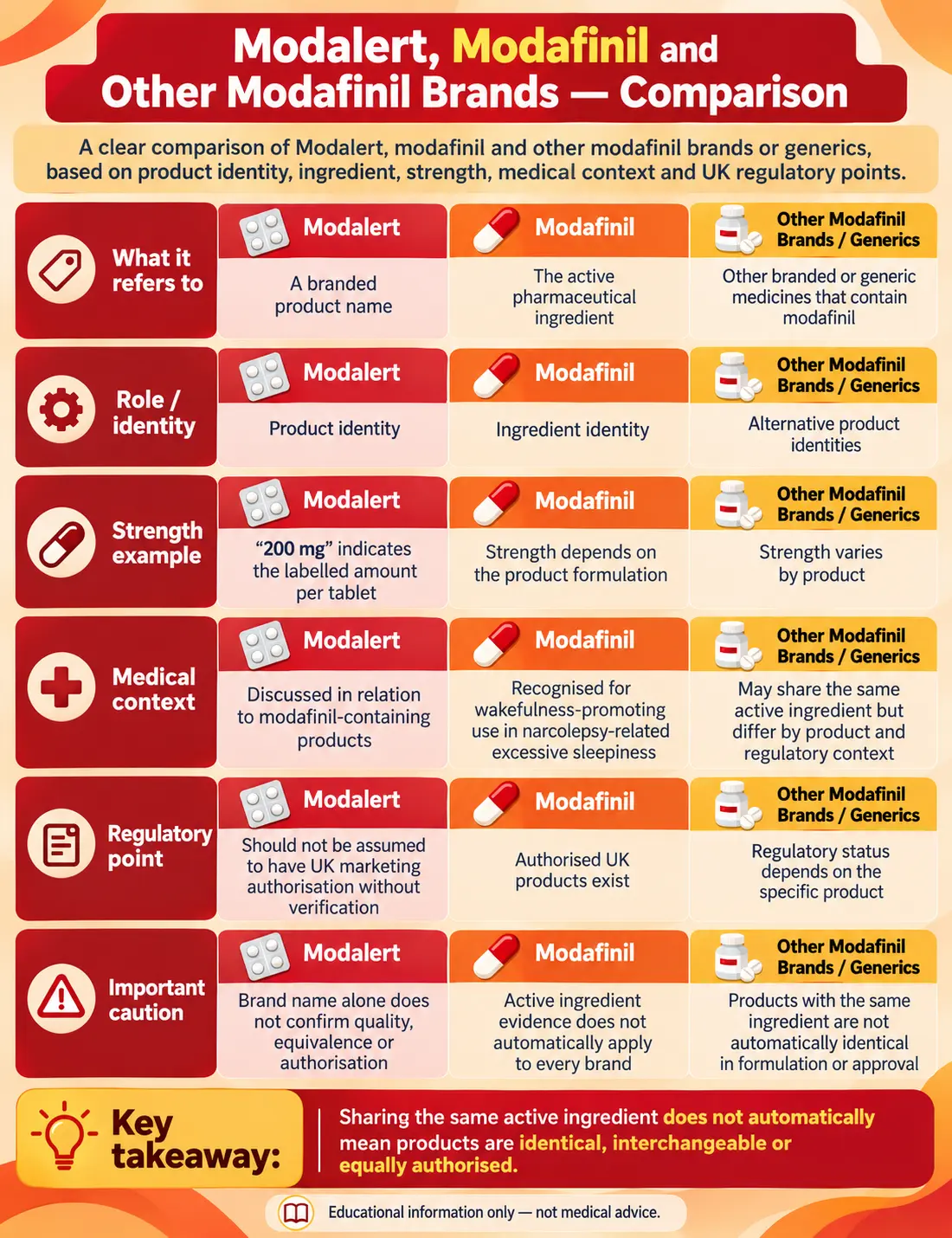
Modalert is a brand associated with the active ingredient modafinil. The ingredient produces the medicine’s pharmacological effects; the brand identifies a commercial formulation. These are not interchangeable regulatory concepts.
A UK marketing authorisation belongs to a specific medicinal product and defines its approved uses, product information and manufacturer responsibilities. Therefore, the authorisation of one modafinil product does not automatically cover another brand.
Likewise, findings from studies of modafinil can explain ingredient-level effects without independently confirming the quality, equivalence or authorisation of every branded formulation.
Clinical evidence and regulatory evidence answer different questions. A trial can measure changes in sleepiness or adverse reactions, while a marketing authorisation assesses a defined product, indication and set of quality standards. Modalert illustrates why readers should treat ingredient-level findings as relevant background, not a certificate for an unfamiliar product. This distinction is especially important when international brands appear in UK search results.
For an overview of product terminology and evidence, see Modalert 200 mg: What First-Time Users Should Know.
How Does Modalert Work?
Modafinil influences brain networks that maintain alertness. One recognised action involves inhibiting the dopamine transporter, a protein that normally helps remove dopamine from the spaces between nerve cells. This changes dopamine signalling in certain brain regions.
Researchers also investigate interactions involving histamine, orexin, noradrenaline and glutamate. Together, these systems contribute to sleep–wake regulation. Nevertheless, researchers have not fully established how every pharmacological action contributes to clinical wakefulness.
A wakefulness effect should not be confused with a uniform improvement in memory, judgement or complex thinking. Those outcomes require separate evidence.
What Is Modalert Used For?
Excessive Daytime Sleepiness in Narcolepsy
Narcolepsy is a neurological disorder that disrupts sleep–wake regulation. It can cause persistent daytime sleepiness and unintended sleep episodes. Some people also experience cataplexy, a sudden temporary loss of muscle tone often associated with emotion.
UK-authorised modafinil products treat excessive sleepiness in adults with narcolepsy, with or without cataplexy. Their role is to improve wakefulness, not cure the condition or necessarily resolve every symptom.
Clinical assessment also distinguishes narcolepsy from inadequate sleep and other causes of sleepiness. UK prescribing information describes the authorised indication and assessment requirements.
Other Uses Discussed in International Research
Researchers have studied modafinil for other forms of sleepiness. Some jurisdictions have permitted broader indications, including sleepiness linked to obstructive sleep apnoea or shift work disorder.
However, a European benefit-risk review led to restriction of the UK indication to narcolepsy. Findings from another country, or an individual clinical study, do not establish an additional UK-authorised use.
Is Modalert Approved for Productivity or Cognitive Enhancement?
Neither studying nor workplace productivity is an authorised UK indication for modafinil. Research into performance in healthy participants is scientifically relevant but cannot be treated as approval for non-medical use.
Furthermore, subjective alertness and objective improvement in attention, reasoning or memory are different outcomes. A person may feel more awake without performing better across complex tasks.
Does Modalert Improve Focus or Mainly Promote Wakefulness?
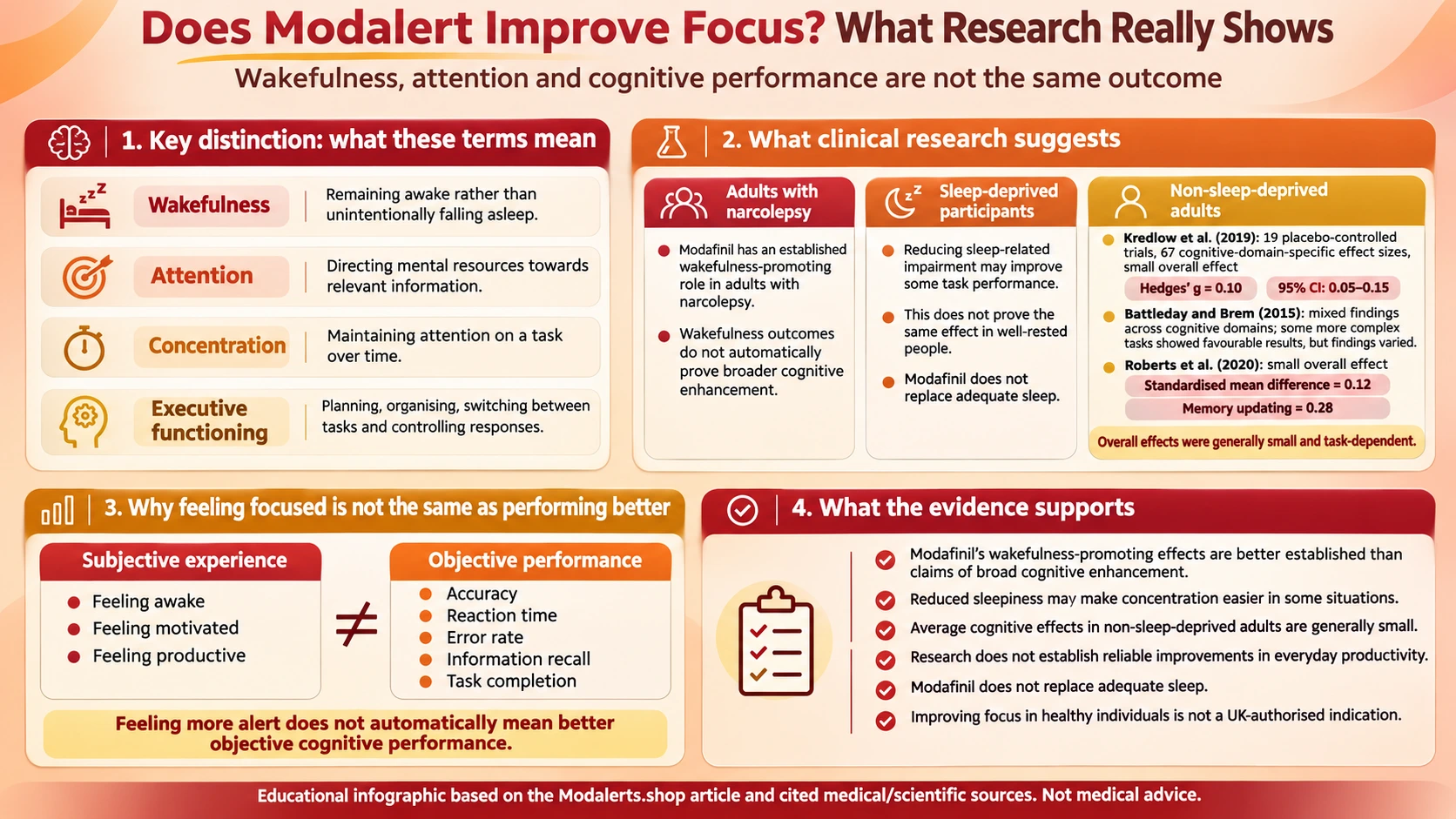
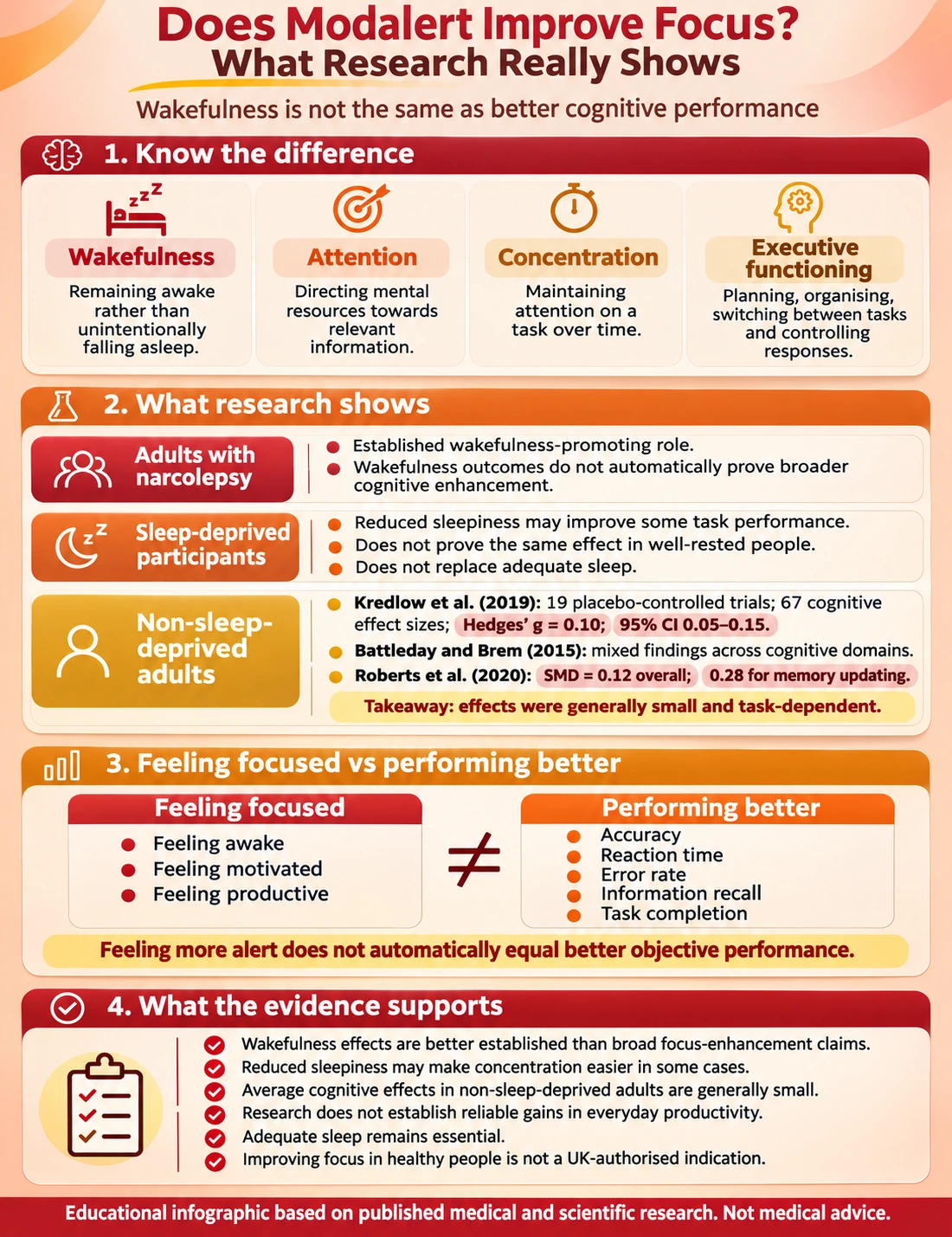
Wakefulness means the capacity to remain awake. Attention concerns directing mental resources to a task; memory involves storing and recalling information; executive functioning includes planning and behavioural control.
These measures are connected but distinct. For example, reduced sleepiness may support task engagement without independently improving reasoning.
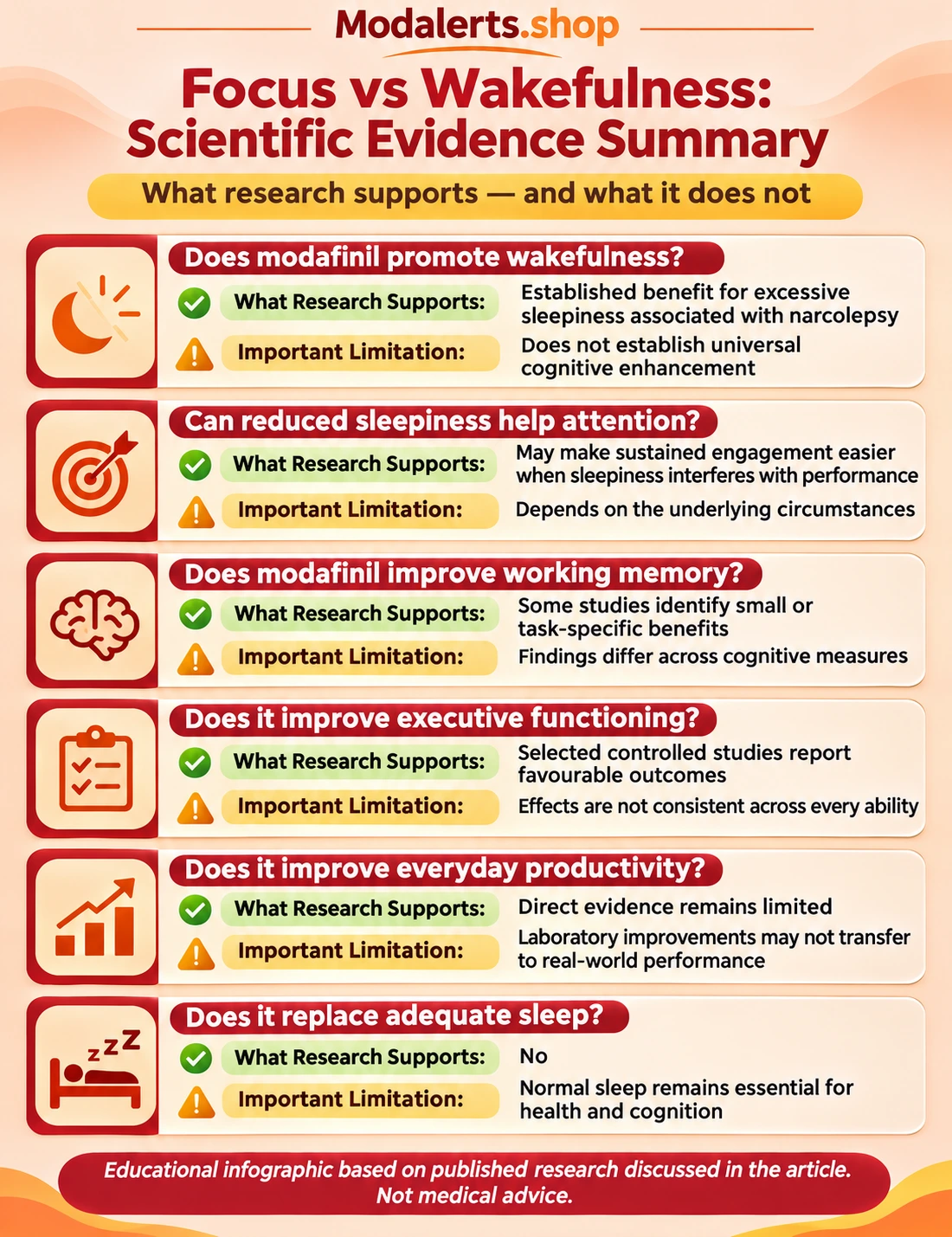
A 2019 systematic review and meta-analysis by Kredlow and colleagues found a small overall positive cognitive effect in non-sleep-deprived adults. A separate 2020 meta-analysis also described small average effects, alongside limits in study design and real-world relevance.
Research methods also affect interpretation. Small laboratory studies may use short tests rather than sustained activities, and participants may differ in baseline sleep, health and expectations. Consequently, a statistically detectable change is not necessarily a meaningful improvement in everyday work, learning or decision-making. The evidence cannot establish what any one person will experience.
Effects vary by task, population and sleep status. In particular, results from sleep-deprived participants cannot simply be applied to well-rested adults. Consequently, the evidence does not justify guaranteed claims about memory, intelligence or productivity.
Does Modalert Improve Focus or Just Wakefulness? explores these research distinctions further.
Modalert Safety and Side Effects
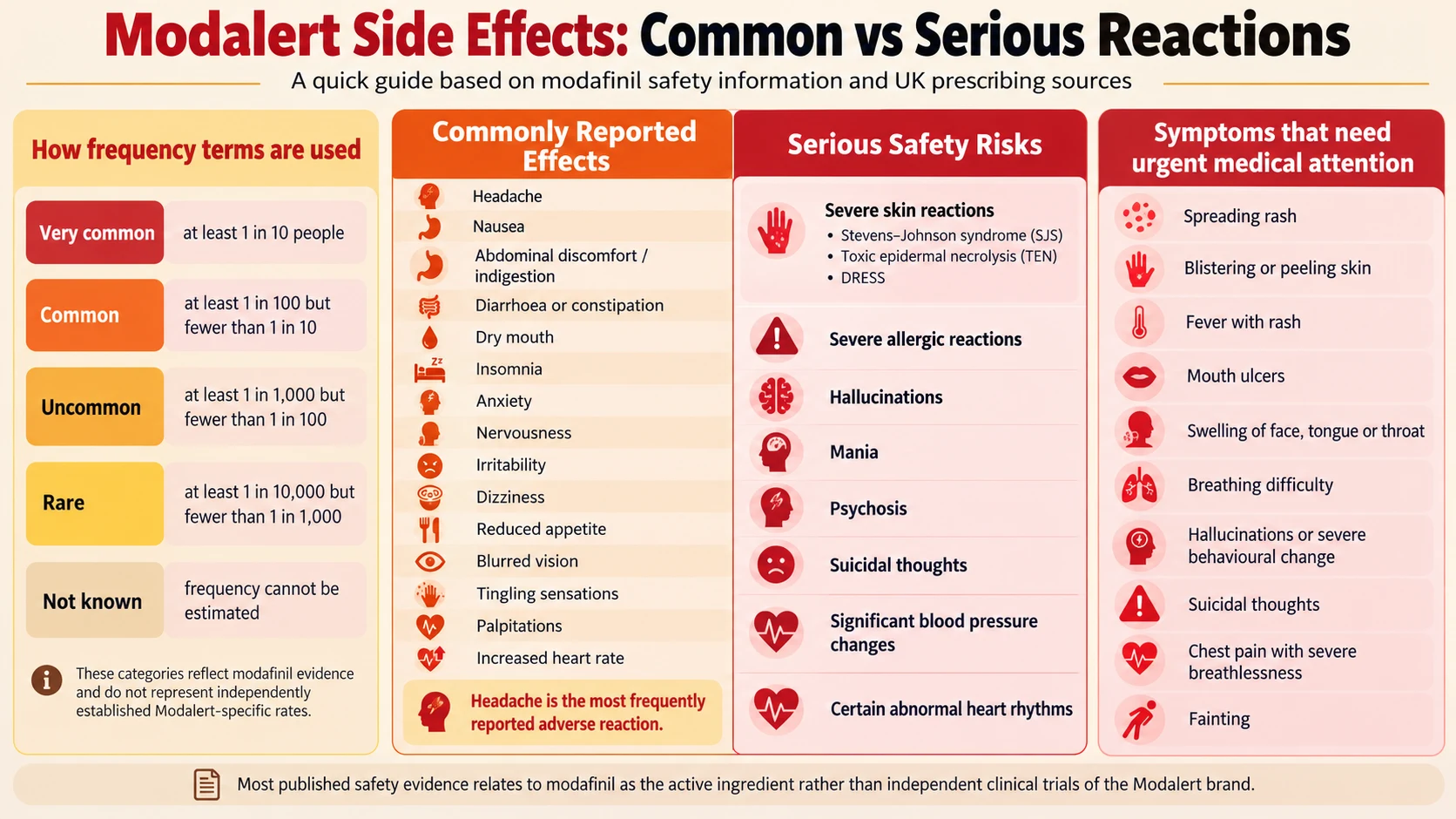
Clinical experience and UK product information identify both common adverse reactions and less frequent serious risks. Their likelihood and severity differ, so they should not be discussed as equally common.
Commonly Reported Side Effects
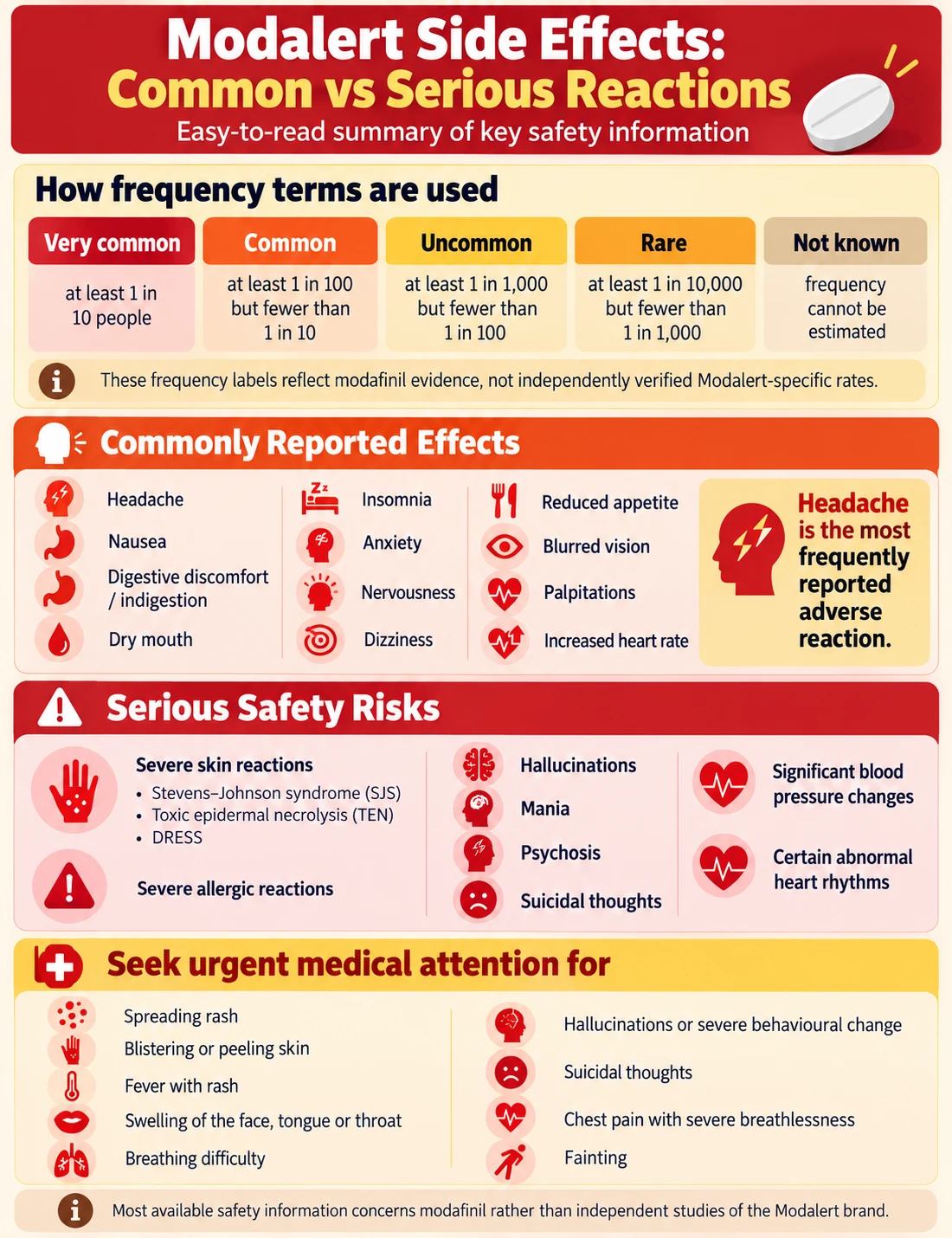
Headache is one of the most frequently reported reactions. Other recognised effects include insomnia, anxiety, nervousness, dizziness, nausea, dry mouth, reduced appetite and digestive discomfort. Palpitations and changes in heart rate can also occur.
However, frequency estimates in the UK Summary of Product Characteristics relate to the studied medicinal product. They are not automatically independent estimates for every Modalert-branded formulation.
Serious Reactions and Important Warnings
UK prescribing information describes rare but serious skin reactions, including Stevens–Johnson syndrome, toxic epidermal necrolysis and DRESS, a reaction that may involve skin and internal organs. Severe hypersensitivity can also affect multiple organs.
Psychiatric concerns include new or worsening depression, anxiety, psychosis, mania and suicidal thoughts. Cardiovascular concerns include blood-pressure changes and abnormal heart rhythms. Some reports come from post-marketing surveillance, which may not establish precise frequencies.
In addition, modafinil interacts with some other medicines. Modalert Side Effects: What to Know About Safety & Risks discusses the clinical safety information in greater detail.
Who may need additional medical assessment?
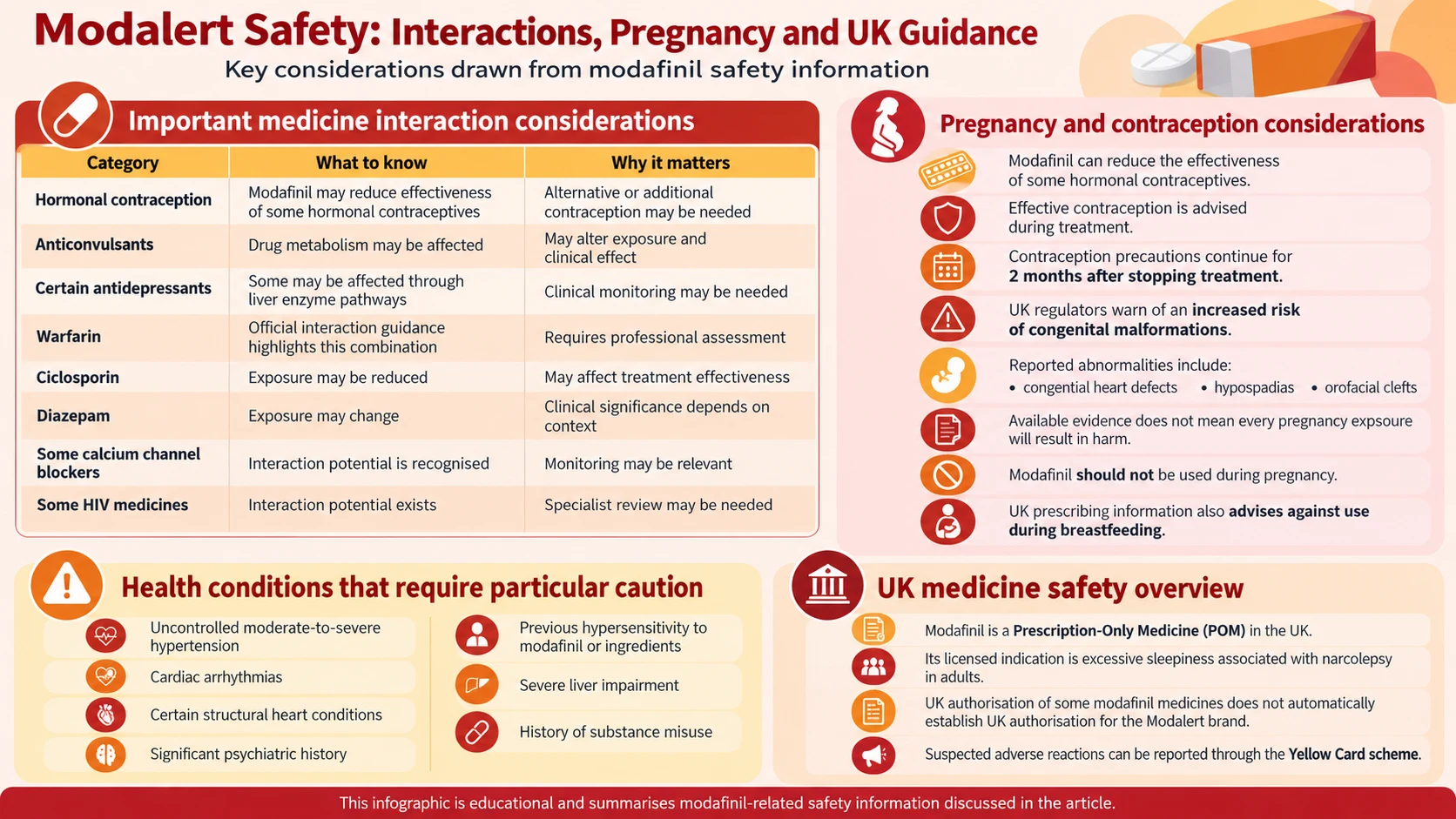
Medical assessment considers more than daytime sleepiness. Relevant factors include cardiovascular disease, psychiatric history, liver function, pregnancy and concurrent medicines.
Heart and circulation: Modafinil can affect pulse and blood pressure. UK product information lists uncontrolled moderate to severe hypertension and cardiac arrhythmias as contraindications.
Mental health: Existing or previous depression, major anxiety, psychosis, mania or substance misuse can influence clinical risk assessment.
Pregnancy and breastfeeding: UK regulatory guidance identifies a suspected increased risk of congenital malformations. Modafinil should not be used during pregnancy; UK product information also advises against its use during breastfeeding.
Contraception: Modafinil can reduce the effectiveness of certain hormonal contraceptives. MHRA guidance specifies effective contraception during treatment and for two months after stopping it.
Other medicines and liver function: Interactions can affect anticoagulants, anticonvulsants and some other prescribed medicines. Severe liver impairment may alter exposure to the ingredient.
These are clinical considerations, not a way to determine individual suitability without assessment.
Modalert and Sleep: Effects on Night-time Rest
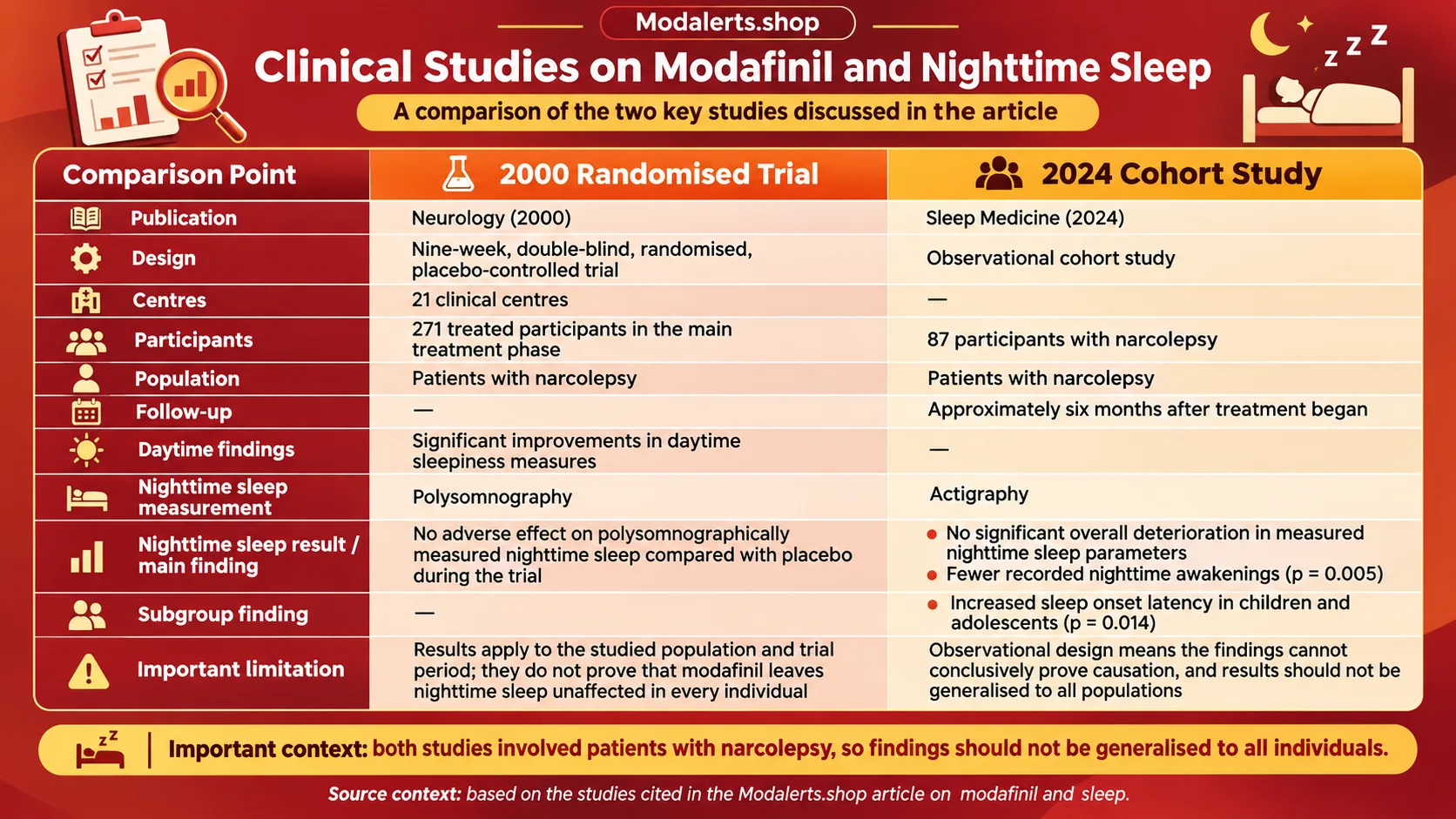
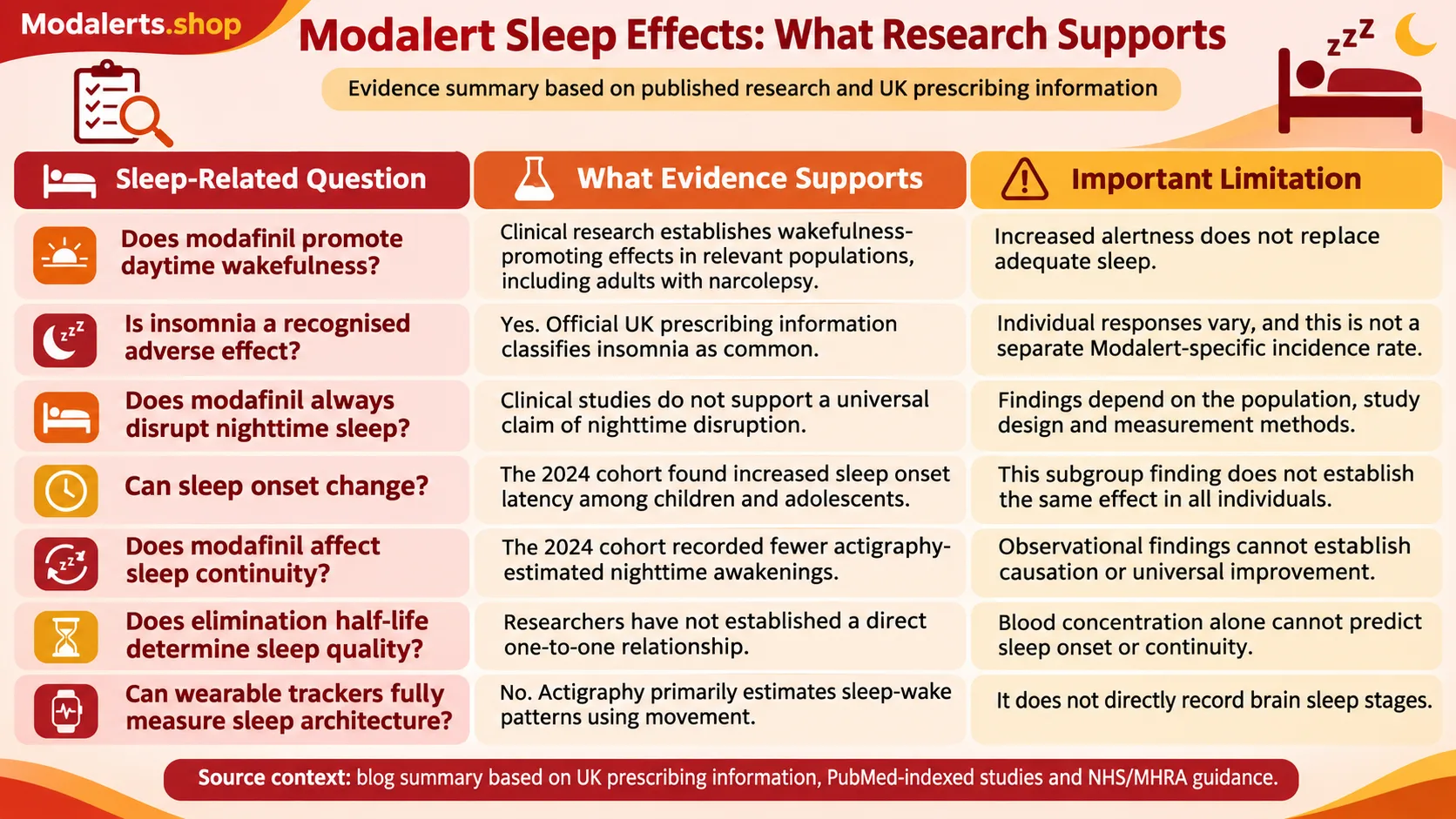
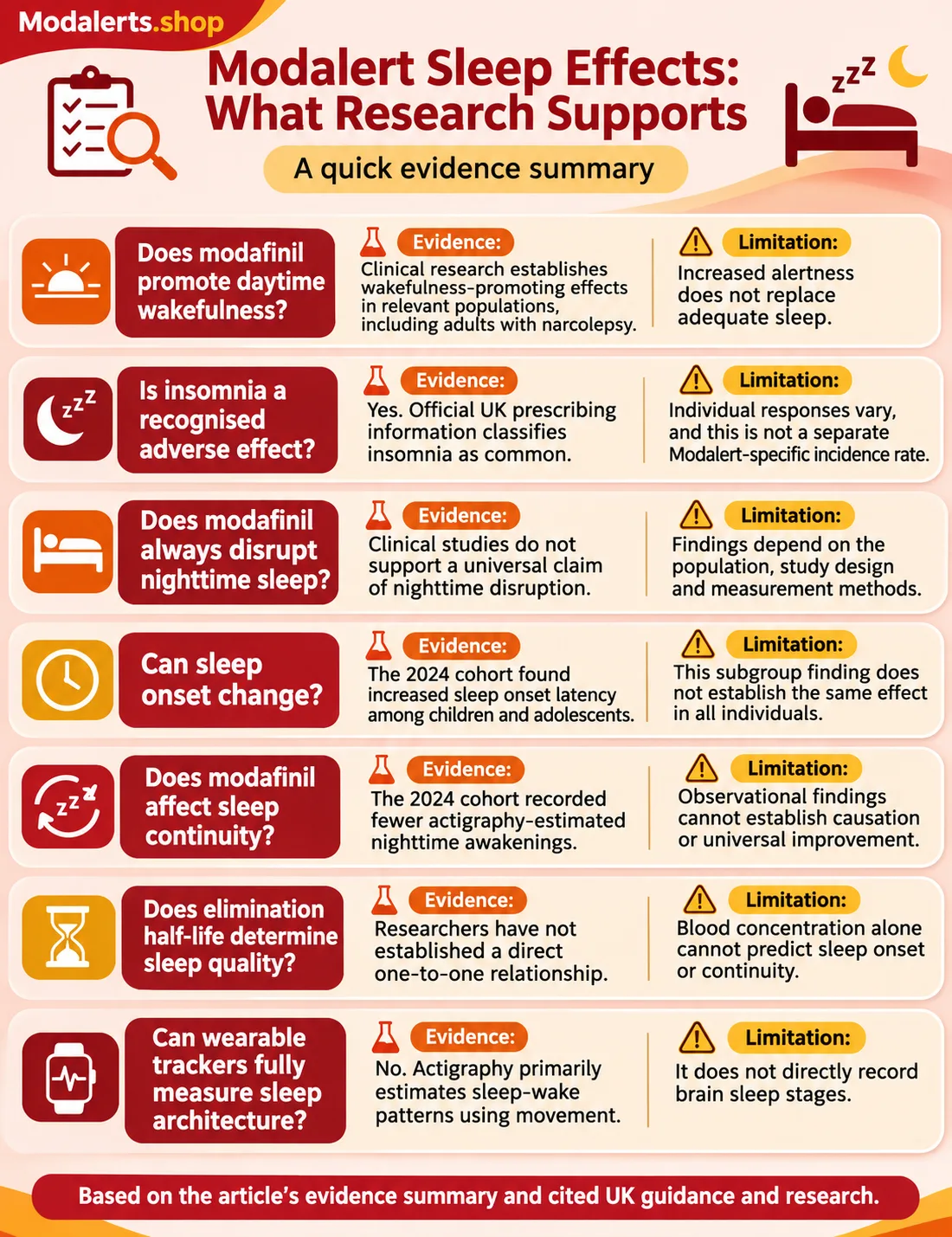
A medicine that reduces daytime sleepiness does not replace restorative sleep. Insomnia is a recognised adverse reaction to modafinil, and some people report difficulty falling asleep or changes in restfulness.
Researchers separate sleep onset, sleep continuity and sleep quality. An improvement or deterioration in one measure need not imply the same change in the others.
Moreover, studies differ by diagnosis, participant characteristics and how they measure sleep. Feeling alert does not establish that accumulated sleep loss has disappeared. Sleep hygiene remains relevant in UK prescribing information.
Modalert and Sleep: Effects on Sleep Quality & Timing examines these differences in more detail.
Modalert Tolerance, Dependence and Long-Term Use
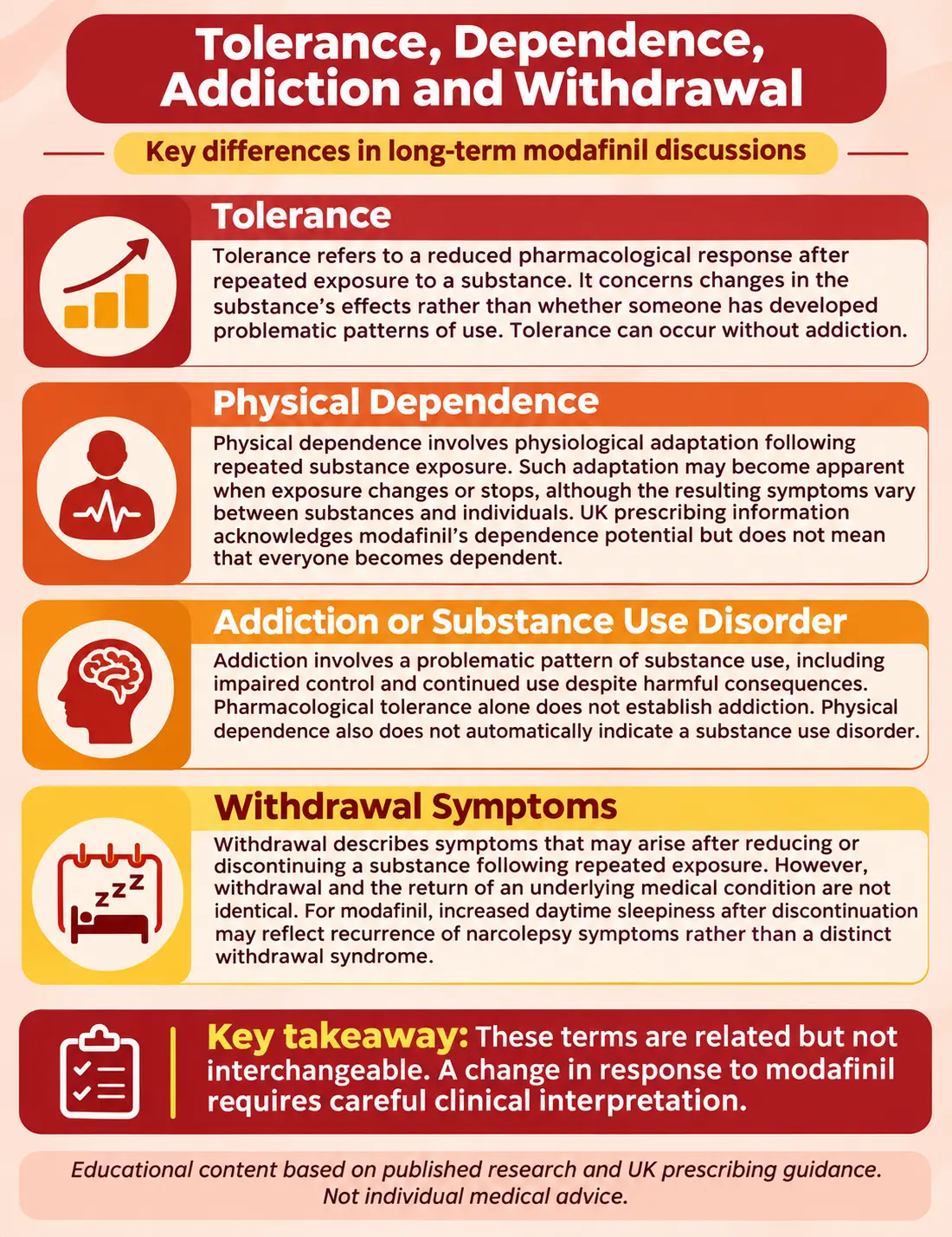
Tolerance means a reduced response after repeated exposure. Physical dependence means the body has adapted physiologically. Addiction involves impaired control and continued use despite harm. These terms describe different processes.
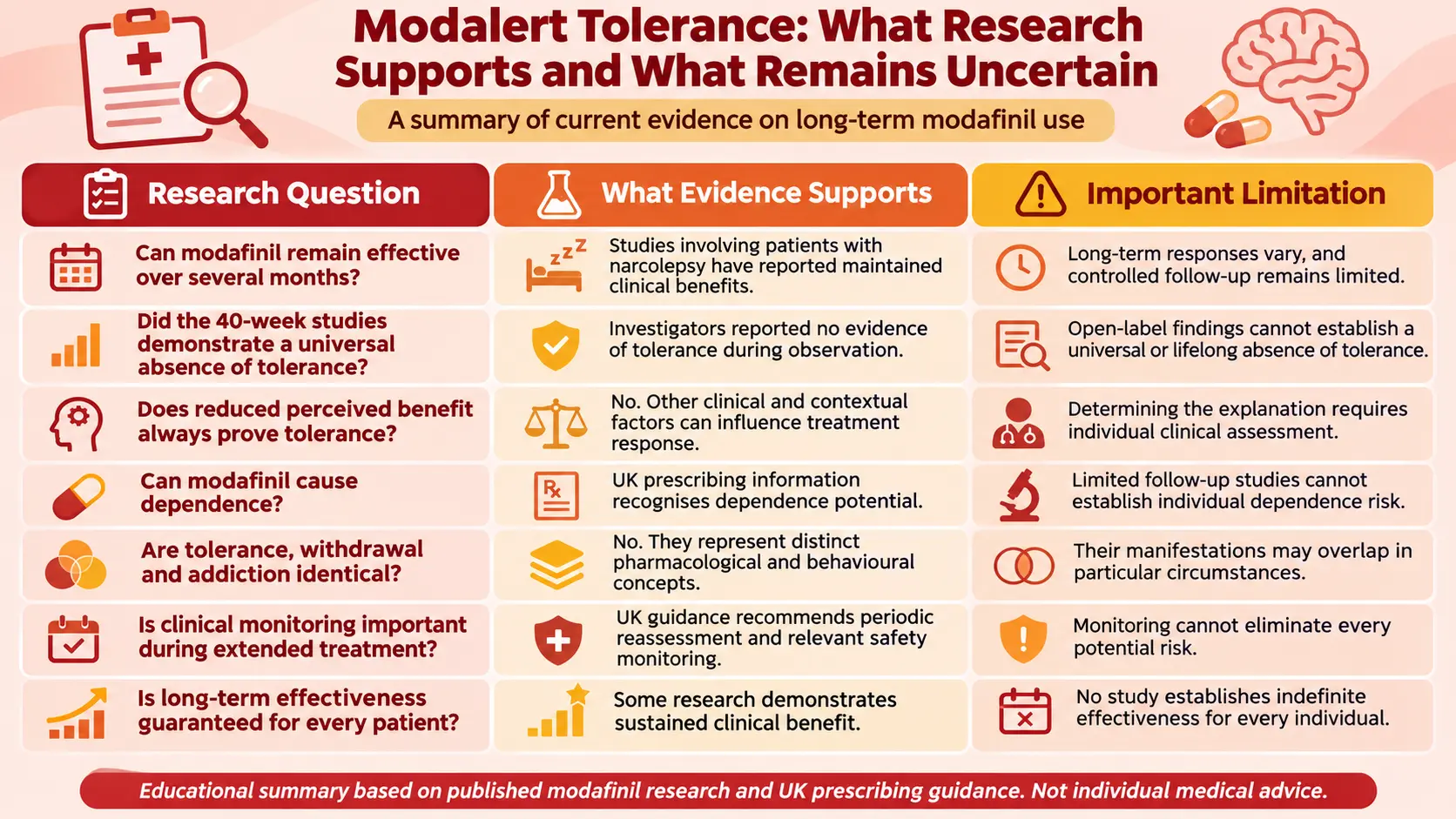
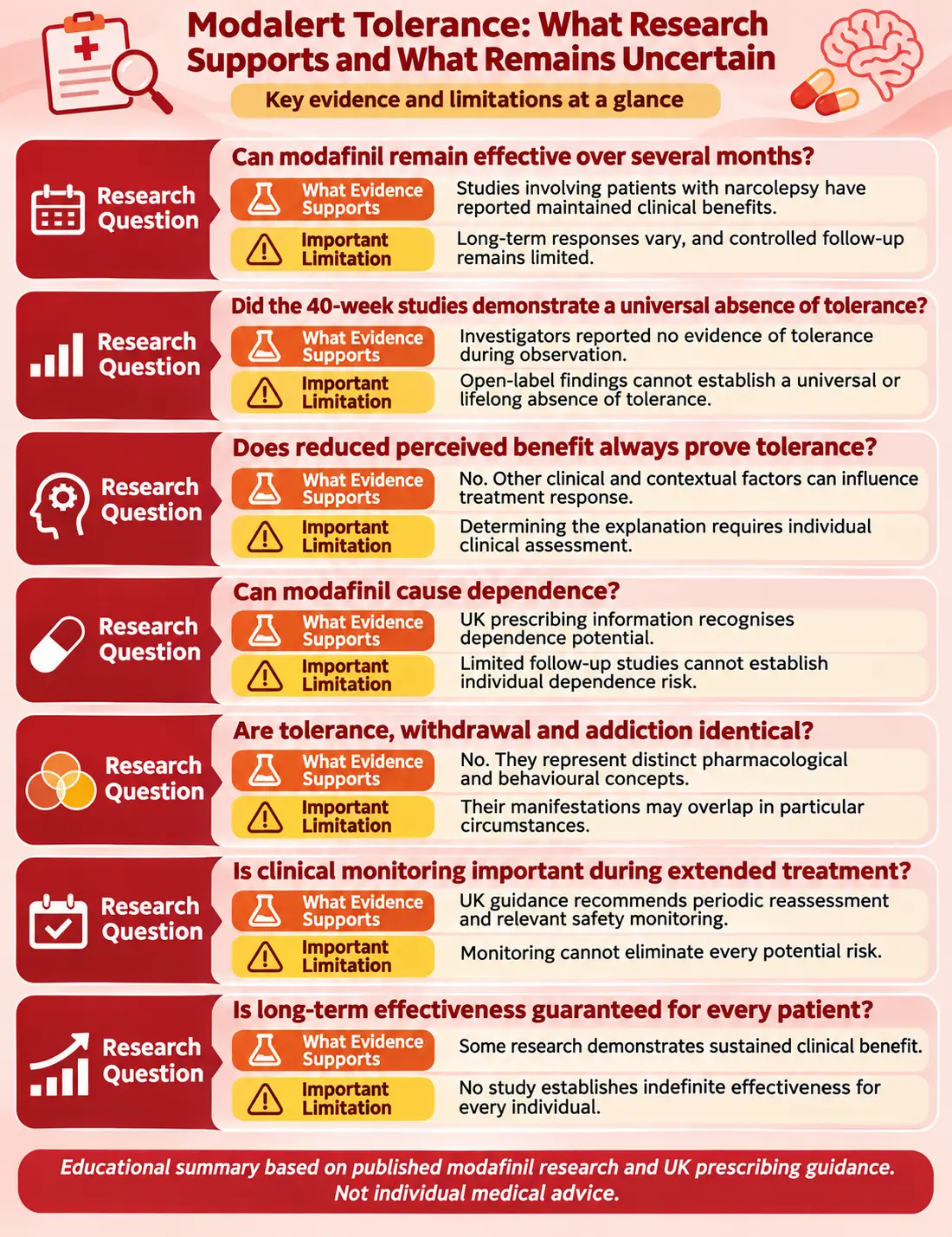
Some longer-term modafinil studies report sustained wakefulness benefits. Nevertheless, selected study populations and limited follow-up cannot rule out tolerance or dependence for everyone.
UK prescribing information acknowledges dependence potential and limitations in long-term effectiveness data. It also describes the role of periodic clinical reassessment.
Modalert Tolerance: Long-Term Use & Considerations expands on these distinctions without assuming inevitable tolerance or an absence of risk.
Modalert Compared With Other Medicines
Comparisons should consider active ingredients, formulations, evidence and national authorisation. Anecdotal claims about one medicine being stronger, safer or longer-lasting are not substitutes for comparative research.


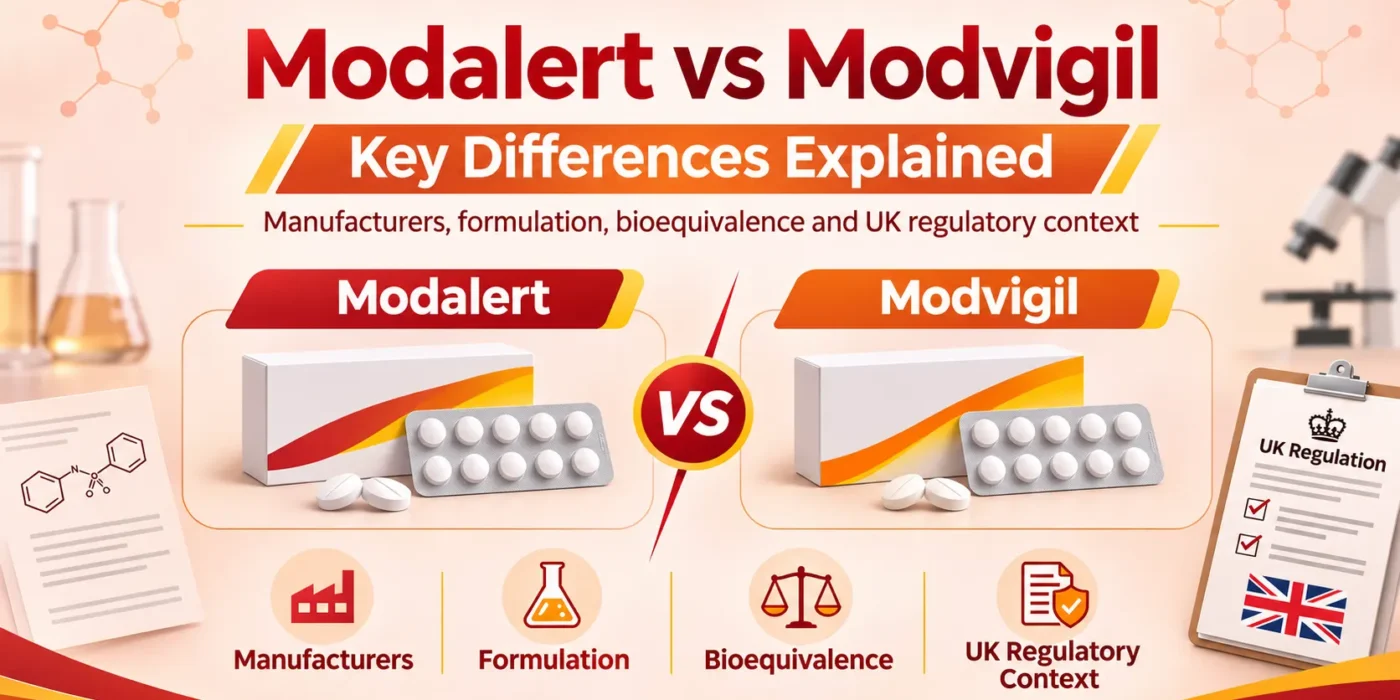
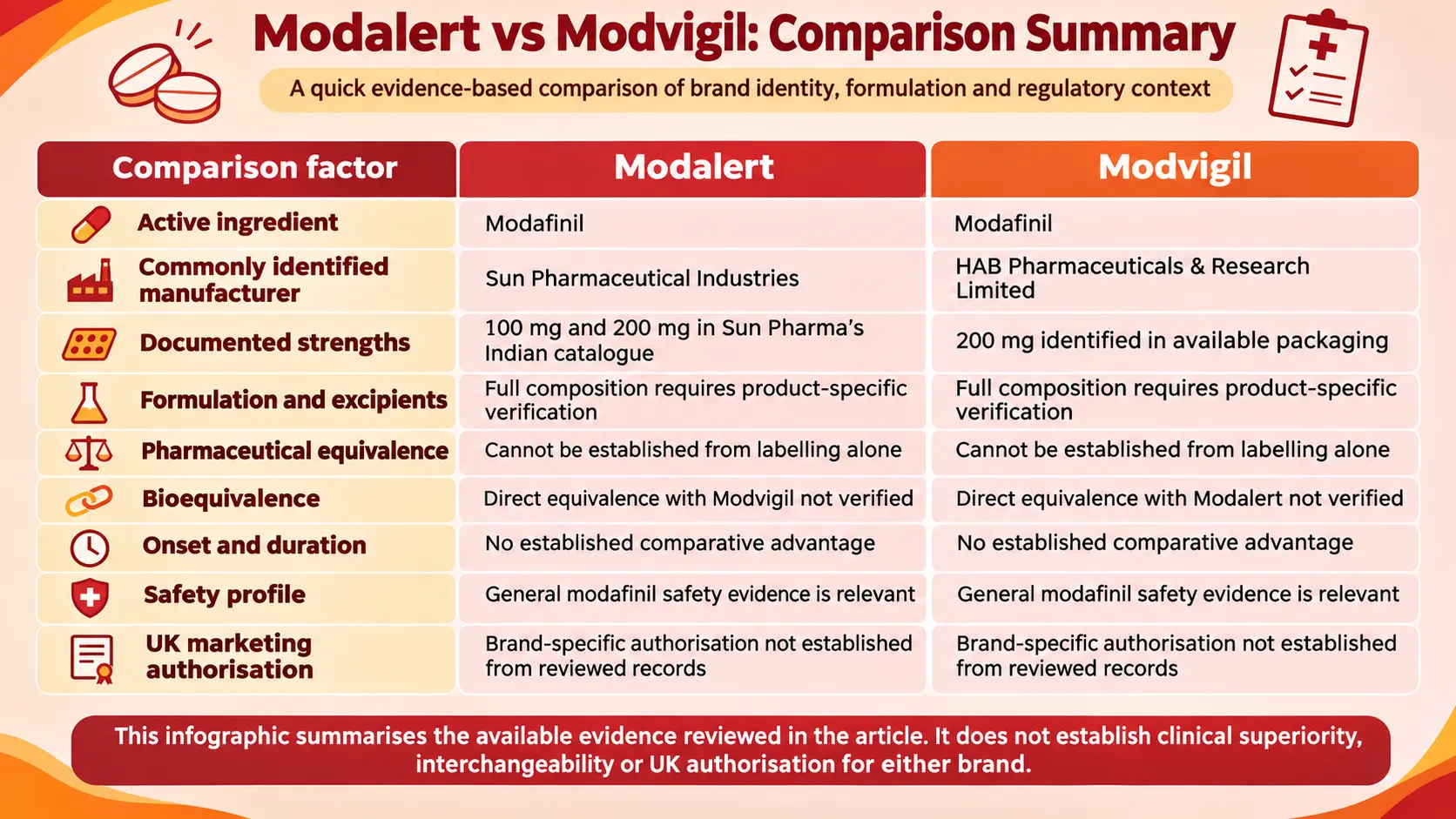
Modalert vs Modvigil
Both names refer to brands associated with modafinil. However, a shared active ingredient alone does not establish identical manufacturing quality, formulation or UK regulatory status.
The article Modalert vs Modvigil: Key Differences Explained considers these product-level distinctions.
Modalert vs Waklert
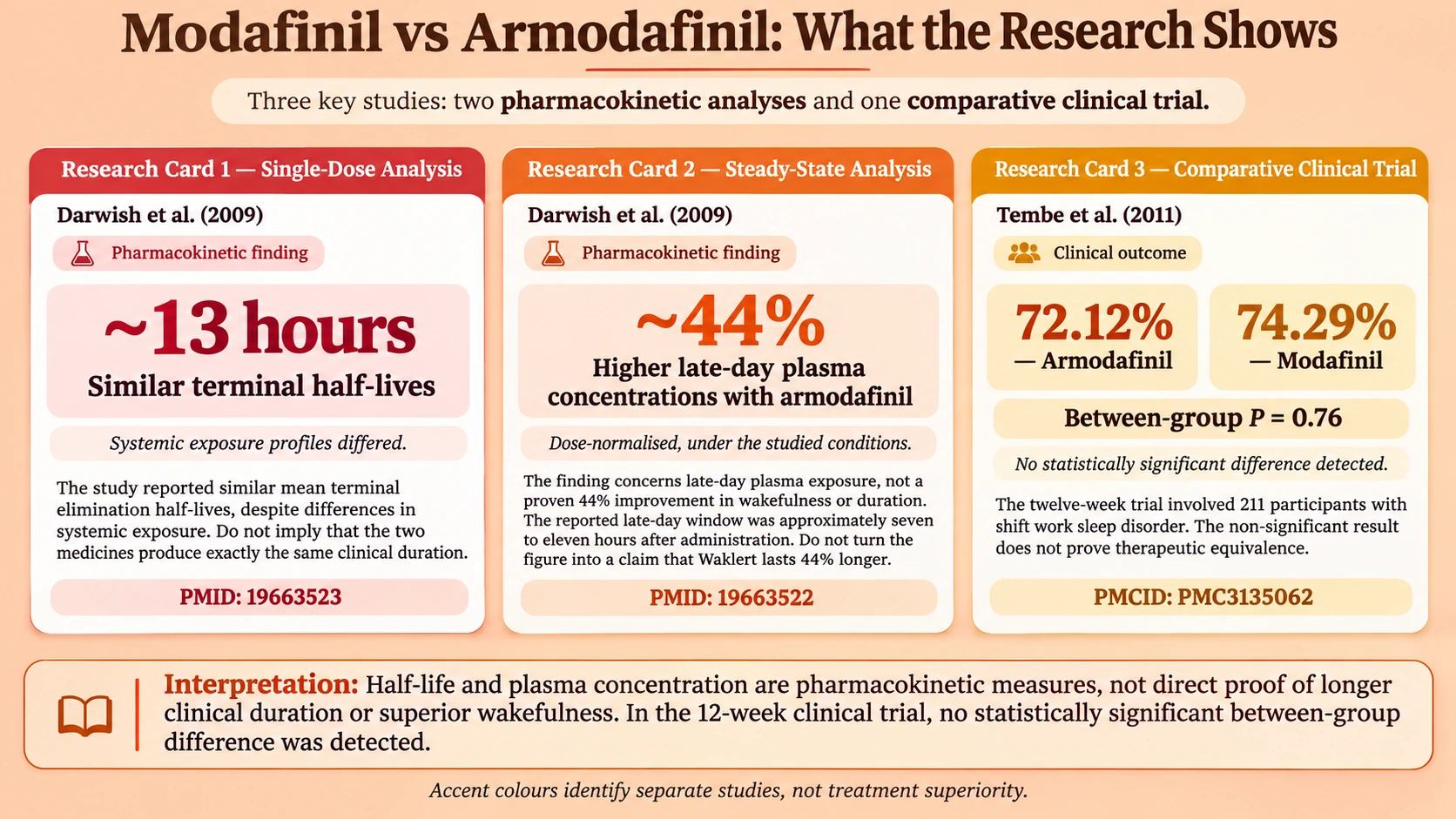
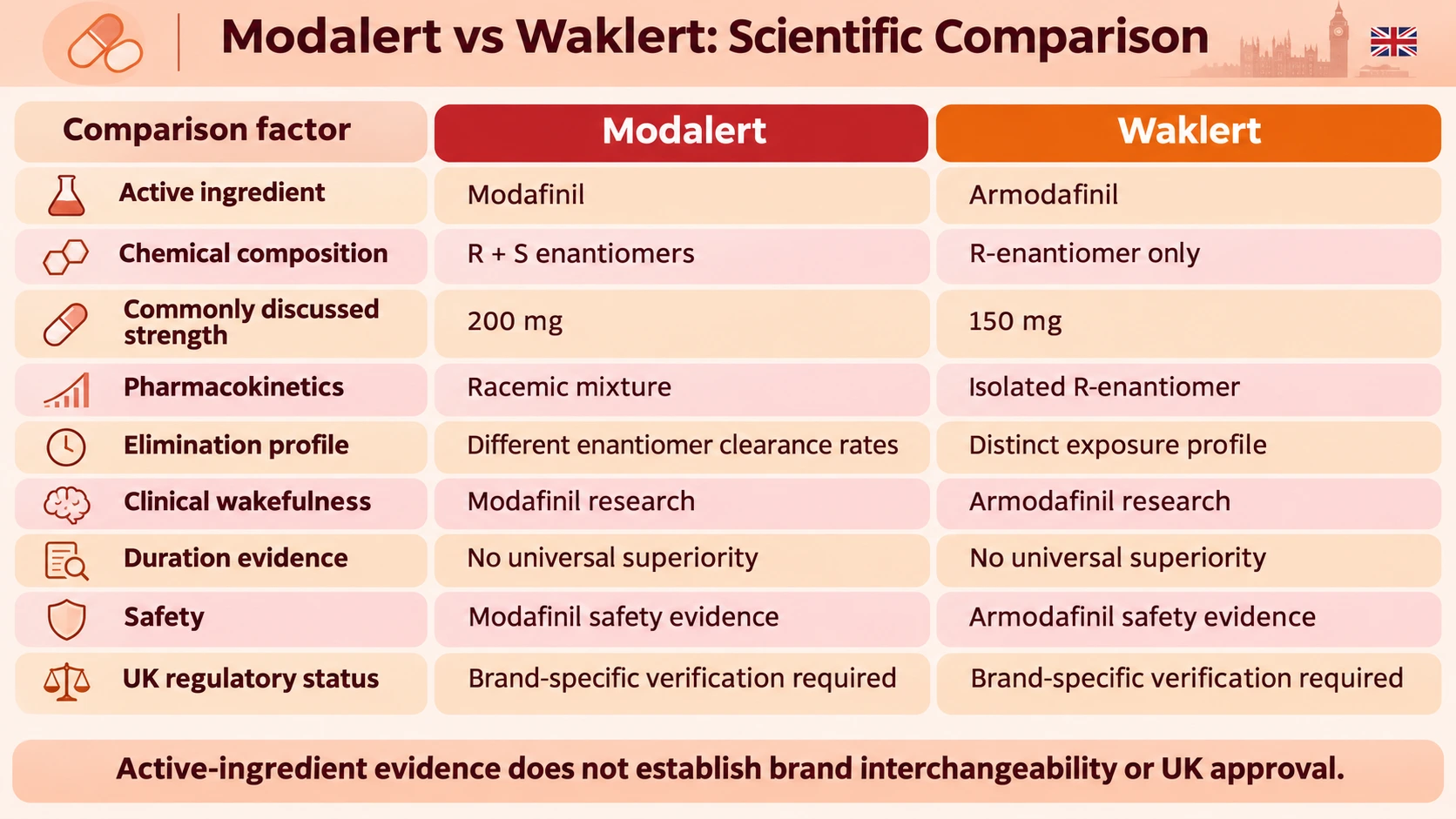
Waklert is associated with armodafinil, which contains the R-enantiomer of modafinil. Modafinil itself contains two enantiomers. Their related chemistry does not make their pharmacokinetic profiles identical.
Likewise, chemical differences do not establish superior clinical outcomes. Modalert vs Waklert: Differences in Effects, Duration & Research Context provides the wider comparison.
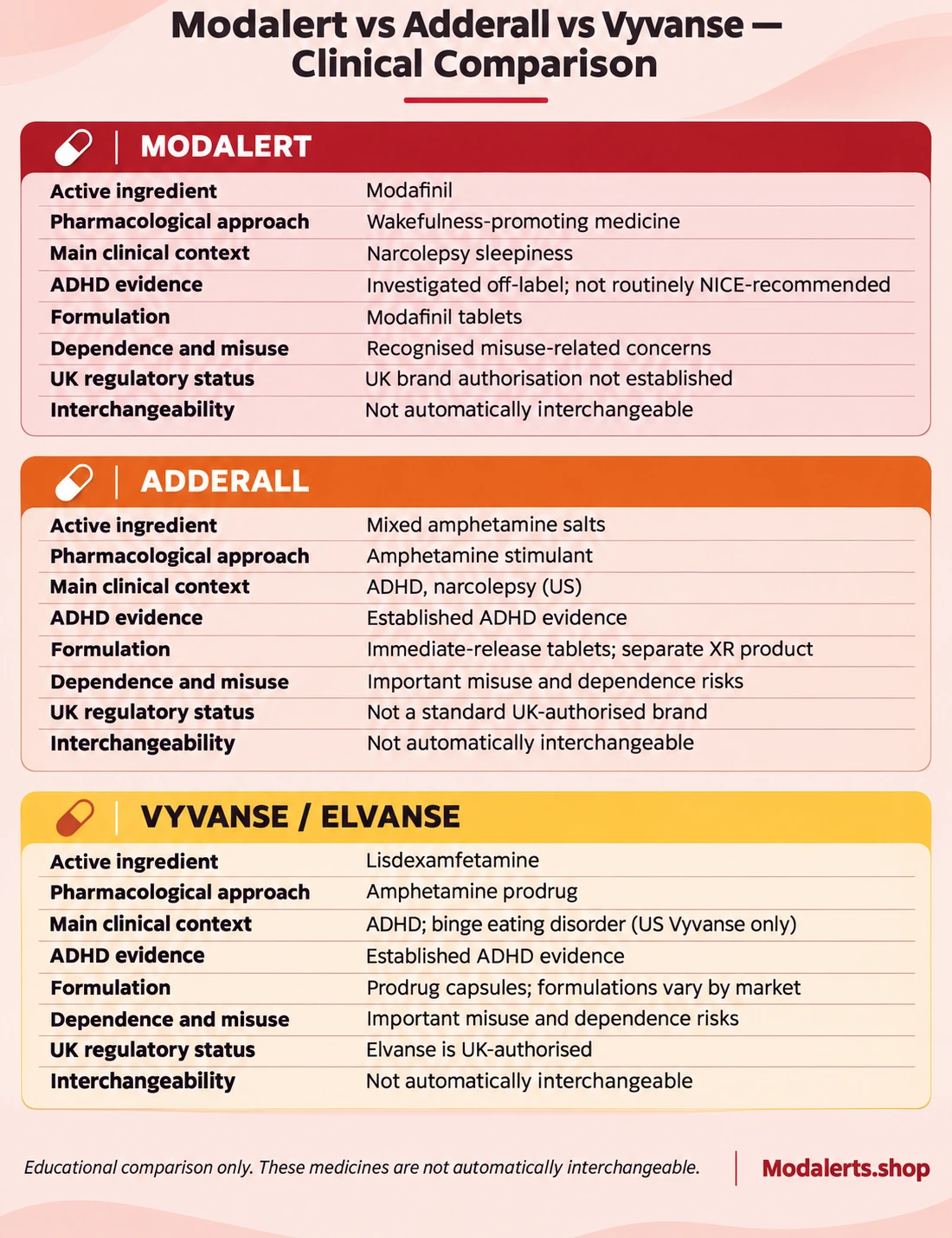
Modalert vs Adderall vs Vyvanse
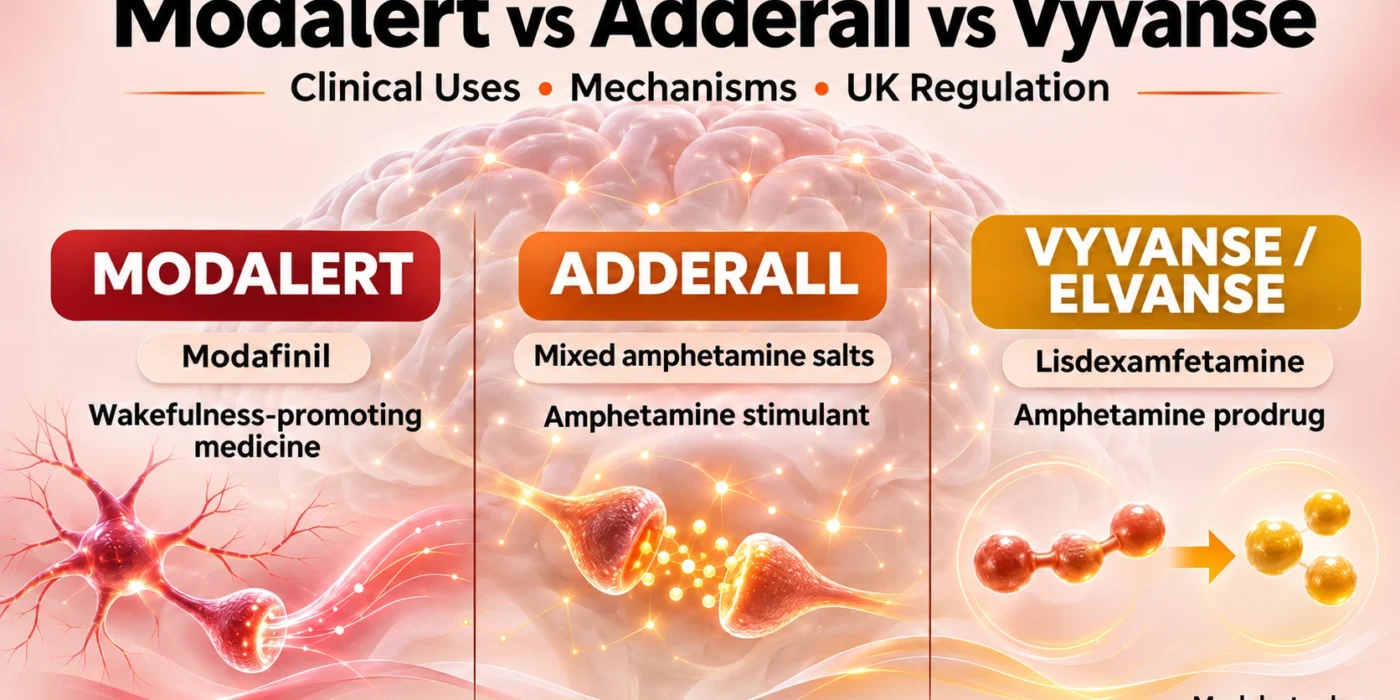
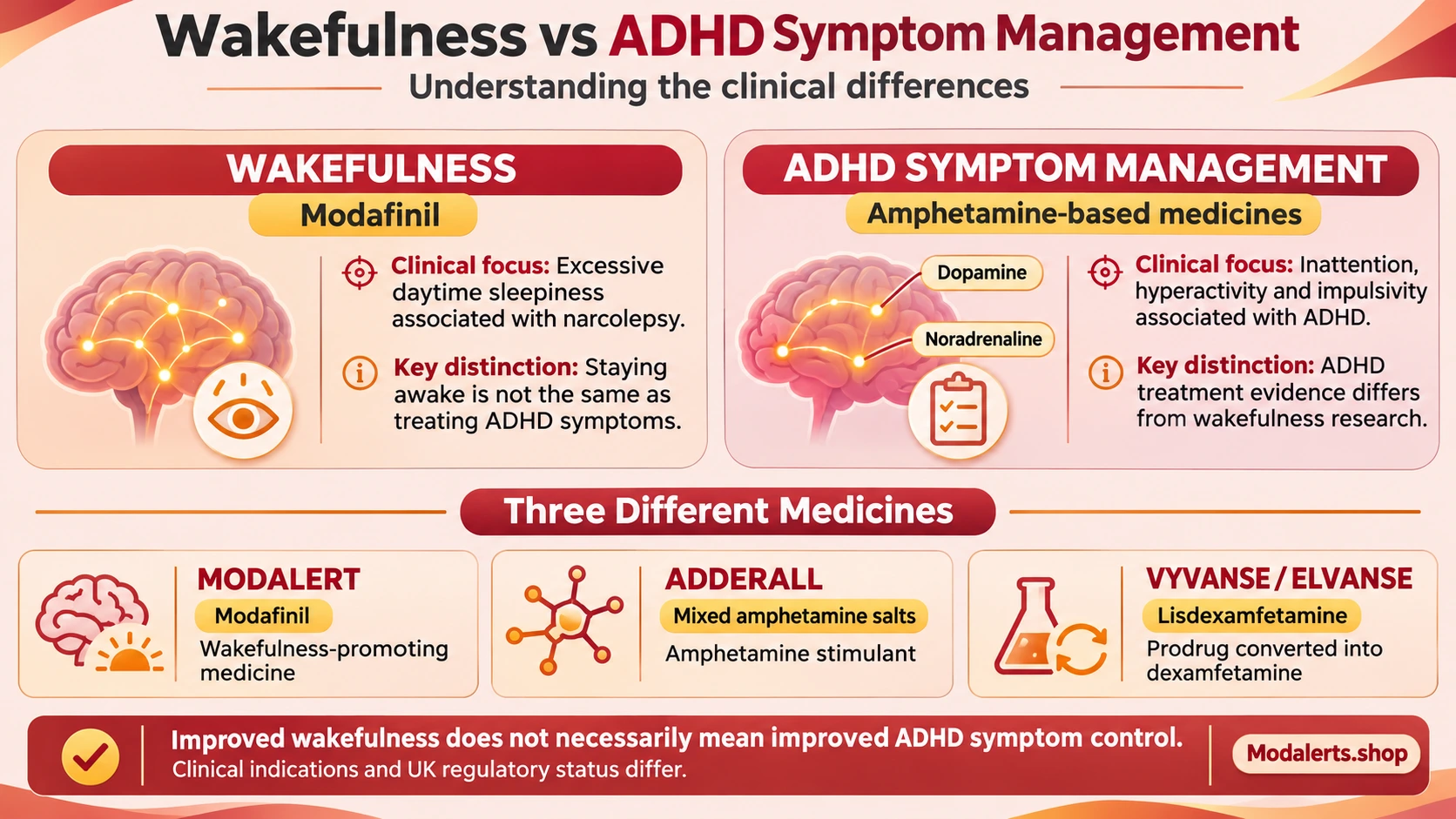
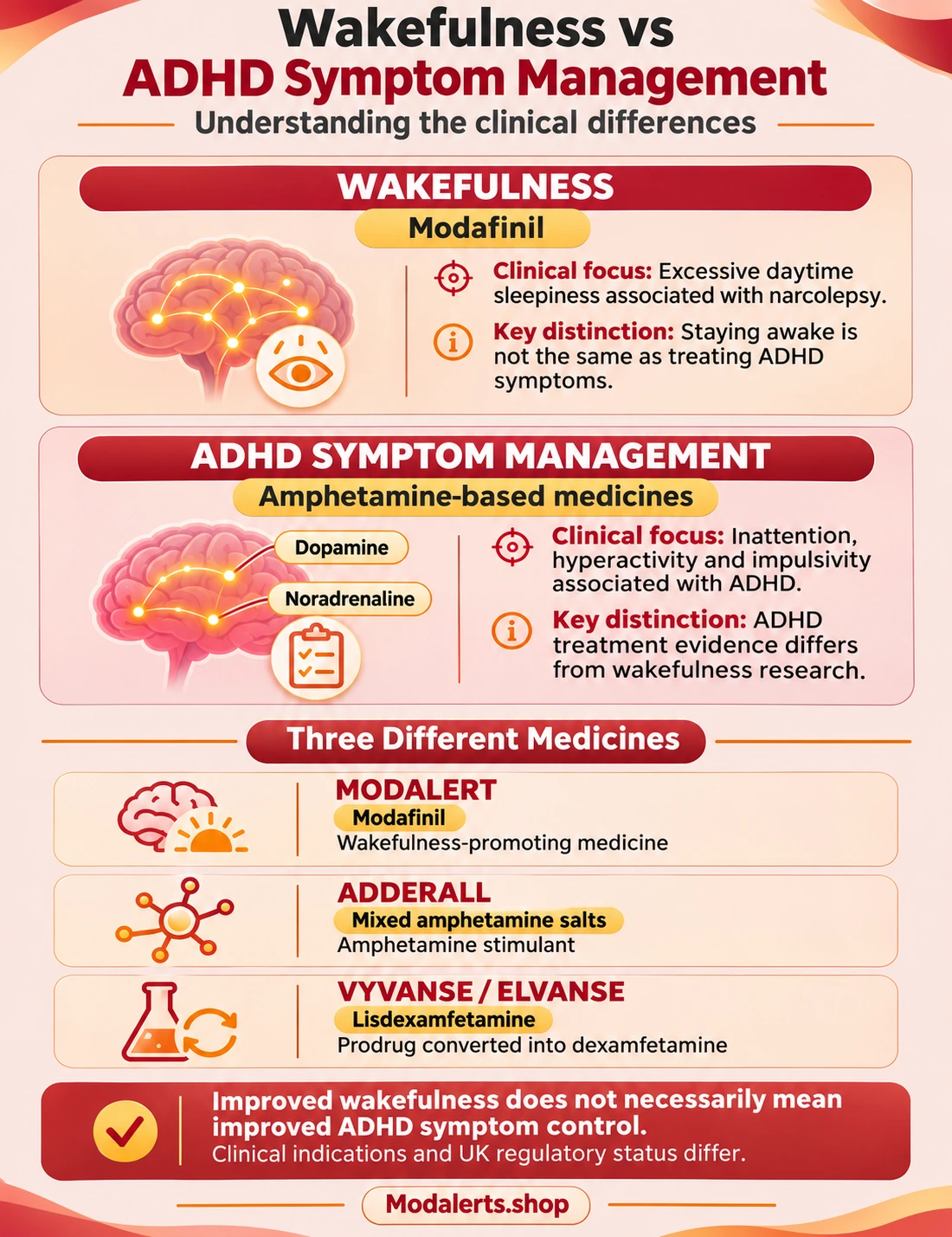
Adderall contains mixed amphetamine salts; Vyvanse contains lisdexamfetamine, which the body converts to dexamfetamine. Their pharmacology and regulatory histories differ from modafinil.
These international brand names should not be assumed to represent corresponding UK-authorised products. Modalert vs Adderall vs Vyvanse: An Educational Comparison explains the distinctions.
Is Modalert Legal in the UK?
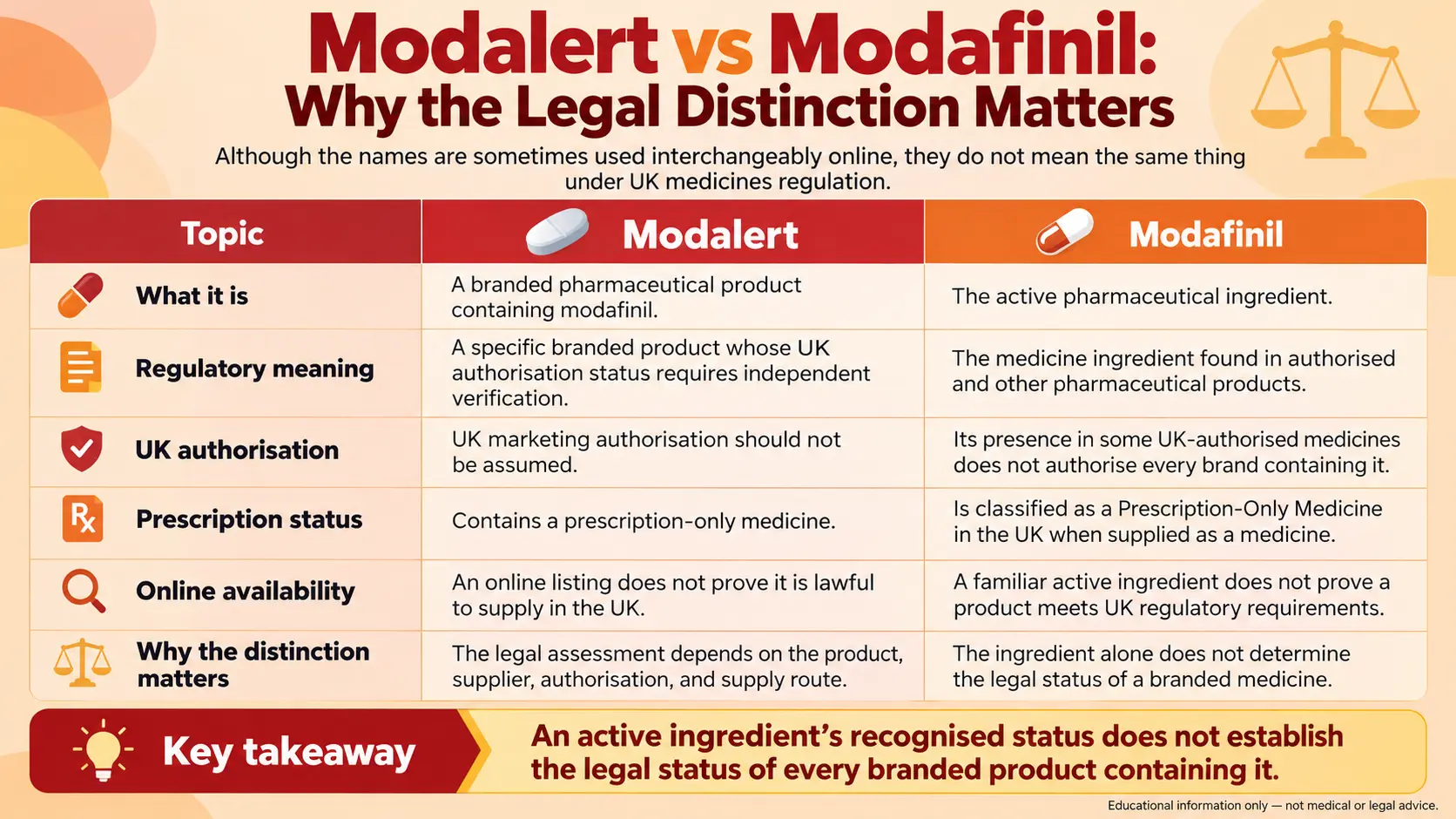
Modafinil is a Prescription-Only Medicine in the UK. Nevertheless, several regulatory questions must remain separate.
Prescription and dispensing: Lawful professional prescribing and medicine supply operate within UK medicines requirements.
Marketing authorisation: Approval covers specified products, not every brand containing the same ingredient.
Unlicensed supply: Particular circumstances can permit supply of an unlicensed medicine, but this does not mean unrestricted commercial availability.
Importation and possession: Rules governing personal possession, importation and commercial distribution differ and depend on the circumstances.
Public advertising: The MHRA’s medicines advertising guidance restricts advertising prescription-only medicines to the public.
An educational article on a commercial website must also be judged in its full setting, including surrounding promotional material. For more context, see Is Modalert Legal in the UK? Prescription Rules & Regulations Explained.
Buying Modalert in the UK: Prescription and Pharmacy Safeguards
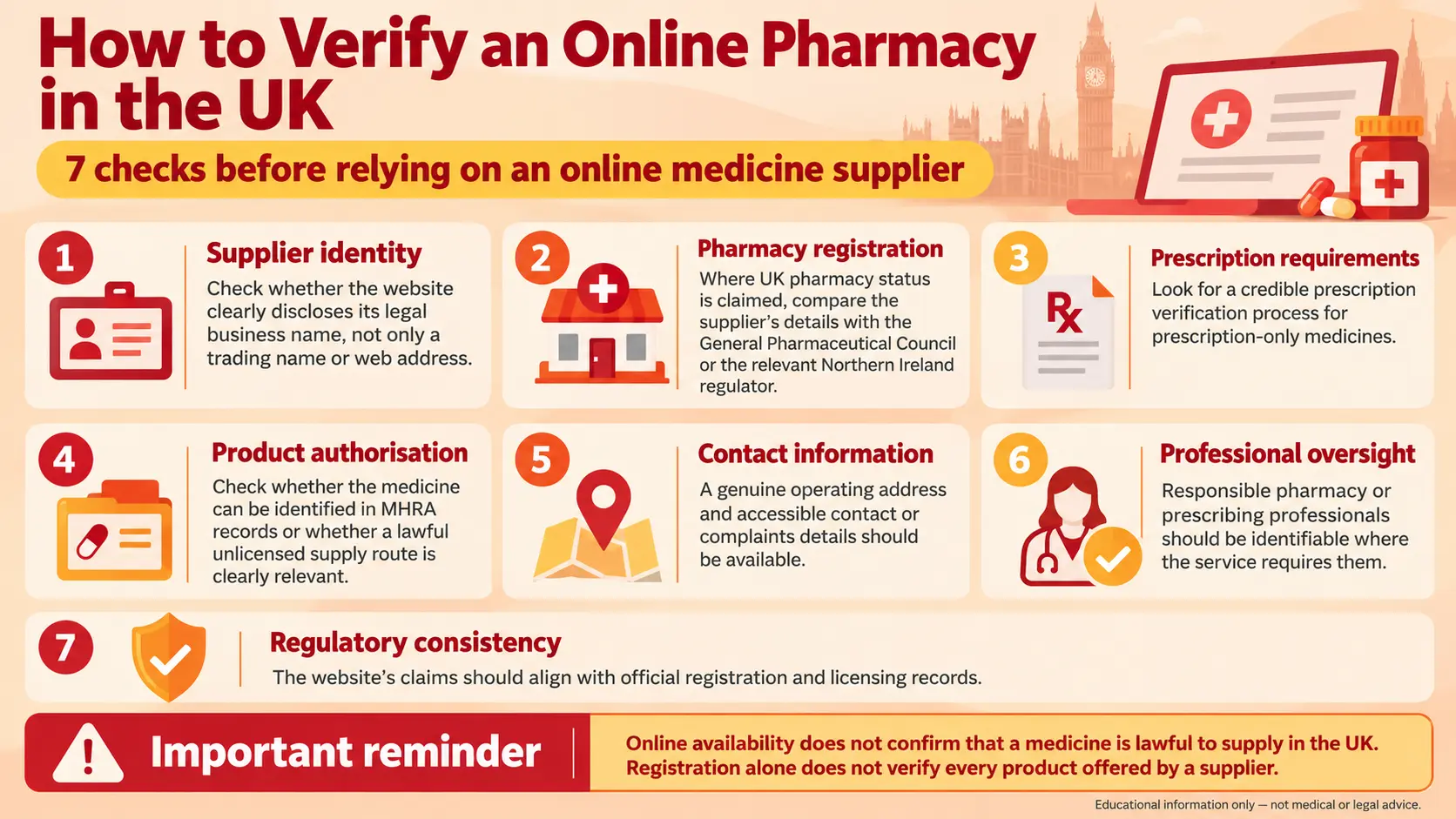
Online availability alone does not establish pharmaceutical quality or lawful supply. Relevant safeguards include clinical assessment, valid prescribing, professional oversight and the regulatory status of the medicine itself.


In Great Britain, the General Pharmaceutical Council maintains registers of pharmacies and pharmacy professionals. Northern Ireland has different professional regulatory arrangements.
However, registration of a pharmacy does not independently prove that each listed product holds UK authorisation. Similarly, a seller’s description cannot confirm the contents, origin or manufacturing quality of a medicine.
A legitimate prescribing service and a registered pharmacy perform different functions. Prescribing involves clinical responsibility, whereas dispensing concerns the lawful preparation and supply of a specified medicine. Online services may combine these activities, but the underlying professional obligations remain separate. In addition, a correctly registered professional does not by itself establish the lawful status of medicines sourced through an unknown supply chain.
Unverified supply chains may involve counterfeit products, inaccurate labelling, uncertain ingredients or inadequate clinical oversight. Importation and unlicensed supply raise additional regulatory questions.
Therefore, prescription status, pharmacy registration, product authorisation and lawful supply must each be considered separately.
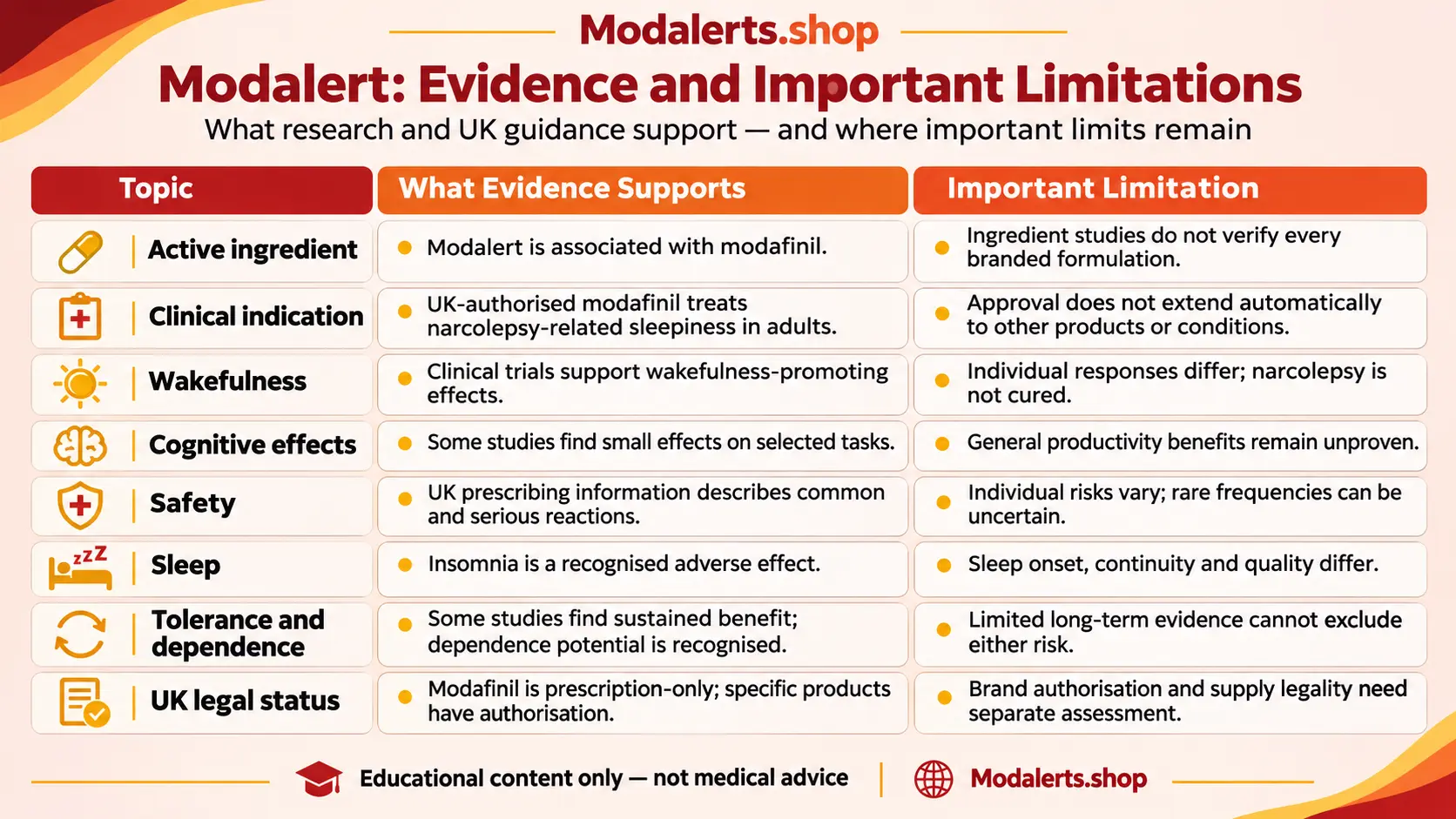
Modalert: Evidence and Important Limitations
The following summary distinguishes supported findings from conclusions that the available evidence cannot establish.
|
Topic |
What Evidence Supports |
Important Limitation |
|
Active ingredient |
Modalert is associated with modafinil. |
Ingredient studies do not verify every branded formulation. |
|
Clinical indication |
UK-authorised modafinil treats narcolepsy-related sleepiness in adults. |
Approval does not extend automatically to other products or conditions. |
|
Wakefulness |
Clinical trials support wakefulness-promoting effects. |
Individual responses differ; narcolepsy is not cured. |
|
Cognitive effects |
Some studies find small effects on selected tasks. |
General productivity benefits remain unproven. |
|
Safety |
UK prescribing information describes common and serious reactions. |
Individual risks vary; rare frequencies can be uncertain. |
|
Sleep |
Insomnia is a recognised adverse effect. |
Sleep onset, continuity and quality differ. |
|
Tolerance and dependence |
Some studies find sustained benefit; dependence potential is recognised. |
Limited long-term evidence cannot exclude either risk. |
|
UK legal status |
Modafinil is prescription-only; specific products have authorisation. |
Brand authorisation and supply legality need separate assessment. |

Frequently Asked Questions About Modalert
What Is Modalert?
Modalert is a branded product associated with modafinil, an ingredient that promotes wakefulness. The name describes a commercial formulation rather than a separate active substance. Its availability internationally does not itself establish UK product authorisation. The relevant clinical evidence largely concerns modafinil and specified authorised products.
Is Modalert the Same as Modafinil?
They are related but not identical terms. Modafinil names the active pharmaceutical ingredient; Modalert names a brand containing it. Studies of the ingredient can inform understanding of pharmacology, but they cannot independently confirm the quality or regulatory standing of each brand sold internationally.
What Is Modalert Used For?
Modafinil’s authorised UK indication concerns excessive sleepiness associated with narcolepsy in adults. Studies have examined other sleep conditions and aspects of cognition, but research publication alone does not create a UK indication. The specific product and clinical context determine how authorisation applies.
Is Modalert Legal in the UK?
Modafinil requires a prescription in the UK. Whether a particular branded product is authorised, and whether its importation or supply is lawful, are additional questions. Rules for possession, dispensing and public advertising also differ. A medicine’s prescription classification therefore cannot settle every regulatory issue.
Can Modalert Cause Side Effects?
Modafinil can cause headache, insomnia, anxiety, dizziness and digestive symptoms. UK prescribing information also identifies serious skin, psychiatric and cardiovascular reactions. These events vary considerably in frequency and severity. Product-specific evidence matters when interpreting claims about a particular branded formulation.
Does Modalert Improve Focus?
Some studies report small average improvements in selected cognitive tasks. However, an alert feeling does not guarantee better memory, judgement or productivity. Results depend on participant characteristics and study methods. Cognitive enhancement is not an authorised UK indication for modafinil.
Can Modalert Affect Sleep or Cause Tolerance?
Insomnia is an established adverse effect. Tolerance describes a reduced response after repeated exposure, while dependence refers to physiological adaptation. Some studies report maintained wakefulness effects, but available long-term evidence cannot exclude tolerance or dependence. These questions remain distinct from addiction.
What Should UK Readers Check Before Obtaining Prescription Modafinil?
Relevant safeguards include the clinical assessment, prescription process, pharmacy registration and authorisation of the specific medicine. The General Pharmaceutical Council regulates pharmacies in Great Britain, with different arrangements in Northern Ireland. An online listing or registration claim alone does not prove lawful supply.
References and Further Reading
- Electronic Medicines Compendium. Modafinil 200 mg tablets — Summary of Product Characteristics. UK prescribing information covering clinical indications, contraindications, interactions and adverse reactions.
- Medicines and Healthcare products Regulatory Agency (MHRA). Modafinil (Provigil): Now Restricted to Narcolepsy. Drug Safety Update. Article originally published March 2011; GOV.UK page published 11 December 2014.
- Medicines and Healthcare products Regulatory Agency (MHRA). Modafinil (Provigil): Increased Risk of Congenital Malformations if Used During Pregnancy. Drug Safety Update, 16 November 2020.
- Medicines and Healthcare products Regulatory Agency (MHRA). Advertise Your Medicines. Official UK guidance on medicines advertising, updated 11 April 2025.
- Medicines and Healthcare products Regulatory Agency (MHRA). Blue Guide: Advertising and Promoting Medicines. Official guidance on the regulation of medicines advertising.
- General Pharmaceutical Council (GPhC). Official Pharmacy Regulation and Professional Registration Resources. Information about pharmacy regulation, professional registration and pharmacy verification in Great Britain.
- Kredlow MA, Keshishian A, Oppenheimer S, Otto MW. The Efficacy of Modafinil as a Cognitive Enhancer: A Systematic Review and Meta-Analysis. Journal of Clinical Psychopharmacology. 2019;39(5):455–461.
- Battleday RM, Brem AK. Modafinil for Cognitive Neuroenhancement in Healthy Non-Sleep-Deprived Subjects: A Systematic Review. European Neuropsychopharmacology. 2015;25(11):1865–1881.
- Roberts CA, Jones A, Sumnall H, Gage SH, Montgomery C. How Effective Are Pharmaceuticals for Cognitive Enhancement in Healthy Adults? A Series of Meta-Analyses of Cognitive Performance During Acute Administration of Modafinil, Methylphenidate and D-Amphetamine. European Neuropsychopharmacology. 2020;38:40–62.
Final Thoughts: Understanding Modalert Responsibly
The strongest evidence concerns modafinil’s clinical role in promoting wakefulness in adults with narcolepsy. Findings about broader cognitive performance are less consistent and do not establish an authorised productivity use.
Understanding safety means considering both relatively common effects and serious but less frequent reactions. Sleep, medicine interactions, pregnancy-related risks and longer-term uncertainties also matter.
Finally, ingredient-level research, brand authorisation and lawful UK supply are different questions. Sound interpretation relies on official product information, qualified clinical assessment and current regulatory requirements.