

Educational and Medical Disclaimer
This article discusses modalert tolerance using published research and official UK prescribing information. It provides educational information, not individual medical advice. Modafinil is a Prescription-Only Medicine in the United Kingdom. Treatment decisions and concerns about changing effectiveness, dependence or adverse effects require assessment by an appropriately qualified healthcare professional. Changes to prescribed treatment require appropriate medical guidance.
Modalert tolerance is an important consideration when examining the long-term effects of modafinil, particularly whether its wakefulness-promoting benefits can change with continued treatment.
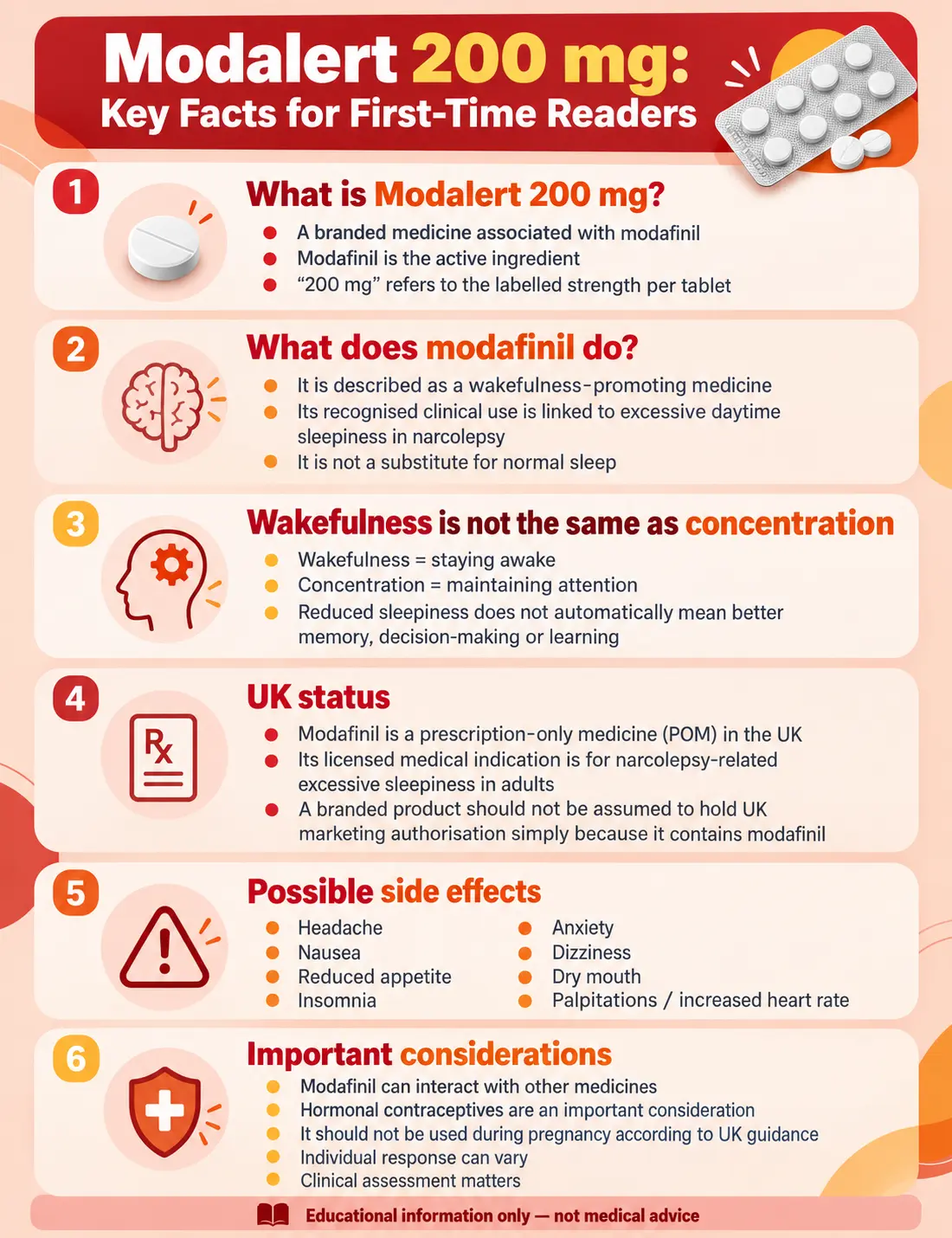
Modalert contains modafinil, a prescription medicine used to manage excessive daytime sleepiness associated with narcolepsy.
Clinical studies have reported maintained effectiveness over several months, with some investigators finding no evidence of tolerance during their observation periods. However, these findings do not establish that tolerance is impossible or that every individual will experience sustained benefits.
Furthermore, UK prescribing information recognises the potential for dependence and recommends periodic clinical reassessment during extended treatment.
Understanding the difference between tolerance, changes in treatment effectiveness and dependence helps place long-term modafinil research within an appropriate medical context.
Questions about tolerance and long-term use are best considered alongside the wider clinical evidence for modafinil. For background on approved indications, recognised adverse effects and UK prescription requirements, consult our comprehensive Modalert guide.
What Does Modalert Tolerance Mean?
Pharmacological tolerance occurs when repeated exposure to a medicine leads to a reduced response over time.
A medicine that initially produces a particular clinical effect may therefore appear less effective following continued treatment.
However, reduced effectiveness does not automatically establish pharmacological tolerance.
For example, someone receiving treatment for excessive daytime sleepiness may experience changes in their underlying condition, sleep quality or general health. These factors can influence daytime alertness independently of the medicine’s pharmacological effects.
Consequently, clinicians must distinguish genuine tolerance from symptom recurrence, changes in sleep patterns and differences in perceived effectiveness.
Available research does not establish a predictable pattern of modafinil tolerance that applies to everyone receiving prolonged treatment.
Can Modafinil Become Less Effective Over Time?
Researchers have investigated modafinil’s effectiveness through short-term randomised trials and longer follow-up studies.
Several investigations involving people with narcolepsy have demonstrated sustained improvements in excessive daytime sleepiness.
Nevertheless, individual responses vary, and evidence of maintained effectiveness during a study does not guarantee permanent treatment benefits.
Pharmacological Tolerance Versus Changes in Symptoms
True pharmacological tolerance involves a diminished response following repeated exposure to a medicine.
In contrast, worsening excessive daytime sleepiness may reflect changes in the underlying sleep disorder or the development of another health-related concern.
These explanations are not interchangeable.
For instance, increasing daytime sleepiness does not necessarily mean that the nervous system has become less responsive to modafinil.
Clinical assessment helps distinguish changes in medicine response from developments involving sleep, health or the underlying condition.
Why Individual Experiences Do Not Establish Tolerance
Personal accounts can describe how someone experiences a medicine over time. However, they cannot independently establish whether physiological tolerance has developed.
Subjective alertness may change because of expectations, daily activities, disrupted sleep or other circumstances.
Researchers also distinguish self-reported sleepiness from objective measures of wakefulness.
For example, someone may feel less alert without demonstrating an equivalent change in clinical wakefulness measurements.
Therefore, a change in perceived effectiveness does not necessarily establish a measurable reduction in the medicine’s clinical activity.
For further context, the educational article Does Modalert Improve Focus or Just Wakefulness? examines how different treatment outcomes are interpreted.
Modalert Tolerance: What Long-Term Studies Actually Show
Long-term modafinil research provides useful evidence about maintained clinical effectiveness. However, study design, participant selection and observation periods influence the strength of the conclusions.
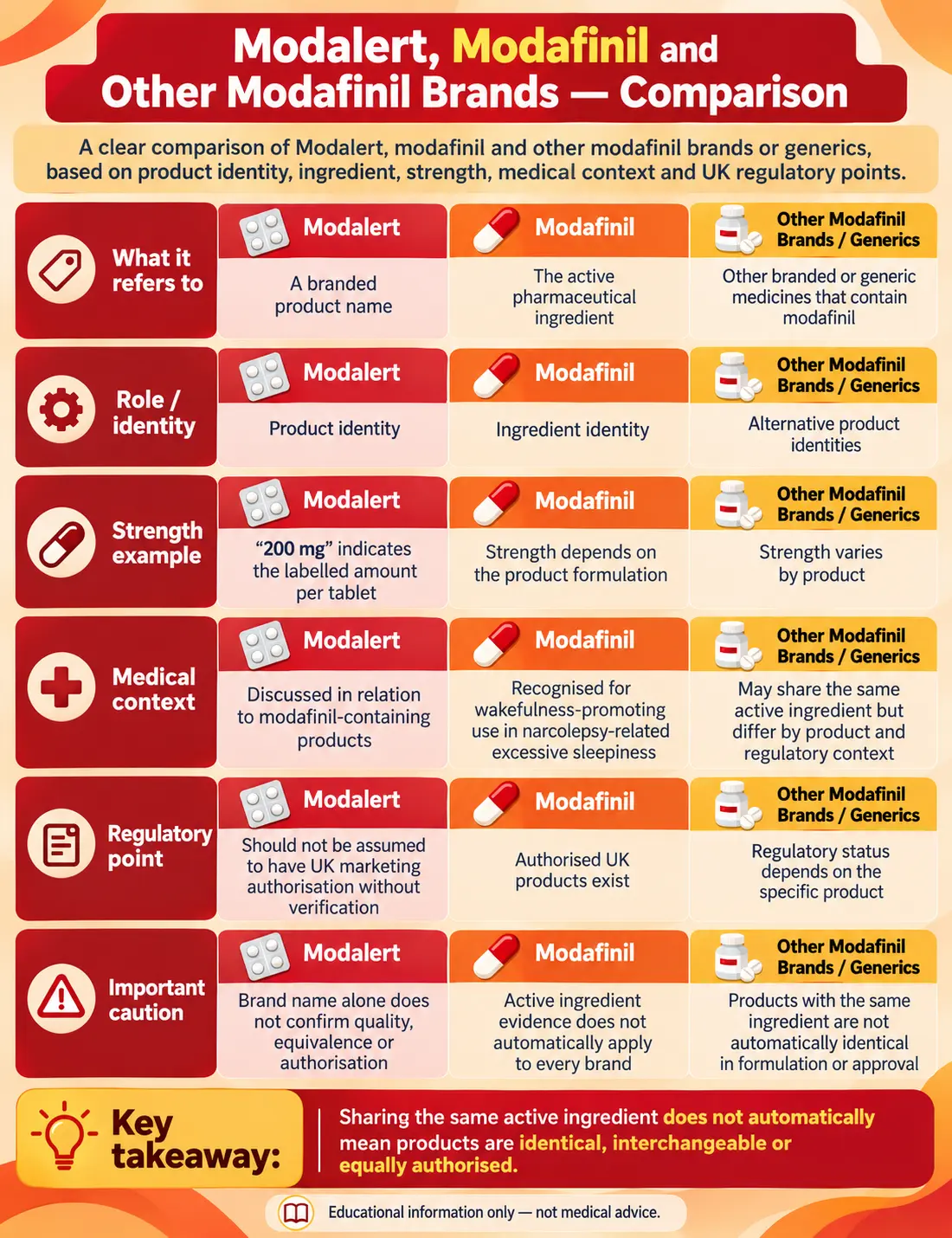
Importantly, studies investigating modafinil as an active ingredient do not automatically provide brand-specific clinical evidence for Modalert.
The 40-Week Open-Label Extension Studies
One significant investigation came from Mitler and colleagues in 2000.
Researchers examined the long-term effectiveness and safety of modafinil in adults with narcolepsy who had previously completed controlled clinical trials.
A total of 478 adults entered two 40-week open-label extension studies following earlier nine-week, placebo-controlled trials.
Researchers assessed daytime sleepiness, perceived clinical improvement, quality of life and adverse events.
Of the 478 participants, 341 completed the extension studies, representing approximately 71% of those enrolled.
The findings showed that improvements in daytime sleepiness remained relatively stable throughout follow-up.
For example, mean Epworth Sleepiness Scale scores improved early in the extension period and remained at approximately the same level through week 40. The Epworth Sleepiness Scale is a questionnaire that measures a person’s tendency to fall asleep during everyday situations.
The investigators reported maintained clinical effectiveness and found no evidence of tolerance developing during the 40-week observation period.
However, several limitations affect how these results should be interpreted.
The extensions were open-label, meaning participants and investigators knew that patients were receiving modafinil.
Unlike the earlier controlled trials, the extensions did not maintain a placebo comparison throughout the full observation period.
Additionally, participants had already completed earlier trials, which may have influenced the characteristics of the study population.
Not everyone completed follow-up, and participant discontinuation can affect long-term outcome estimates.
Consequently, these findings support maintained effectiveness within the observed population. They do not establish that tolerance can never develop or that modafinil remains equally effective throughout lifelong treatment.
A 16-Week Continued-Efficacy Study
Another investigation came from Moldofsky and colleagues in 2000.
Researchers examined whether modafinil continued to provide clinical benefits following an extended treatment period.
Initially, 69 patients with narcolepsy entered a 16-week open-label extension after completing an earlier six-week crossover study.
After this extension, 63 participants entered a separate two-week randomised, blinded comparison.
Of these participants:
- 30 continued receiving modafinil.
- 33 received placebo.
Researchers assessed excessive daytime sleepiness using the Maintenance of Wakefulness Test, the Epworth Sleepiness Scale and patient-reported episodes of severe sleepiness.
The Maintenance of Wakefulness Test measures the ability to remain awake under controlled testing conditions.
During the randomised comparison, participants who continued modafinil demonstrated significantly better wakefulness outcomes than those receiving placebo.
This comparison provided stronger evidence of continued clinical activity than an open-label extension alone.
However, the randomised phase lasted only two weeks after the 16-week open-label period.
Therefore, the investigation supports continued effectiveness over the studied period rather than proving that pharmacological tolerance cannot develop during substantially longer treatment.
Why the Evidence Still Has Limitations
Taken together, these investigations indicate that modafinil can maintain wakefulness-promoting effectiveness over extended periods in some patients with narcolepsy.
Nevertheless, important uncertainties remain.
First, studies have not consistently applied a single definition or measurement method for pharmacological tolerance.
Second, longer investigations frequently lack continuous placebo comparisons. Participant selection, treatment discontinuation and differences in clinical assessment can also affect the results.
Furthermore, most relevant studies involve people with diagnosed narcolepsy rather than healthy individuals or populations using modafinil for other purposes.
Research concerning modafinil or Provigil should not automatically be presented as clinical evidence specific to Modalert.
Ultimately, maintained effectiveness during a defined observation period does not establish indefinite effectiveness.
More extensive controlled research would help clarify individual response patterns and the frequency of clinically significant tolerance.
Modalert Tolerance, Dependence and Addiction: Key Differences
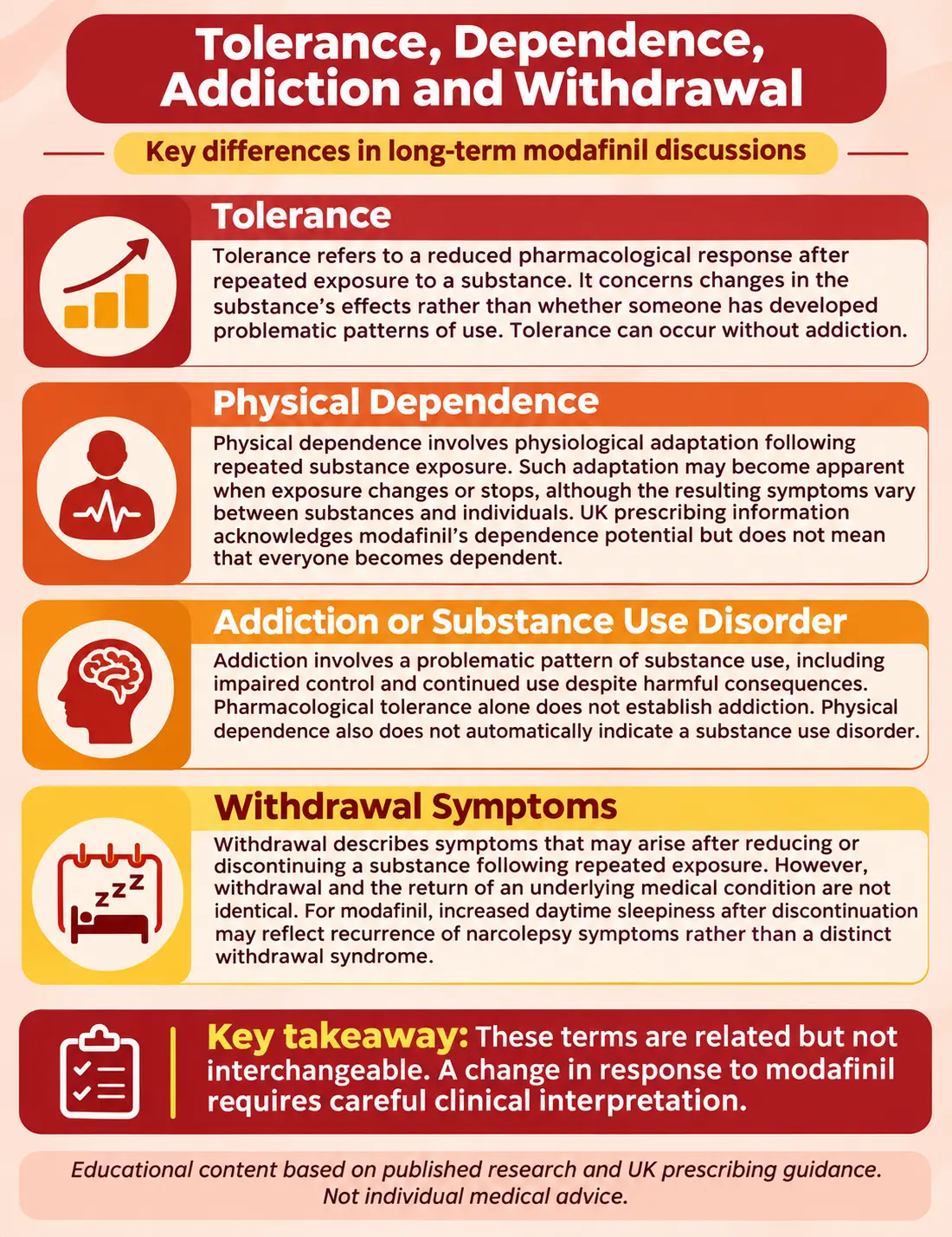
Tolerance, physical dependence, addiction and withdrawal describe related but distinct concepts.
Understanding these differences is essential when interpreting long-term modafinil research.

Tolerance
Tolerance refers to a reduced pharmacological response after repeated exposure to a substance.
It concerns changes in the substance’s effects rather than whether someone has developed problematic patterns of use.
Importantly, tolerance can occur without addiction.
Physical Dependence
Physical dependence involves physiological adaptation following repeated substance exposure.
Such adaptation may become apparent when exposure changes or stops, although the resulting symptoms vary between substances and individuals.
UK prescribing information acknowledges evidence indicating modafinil’s dependence potential. It also states that dependence during long-term treatment cannot be entirely excluded.
However, this caution does not mean that everyone receiving modafinil develops physical dependence.
Addiction or Substance Use Disorder
Addiction involves a problematic pattern of substance use, including impaired control and continued use despite harmful consequences.
Pharmacological tolerance alone does not establish addiction.
Similarly, physical dependence does not automatically indicate a substance use disorder.
These distinctions matter because a medicine can produce physiological changes without necessarily causing compulsive use.
Withdrawal Symptoms
Withdrawal describes symptoms that may arise after reducing or discontinuing a substance following repeated exposure.
However, withdrawal and the return of an underlying medical condition are not identical.
For example, increased daytime sleepiness after discontinuing modafinil may reflect the recurrence of narcolepsy symptoms rather than a distinct withdrawal syndrome.
Distinguishing these possibilities requires appropriate clinical interpretation.
Available evidence does not justify claiming that a particular modafinil withdrawal syndrome is either inevitable or impossible for every individual.
Why Modafinil May Seem Less Effective Without Proven Tolerance
Several factors can influence perceived treatment effectiveness during long-term modafinil use.
Insufficient sleep and fragmented nighttime sleep may increase daytime sleepiness independently of treatment.
Similarly, changes in narcolepsy symptoms or the development of another medical condition may affect overall alertness.
Concurrent medicines, changes in daily routines and differences in sleep circumstances may also influence how someone experiences treatment.
Another important distinction concerns subjective alertness versus objectively measured wakefulness.
For instance, someone may describe a medicine as less noticeable even when certain clinical measures remain relatively stable.
Expectations may also change as treatment becomes familiar.
However, these possibilities do not establish the cause of any individual change in response. Instead, they illustrate why perceived reductions in effectiveness should not automatically be classified as pharmacological tolerance.
The related article Modalert and Sleep: Effects on Sleep Quality & Timing provides additional context about sleep-related factors.
Meaningful changes in treatment response require appropriate clinical evaluation rather than assumptions about the underlying cause.
What Long-Term Modafinil Treatment Requires Clinicians to Monitor
Long-term modafinil assessment involves more than determining whether daytime sleepiness has improved.
UK prescribing information identifies several areas requiring continuing clinical attention.
Cardiovascular Health
UK product information recommends regular blood pressure and heart rate monitoring during modafinil treatment.
It also recommends an electrocardiogram before treatment begins, with further specialist assessment where clinicians identify relevant abnormalities.
Existing cardiovascular conditions and emerging symptoms may influence treatment suitability.
Consequently, cardiovascular monitoring remains an important part of assessing continued treatment.
Cardiovascular Health
UK product information recommends regular blood pressure and heart rate monitoring during modafinil treatment.
It also recommends an electrocardiogram before treatment begins, with further specialist assessment where clinicians identify relevant abnormalities.
Existing cardiovascular conditions and emerging symptoms may influence treatment suitability.
Consequently, cardiovascular monitoring remains an important part of assessing continued treatment.
Mental Health and Behaviour
Clinical monitoring also considers anxiety, mood changes and other psychiatric symptoms.
UK prescribing information highlights the possibility of new or worsening psychiatric concerns, including behavioural changes and symptoms involving mood or perception.
Furthermore, clinicians consider relevant mental health history when assessing ongoing treatment suitability.
Regular review helps identify developments that may affect the balance between treatment benefits and risks.
Sleep and Daytime Functioning
Continued treatment assessment includes remaining excessive daytime sleepiness, insomnia and changes in everyday functioning.
Clinicians may consider both patient-reported experiences and relevant clinical measurements.
These assessments help establish whether the original treatment objectives remain appropriate and whether meaningful benefits continue.
Additionally, sleep-related changes may help explain differences in perceived treatment effectiveness without assuming pharmacological tolerance.
Other Important Safety Considerations
UK prescribing information identifies serious skin reactions, hypersensitivity and clinically significant interactions with other medicines.
For example, modafinil can reduce the effectiveness of some hormonal contraceptives and influence the handling of certain medicines through liver enzyme pathways.
Pregnancy-related risks also form part of the medicine’s regulatory safety information.
These concerns remain relevant when clinicians assess ongoing treatment, although extended use does not mean that every patient will experience adverse reactions.
A broader explanation appears in Modalert Side Effects: What to Know About Safety & Risks.
Overall, clinical monitoring helps assess continuing benefit alongside potential risks without assuming that prolonged treatment is universally safe or inherently unsuitable.
Modalert Tolerance and Long-Term Use: UK Medical Guidance
In the United Kingdom, modafinil is a Prescription-Only Medicine.
UK-authorised modafinil products are indicated for treating excessive daytime sleepiness associated with narcolepsy in adults, with or without cataplexy.
The Medicines and Healthcare products Regulatory Agency restricted modafinil’s authorised indications following a European review of its benefits and risks.
The UK Summary of Product Characteristics also recommends periodic reassessment when clinicians prescribe modafinil for extended periods.
Importantly, the SmPC states that long-term efficacy has not been evaluated beyond nine weeks within the regulatory evidence basis reflected in that document.
This statement requires careful interpretation.
It does not mean that researchers have never conducted longer studies.
As discussed earlier, published investigations include 16-week and 40-week extension periods alongside longer observational follow-up.
Therefore, three different evidence questions must remain separate:
- Regulatory evidence: The duration and scope of efficacy evidence described in the authorised product information.
- Published follow-up evidence: Longer clinical investigations reporting outcomes in selected research populations.
- Indefinite effectiveness: The substantially stronger proposition that a medicine continues producing equivalent benefits throughout prolonged treatment for every individual.
The first two categories can coexist without contradiction. However, neither establishes the third.
Additionally, the SmPC recognises that dependence potential cannot be entirely excluded during extended modafinil treatment.
These regulatory statements concern the specified UK-authorised modafinil product. They do not independently establish UK marketing authorisation for Modalert as a particular brand.
The educational article Is Modalert Legal in the UK? Prescription Rules & Regulations Explained discusses the broader regulatory distinctions.
Modalert Tolerance: What Research Supports and What Remains Uncertain
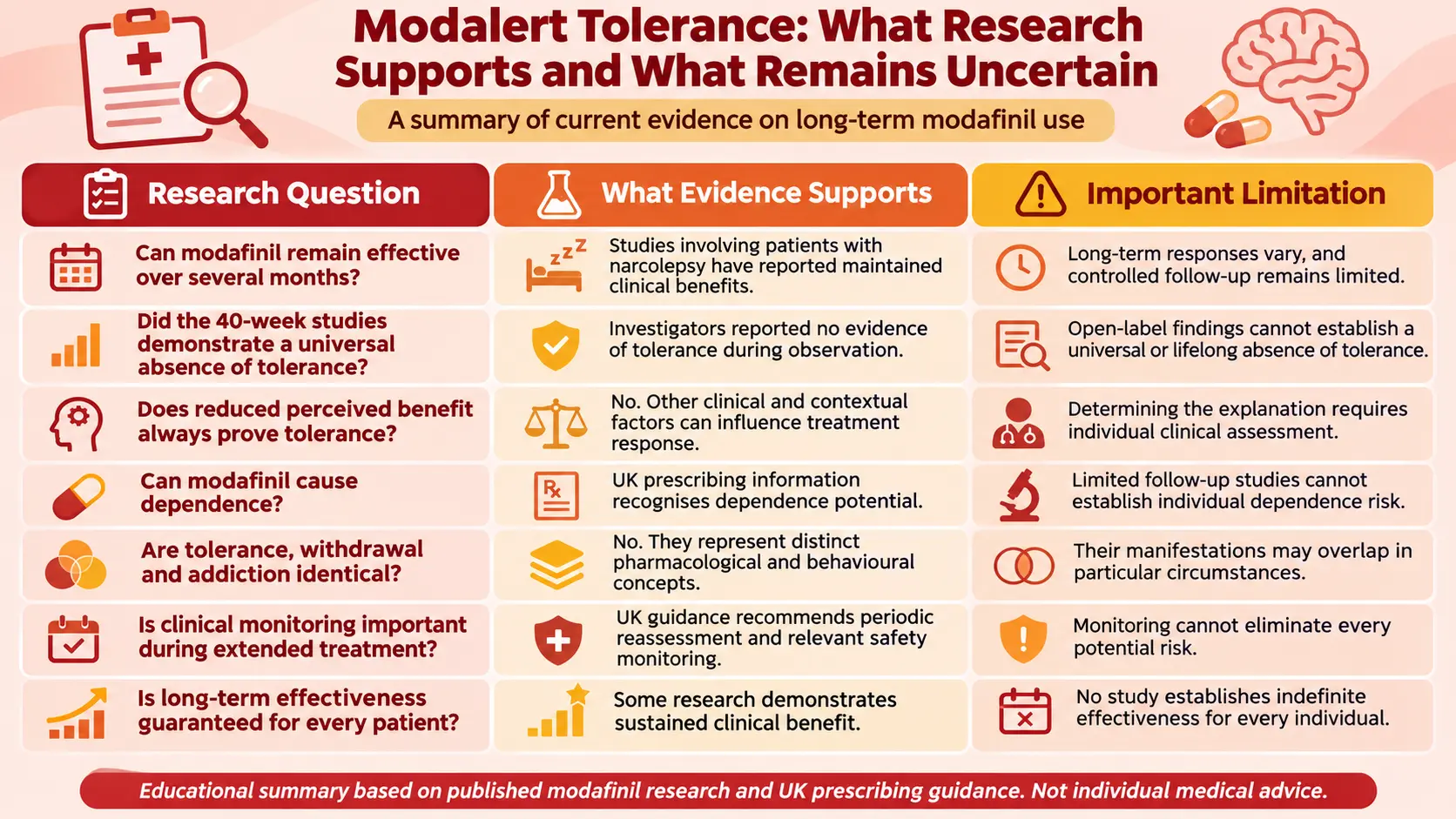
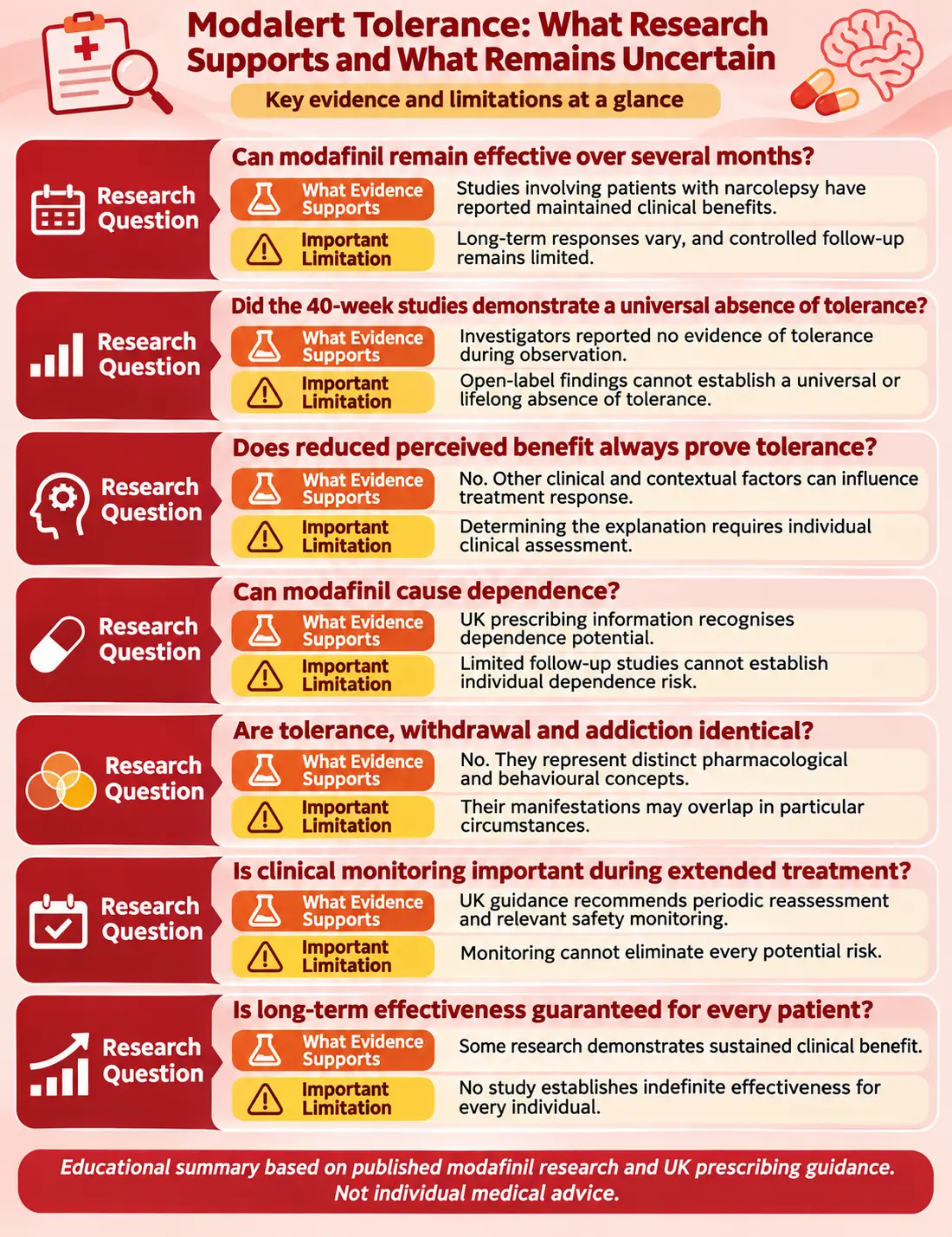
The following comparison summarises the main findings and limitations of the available clinical evidence.
|
Research Question |
What Evidence Supports |
Important Limitation |
|
Can modafinil remain effective over several months? |
Studies involving patients with narcolepsy have reported maintained clinical benefits. |
Long-term responses vary, and controlled follow-up remains limited. |
|
Did the 40-week studies demonstrate a universal absence of tolerance? |
Investigators reported no evidence of tolerance during observation. |
Open-label findings cannot establish a universal or lifelong absence of tolerance. |
|
Does reduced perceived benefit always prove tolerance? |
No. Other clinical and contextual factors can influence treatment response. |
Determining the explanation requires individual clinical assessment. |
|
Can modafinil cause dependence? |
UK prescribing information recognises dependence potential. |
Limited follow-up studies cannot establish individual dependence risk. |
|
Are tolerance, withdrawal and addiction identical? |
No. They represent distinct pharmacological and behavioural concepts. |
Their manifestations may overlap in particular circumstances. |
|
Is clinical monitoring important during extended treatment? |
UK guidance recommends periodic reassessment and relevant safety monitoring. |
Monitoring cannot eliminate every potential risk. |
|
Is long-term effectiveness guaranteed for every patient? |
Some research demonstrates sustained clinical benefit. |
No study establishes indefinite effectiveness for every individual. |
Why Periodic Clinical Reassessment Matters
Long-term modafinil treatment requires more than continuing a medicine because it previously produced a favourable response.
Clinical reassessment considers whether treatment remains appropriate for the underlying condition.
For example, clinicians review excessive daytime sleepiness, ongoing treatment benefits and changes in everyday functioning.
They also consider potential adverse effects, relevant physical and mental health developments, and interactions with other medicines.
Furthermore, a changed treatment response does not necessarily establish tolerance. Equally, maintained effectiveness does not remove the need for clinical oversight.
Periodic reassessment therefore provides a structured way to interpret changes over time.
This approach reflects the uncertainties surrounding individual long-term responses without assuming that treatment will inevitably lose effectiveness or remain beneficial indefinitely.
Frequently Asked Questions About Long-Term Modafinil Use
Can People Develop Tolerance to Modalert?
The possibility of modalert tolerance cannot be excluded, although longer clinical studies have reported maintained effectiveness in some patients with narcolepsy. Current evidence does not establish that everyone develops tolerance or that modafinil is entirely tolerance-free. Importantly, most published investigations examine modafinil as an active ingredient rather than the Modalert brand specifically.
Does Modafinil Stop Working After Long-Term Use?
Not necessarily. Clinical studies have reported sustained improvements in excessive daytime sleepiness over several months of modafinil treatment. However, individual responses vary, and existing research does not guarantee indefinite effectiveness. Changes in sleep circumstances, underlying symptoms or other health-related factors may also influence perceived treatment benefits.
Is Modalert Tolerance the Same as Dependence?
No. Tolerance describes a reduced pharmacological response following repeated exposure, whereas physical dependence involves physiological adaptation that may become apparent when exposure changes. Addiction represents another distinct concept involving problematic substance use. UK prescribing information recognises that dependence potential during prolonged modafinil treatment cannot be entirely excluded.
Can Stopping Modafinil Cause Withdrawal Symptoms?
Withdrawal-related symptoms and the recurrence of underlying excessive daytime sleepiness require different interpretations. In patients with narcolepsy, increased sleepiness after discontinuation may reflect the return of the condition being treated. Available evidence does not establish that a particular withdrawal syndrome occurs in every patient, nor does it justify excluding withdrawal-related concerns entirely.
Why Does Long-Term Modafinil Treatment Require Medical Monitoring?
Clinical monitoring helps assess whether treatment continues to provide meaningful benefits while identifying relevant safety concerns. UK prescribing information recommends periodic reassessment and monitoring of cardiovascular health, psychiatric symptoms and other clinically significant developments. This remains important because individual responses may change and existing studies do not establish lifelong effectiveness or an absence of long-term risks.
References and Further Reading
- Electronic Medicines Compendium.
Modafinil 200 mg Tablets: Summary of Product Characteristics. Aurobindo Pharma Milpharm Ltd.
Relevant sections include therapeutic indications, long-term treatment reassessment, warnings, precautions and interactions.
- Mitler MM, Harsh J, Hirshkowitz M, Guilleminault C. (2000).
Sleep Medicine, 1(3), 231–243.
DOI: 10.1016/S1389-9457(00)00031-9
- Moldofsky H, Broughton RJ, Hill JD. (2000).
A randomized trial of the long-term, continued efficacy and safety of modafinil in narcolepsy.
Sleep Medicine, 1(2), 109–116.
DOI: 10.1016/S1389-9457(99)00014-3
- Besset A, Chetrit M, Carlander B, Billiard M. (1996).
Use of modafinil in the treatment of narcolepsy: a long term follow-up study.
Neurophysiologie Clinique/Clinical Neurophysiology, 26(1), 60–66.
DOI: 10.1016/0987-7053(96)81535-8
- Medicines and Healthcare products Regulatory Agency (MHRA).
Modafinil (Provigil): Now Restricted to Narcolepsy.
Drug Safety Update. Article dated March 2011; published on GOV.UK on 11 December 2014
Final Thoughts: Modalert, Sleep Quality and Timing
Current research indicates that modafinil can maintain wakefulness-promoting effectiveness over several months in some patients with narcolepsy.
The 40-week open-label extension studies reported no evidence of tolerance during their observation period. However, their design and duration do not establish that tolerance can never occur.
Furthermore, tolerance, physical dependence, withdrawal and addiction represent different concepts and should not be treated interchangeably.
UK prescribing information recognises dependence potential and recommends periodic reassessment during extended treatment.
Overall, the available evidence supports a balanced conclusion: sustained effectiveness is possible, but individual responses and longer-term uncertainties remain important.
Continued modafinil treatment therefore requires appropriately qualified clinical assessment rather than assumptions based solely on general research findings.