

Educational and Medical Disclaimer
This article examines modalert sleep effects using published medical research and official UK guidance. It provides general educational information, not individual medical advice or treatment recommendations. Modafinil is a Prescription-Only Medicine in the UK, and its appropriate use requires assessment by a qualified healthcare professional. This article does not recommend using medication to change sleep patterns or replace adequate rest.
Modalert sleep concerns often centre on a straightforward question: can a medicine that promotes daytime wakefulness also affect nighttime rest?
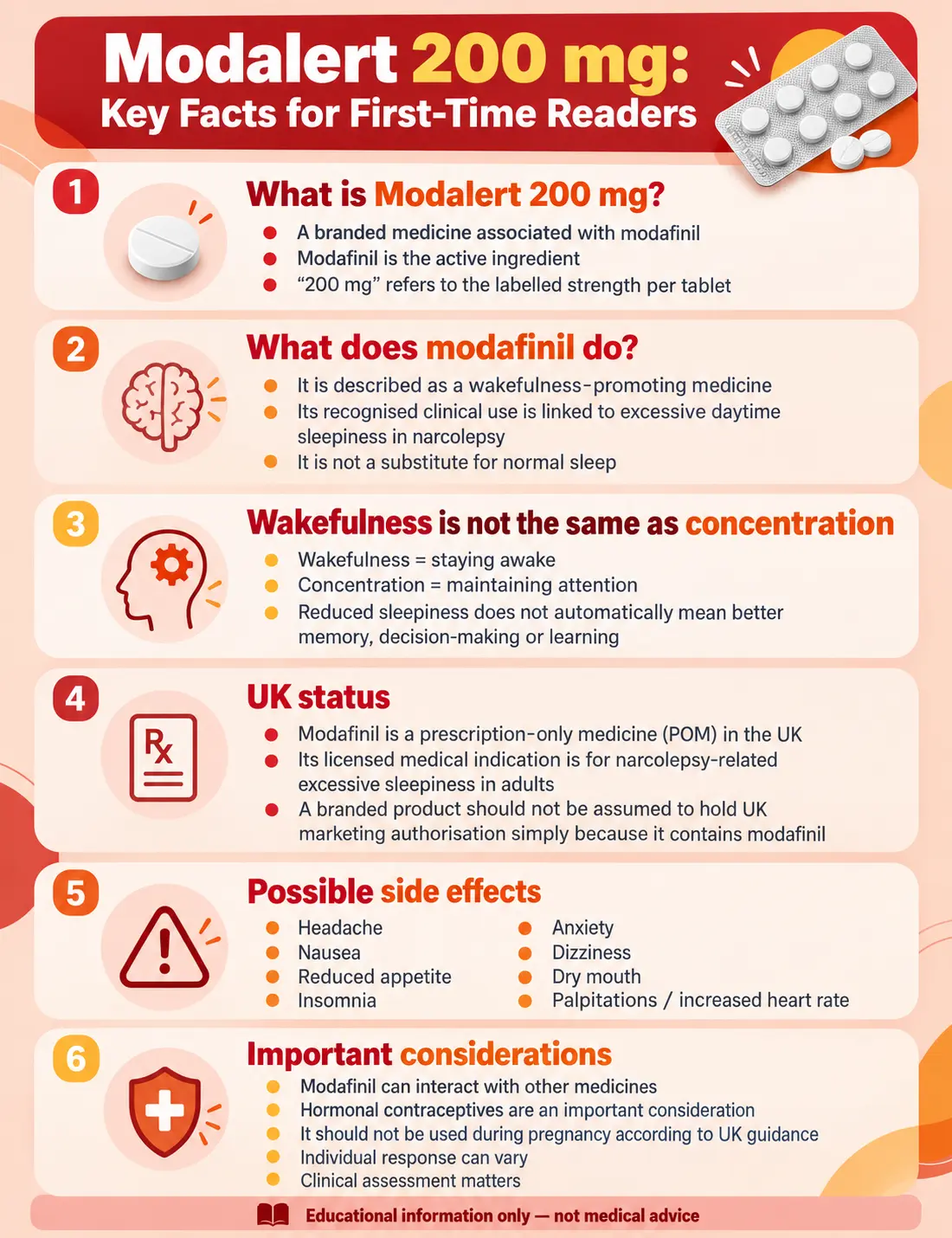
Modalert contains modafinil, a prescription medicine that helps manage excessive daytime sleepiness associated with narcolepsy.
However, clinical research provides a more complex picture than simply suggesting that modafinil prevents or preserves normal sleep.
Insomnia is a recognised possible adverse effect. In contrast, some studies involving patients with narcolepsy have found no significant overall deterioration in measured nighttime sleep.
Understanding these findings requires examining sleep timing, sleep continuity, individual responses and the methods researchers use to assess sleep quality.
Understanding how modafinil affects sleep is one part of evaluating the medicine’s overall clinical profile. Our Modalert uses and safety guide provides additional information about its medical uses, potential risks and UK prescription rules.
Can Modalert Sleep Effects Influence Nighttime Rest?
Daytime wakefulness and nighttime sleep are closely connected. However, they represent different physiological outcomes.
Modafinil promotes alertness by influencing brain systems that regulate wakefulness. Its established clinical purpose is to reduce excessive daytime sleepiness in adults with narcolepsy.
Nevertheless, increased alertness does not automatically reveal what happens when someone subsequently attempts to sleep.
Researchers distinguish several aspects of nighttime rest:
- Sleep onset: How easily a person falls asleep after attempting to sleep.
- Sleep maintenance: Whether sleep continues without frequent or prolonged interruptions.
- Sleep duration: The total amount of time someone spends asleep.
- Sleep quality: How restorative or satisfactory sleep feels, alongside measurable sleep characteristics.
These outcomes can change independently.
For example, someone may fall asleep quickly but experience repeated nighttime awakenings. Another person may sleep continuously yet wake feeling unrefreshed.
Therefore, increased daytime wakefulness does not necessarily mean insomnia will occur. Similarly, feeling alert during the day does not prove that nighttime sleep remains unaffected.
Wakefulness also differs from cognitive performance. For a closer examination of this distinction, see Does Modalert Improve Focus or Just Wakefulness?.
How Modafinil Interacts With the Sleep-Wake System
Several interacting brain networks regulate wakefulness rather than one isolated chemical process.
Modafinil influences central nervous system activity, including dopamine-related signalling associated with alertness. Research also indicates interactions with wider networks that help maintain wakefulness.
However, researchers have not fully established its precise mechanism of action.
The UK Summary of Product Characteristics for modafinil acknowledges this uncertainty.
Consequently, pharmacologically increased wakefulness should not be confused with the body’s natural regulation of sleeping and waking.
For general educational background about the medicine and its formulation, see Modalert 200 mg: What First-Time Users Should Know.
Two biological processes are especially relevant to understanding how sleep and wakefulness interact.
Sleep Pressure and the Need for Rest
Homeostatic sleep pressure describes the biological drive to sleep that increases during prolonged wakefulness.
Generally, the longer someone remains awake, the stronger this pressure becomes. Normal sleep subsequently helps reduce it.
Although modafinil can reduce perceived sleepiness, this does not mean the body’s underlying requirement for sleep disappears.
As a result, someone may feel more alert despite obtaining insufficient restorative rest.
This distinction explains why wakefulness-promoting medicines cannot replace normal sleep.
Circadian Rhythm and Day-Night Timing
The circadian rhythm is the body’s internal timing system, which operates on an approximately 24-hour cycle.
It helps coordinate sleepiness, alertness, body temperature and hormone activity.
Environmental light plays an important role in keeping this rhythm aligned with the natural day-night cycle.
However, modafinil’s wakefulness-promoting effects differ from the biological processes that regulate the circadian clock.
Current evidence does not establish that modafinil reliably resets or corrects the body’s internal timing system.
Instead, sleep timing reflects several interacting factors, including circadian signals, accumulated sleep pressure, behaviour and individual physiology.
Modalert Sleep Problems: What Is the Evidence for Insomnia?
Insomnia is a recognised adverse effect associated with modafinil.
UK prescribing information classifies insomnia as a common adverse reaction.
In standard UK medicine safety terminology, common generally means an adverse reaction occurs in at least 1% but fewer than 10% of people within the relevant evidence.
However, this classification applies to modafinil-containing medicines and their supporting clinical data. It does not establish a separate insomnia rate specifically for the Modalert brand.
Insomnia can involve several symptoms:
- Difficulty falling asleep.
- Repeated nighttime awakenings.
- Waking earlier than intended.
- Feeling unrefreshed after sleeping.
- Ongoing dissatisfaction with sleep quality.
The NHS also recognises these different presentations of insomnia.
Importantly, a recognised adverse effect does not occur in every individual.
Likewise, the absence of noticeable insomnia does not prove that every aspect of nighttime sleep remains unchanged.
For broader safety information, Modalert Side Effects: What to Know About Safety & Risks explains other potential adverse reactions associated with modafinil.
Why Sleep Responses Differ Between Individuals
Several factors may influence how individuals experience nighttime sleep.
For example, someone with an existing sleep disorder may already experience fragmented rest before receiving treatment.
Baseline sleep quality, personal medicine sensitivity, other medicines, caffeine consumption and stress may also contribute to differences.
Additionally, environmental conditions and established sleep routines can affect sleep onset and continuity.
These overlapping influences make it difficult to determine whether an individual sleep change directly results from modafinil.
Therefore, one person’s experience of sleeping well or poorly cannot establish how Modalert affects everyone.
What Clinical Studies Reveal About Nighttime Sleep
Clinical studies help clarify the relationship between modafinil and nighttime sleep.
However, researchers must distinguish changes in daytime sleepiness from changes in nighttime sleep patterns.
Two studies provide particularly relevant evidence.
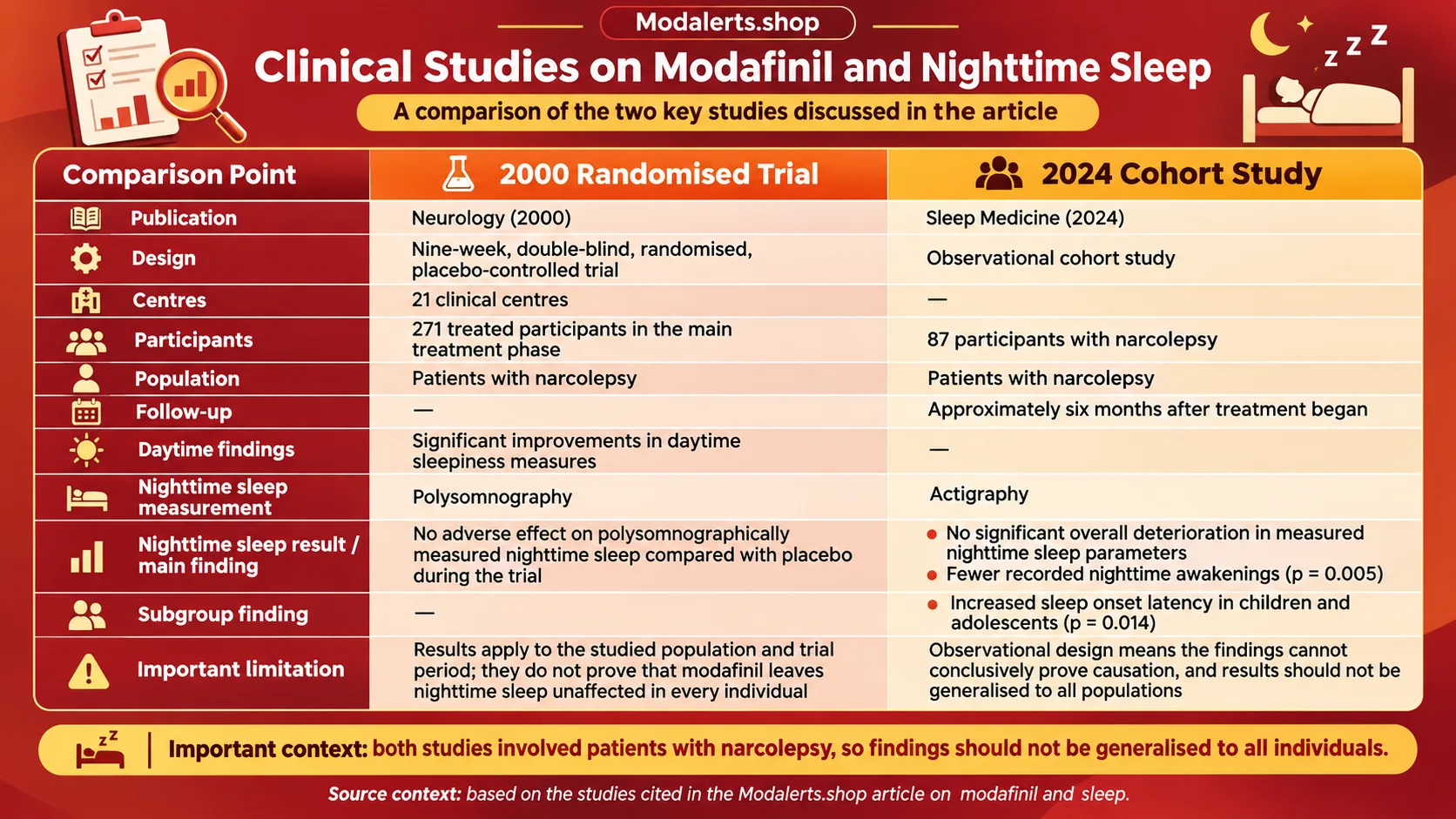
The 2000 Randomised Narcolepsy Trial
A clinical trial published in Neurology in March 2000 examined modafinil in patients with excessive daytime sleepiness associated with narcolepsy.
The researchers conducted a nine-week, double-blind, randomised, placebo-controlled trial across 21 clinical centres.
A total of 271 participants received study medication during the main treatment phase.
Researchers measured daytime sleepiness using recognised assessments, including:
- Multiple Sleep Latency Test.
- Maintenance of Wakefulness Test.
- Epworth Sleepiness Scale.
The findings showed significant improvements in daytime sleepiness measures among participants receiving modafinil.
Importantly, the researchers also examined nighttime sleep using polysomnography, a clinical method that records physiological activity during sleep.
They reported no adverse effect on polysomnographically measured nighttime sleep compared with placebo during the trial.
Therefore, increased daytime wakefulness did not necessarily coincide with measurable deterioration in nighttime sleep under these study conditions.
However, the trial involved patients with narcolepsy over a defined period.
Its findings cannot establish that modafinil leaves nighttime sleep unaffected in every individual or population.
Research source: Randomized trial of modafinil as a treatment for the excessive daytime somnolence of narcolepsy (2000).
The 2024 Study of Nocturnal Sleep Patterns
A cohort study published in Sleep Medicine in July 2024 examined nighttime sleep patterns among patients with narcolepsy receiving modafinil.
The observational study included 87 participants with narcolepsy.
Researchers assessed sleep before treatment and approximately six months after treatment began.
Unlike the 2000 trial, this study used actigraphy.
Actigraphy involves wearable movement sensors that estimate sleep-wake patterns across several days.
The researchers also assessed subjective sleepiness and quality of life through questionnaires.
Overall, participants showed improvements in excessive daytime sleepiness without significant deterioration in the nighttime sleep parameters measured through actigraphy.
Notably, the researchers recorded fewer nighttime awakenings, with a statistically significant result of p = 0.005.
However, subgroup results differed.
Children and adolescents showed increased sleep onset latency, meaning they took longer to fall asleep. This finding reached statistical significance at p = 0.014.
UK prescribing information does not support modafinil use in people under 18 because of safety and efficacy concerns.
Furthermore, the study did not include a randomised placebo-controlled comparison.
Consequently, researchers could identify changes over time but could not conclusively attribute every change to modafinil itself.
These modalert sleep findings also require an important qualification: the study investigated modafinil in patients with narcolepsy, not a separate Modalert-branded treatment group.
The results therefore cannot establish improved sleep continuity in people without narcolepsy.
Research source: Effects of modafinil on nocturnal sleep patterns in patients with narcolepsy: A cohort study (2024).
What the Studies Cannot Establish
Both studies contribute useful evidence, but their limitations matter.
First, they examined patients with narcolepsy. This condition often involves disrupted nighttime sleep, so the findings may not apply to people without diagnosed sleep disorders.
Second, the studies used different research designs and observation periods.
Randomised controlled trials provide stronger evidence for identifying treatment-related effects. In contrast, observational research identifies associations without establishing the same level of causal certainty.
Third, the measurement methods differed.
The 2000 study used polysomnography, while the 2024 cohort used movement-based actigraphy.
Additionally, subgroup findings require careful interpretation because sample size and participant characteristics can influence results.
An absence of significant overall deterioration also does not mean no individual experienced disturbed sleep.
Taken together, the evidence indicates that modafinil does not necessarily worsen measured nighttime sleep in patients with narcolepsy, even though insomnia remains a recognised possible adverse effect.

Understanding Sleep Onset, Duration and Quality
Researchers use several terms when examining modafinil sleep quality.
Although related, these measurements describe different aspects of rest.
Sleep onset latency measures the time between attempting to fall asleep and actually falling asleep.
A longer sleep onset latency may indicate difficulty initiating sleep. However, its interpretation depends on the circumstances and measurement method.
Total sleep time describes how much time someone actually spends asleep.
This differs from time spent in bed. For example, remaining in bed for eight hours does not necessarily mean someone slept for the entire period.
Sleep continuity describes how consistently sleep continues after it begins.
Researchers may assess the number of awakenings and the time spent awake after initially falling asleep.
Sleep quality covers a broader range of experiences and measurements.
It includes perceived restfulness, satisfaction with sleep and measurable features such as sleep continuity and sleep architecture.
Consequently, bedtime and waking time alone cannot establish the full physiological quality of sleep.
Does Modafinil's Half-Life Predict Sleep Disturbance?
Elimination half-life describes the approximate time the body takes to reduce a medicine’s concentration by half during elimination.
UK prescribing information reports an effective elimination half-life of approximately 15 hours after repeated modafinil administration.
However, this measurement does not directly establish how long wakefulness or sleep disturbance will continue.
Blood concentration, perceived alertness and nighttime sleep quality represent different outcomes.
Additionally, individual metabolism, sensitivity and underlying sleep conditions may influence how these outcomes relate to one another.
A measurable amount of medicine remaining in the body does not necessarily indicate the strength of its ongoing effects.
Similarly, decreasing blood concentrations do not guarantee that sleep onset or continuity will remain unaffected.
Therefore, the modafinil half-life provides useful information about how the body processes the medicine but cannot independently predict insomnia duration.
Understanding modalert sleep effects requires considering the broader sleep-wake system rather than relying on half-life alone.
How Researchers Measure Changes in Sleep
Researchers use different methods to assess nighttime sleep.
Each method provides useful information, but none captures every aspect of sleep independently.
Polysomnography
Polysomnography is a clinical sleep investigation that records several physiological signals.
These commonly include brain electrical activity, eye movements, muscle activity, breathing and blood oxygen levels.
Researchers use this information to identify sleep stages, interruptions and certain sleep-related abnormalities.
Because polysomnography measures physiological activity directly, it provides detailed information about sleep architecture.
However, laboratory investigations generally cover limited observation periods and may not fully represent someone’s normal home environment.
Actigraphy
Actigraphy uses a wearable movement sensor, usually worn on the wrist, to estimate activity and rest periods.
Researchers commonly use this method to observe sleep timing and regularity across several days or weeks.
However, actigraphy does not directly record brain activity.
For example, the device may sometimes classify quiet wakefulness as sleep. Movement during sleep can also influence estimates of nighttime awakenings.
Consequently, actigraphy cannot reliably identify every sleep stage or reproduce all the physiological information obtained through polysomnography.
Sleep Diaries and Patient-Reported Outcomes
Sleep diaries capture personal observations about bedtime, sleep onset, nighttime awakenings and morning restfulness.
Questionnaires can also assess daytime sleepiness and perceived sleep quality.
These methods help researchers understand the subjective experience of sleep.
For example, someone may report feeling unrefreshed despite an objective assessment showing no major reduction in sleep duration.
Conversely, another person may feel satisfied with their sleep despite measurable interruptions.
Therefore, combining subjective reports with objective measurements provides a more complete interpretation.
Consumer sleep trackers may help identify personal patterns, but they cannot independently diagnose sleep disorders or replace a clinical sleep investigation.
Why Healthy Sleep Habits Still Matter
Modafinil’s wakefulness-promoting effects do not remove the biological importance of sufficient sleep.
UK prescribing information specifically states that modafinil is not a replacement for sleep and recognises the importance of good sleep hygiene.
Healthy sleep habits include regular sleep routines, suitable sleeping conditions and reducing avoidable environmental disturbances.
Additionally, caffeine can influence sleep, particularly when its alerting effects overlap with normal rest periods.
The NHS insomnia guidance provides general information about sleep routines, bedroom conditions and everyday factors that may interfere with rest.
According to the NHS, adults need approximately seven to nine hours of sleep on average, although individual requirements vary.
Persistent difficulty falling asleep, remaining asleep or feeling adequately rested may require medical assessment, especially when sleep problems affect daily functioning.
Ultimately, healthy sleep habits support general wellbeing but cannot replace appropriate assessment of an underlying sleep disorder.
What UK Readers Should Understand About Modalert and Sleep
In the United Kingdom, modafinil is a Prescription-Only Medicine (POM).
UK-authorised modafinil products carry an indication for treating excessive sleepiness associated with narcolepsy in adults, with or without cataplexy.
The Medicines and Healthcare products Regulatory Agency (MHRA) confirmed the restriction of modafinil’s authorised indication to narcolepsy following a European regulatory review.
However, regulatory authorisation applies to specific medicinal products.
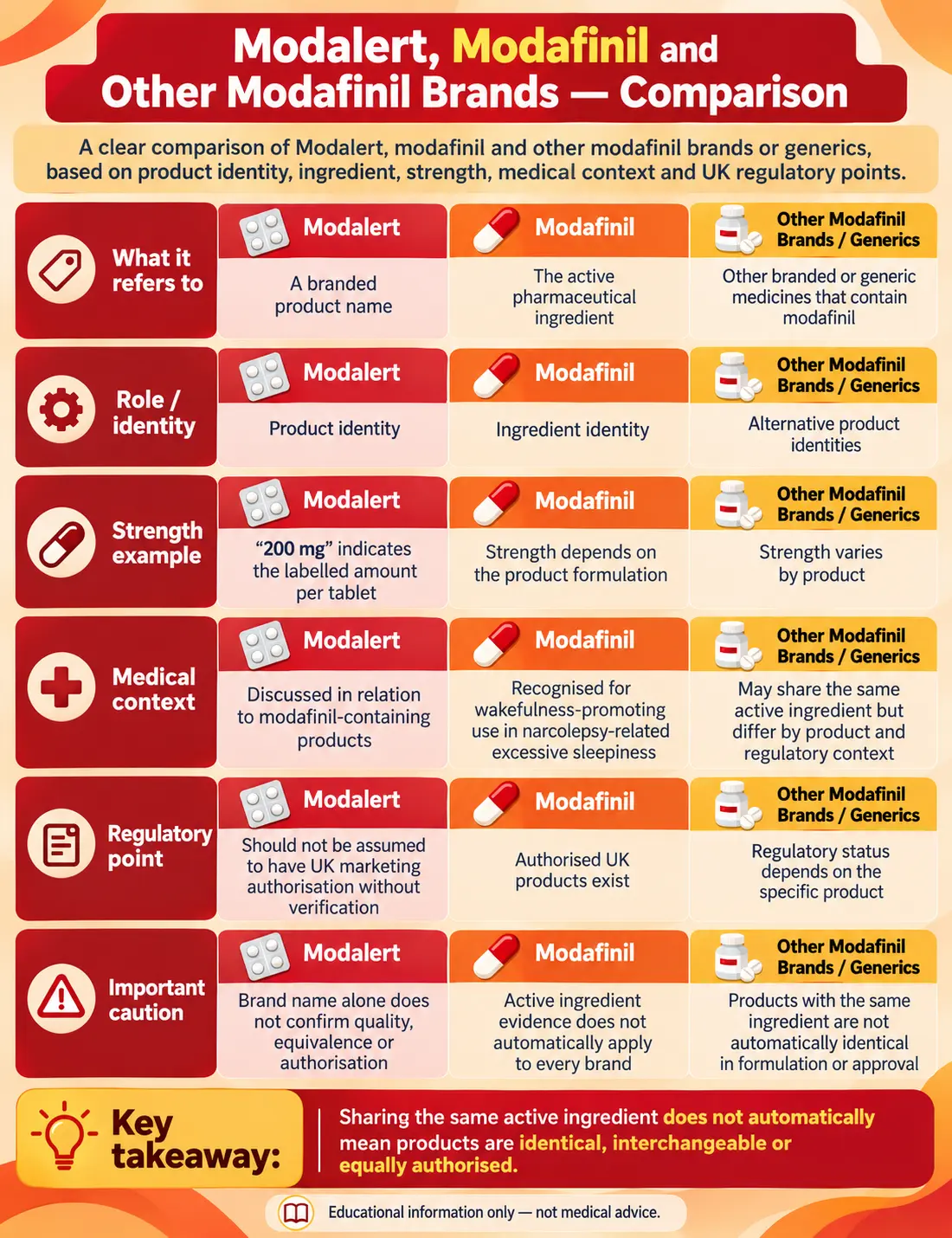
Modalert contains modafinil, but the UK marketing authorisation of one modafinil-containing product does not establish that the Modalert brand itself holds equivalent authorisation.
This distinction also matters when interpreting scientific evidence.
Most published findings concerning modafinil and nighttime sleep relate to the active ingredient rather than independent studies of the Modalert brand.
For further regulatory context, Is Modalert Legal in the UK? Prescription Rules & Regulations Explained examines prescription requirements and the wider UK legal framework.
Regardless of brand, wakefulness-promoting medicines cannot replace adequate sleep. Significant or persistent sleep disturbances also require appropriate professional assessment.
Modalert Sleep Effects: What Research Supports
The available evidence becomes clearer when established findings are separated from their scientific limitations.
|
Sleep-Related Question |
What Evidence Supports |
Important Limitation |
|
Does modafinil promote daytime wakefulness? |
Clinical research establishes wakefulness-promoting effects in relevant populations, including adults with narcolepsy. |
Increased alertness does not replace adequate sleep. |
|
Is insomnia a recognised adverse effect? |
Yes. Official UK prescribing information classifies insomnia as common. |
Individual responses vary, and this is not a separate Modalert-specific incidence rate. |
|
Does modafinil always disrupt nighttime sleep? |
Clinical studies do not support a universal claim of nighttime disruption. |
Findings depend on the population, study design and measurement methods. |
|
Can sleep onset change? |
The 2024 cohort found increased sleep onset latency among children and adolescents. |
This subgroup finding does not establish the same effect in all individuals. |
|
Does modafinil affect sleep continuity? |
The 2024 cohort recorded fewer actigraphy-estimated nighttime awakenings. |
Observational findings cannot establish causation or universal improvement. |
|
Does elimination half-life determine sleep quality? |
Researchers have not established a direct one-to-one relationship. |
Blood concentration alone cannot predict sleep onset or continuity. |
|
Can wearable trackers fully measure sleep architecture? |
No. Actigraphy primarily estimates sleep-wake patterns using movement. |
It does not directly record brain sleep stages. |
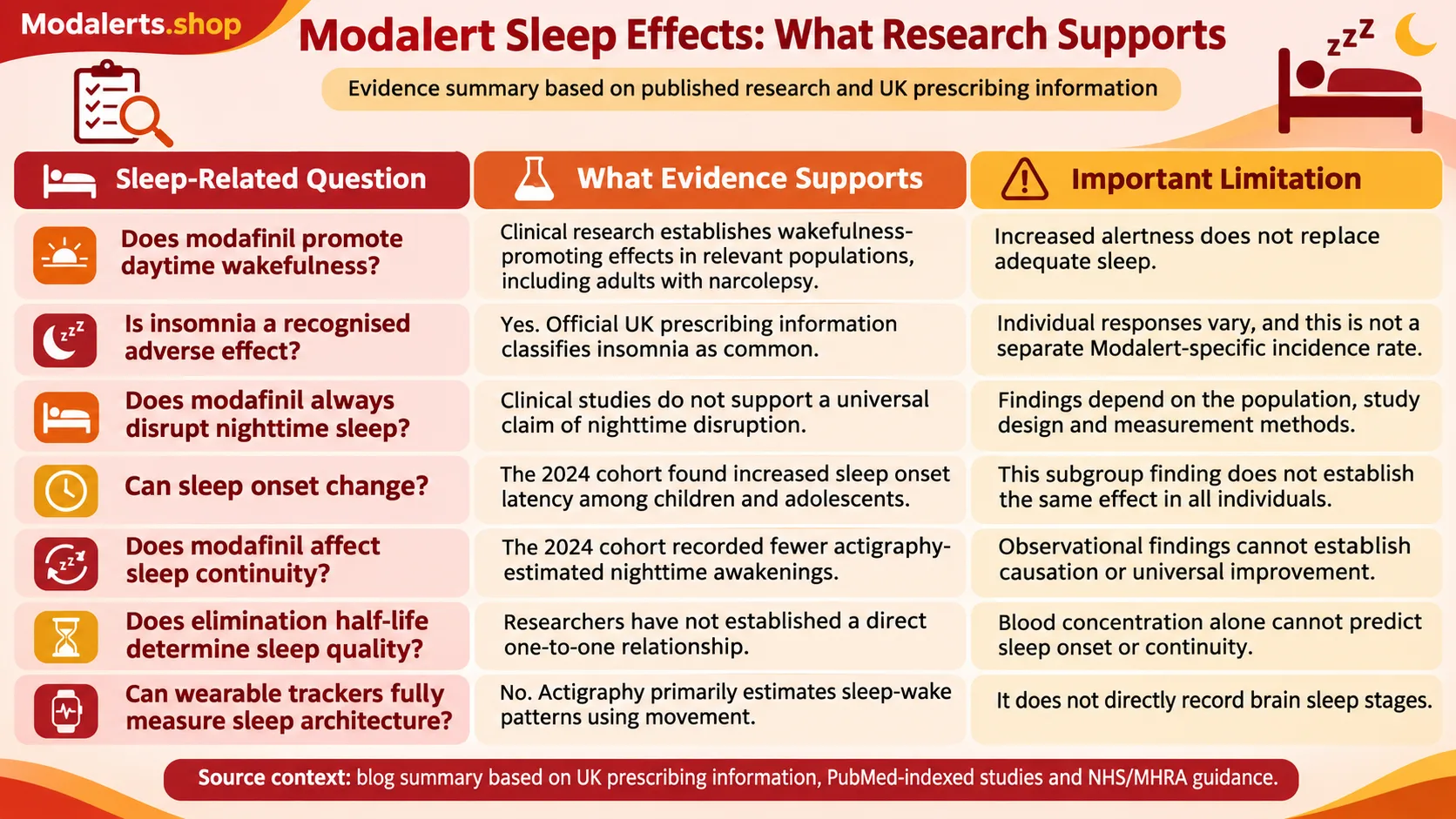
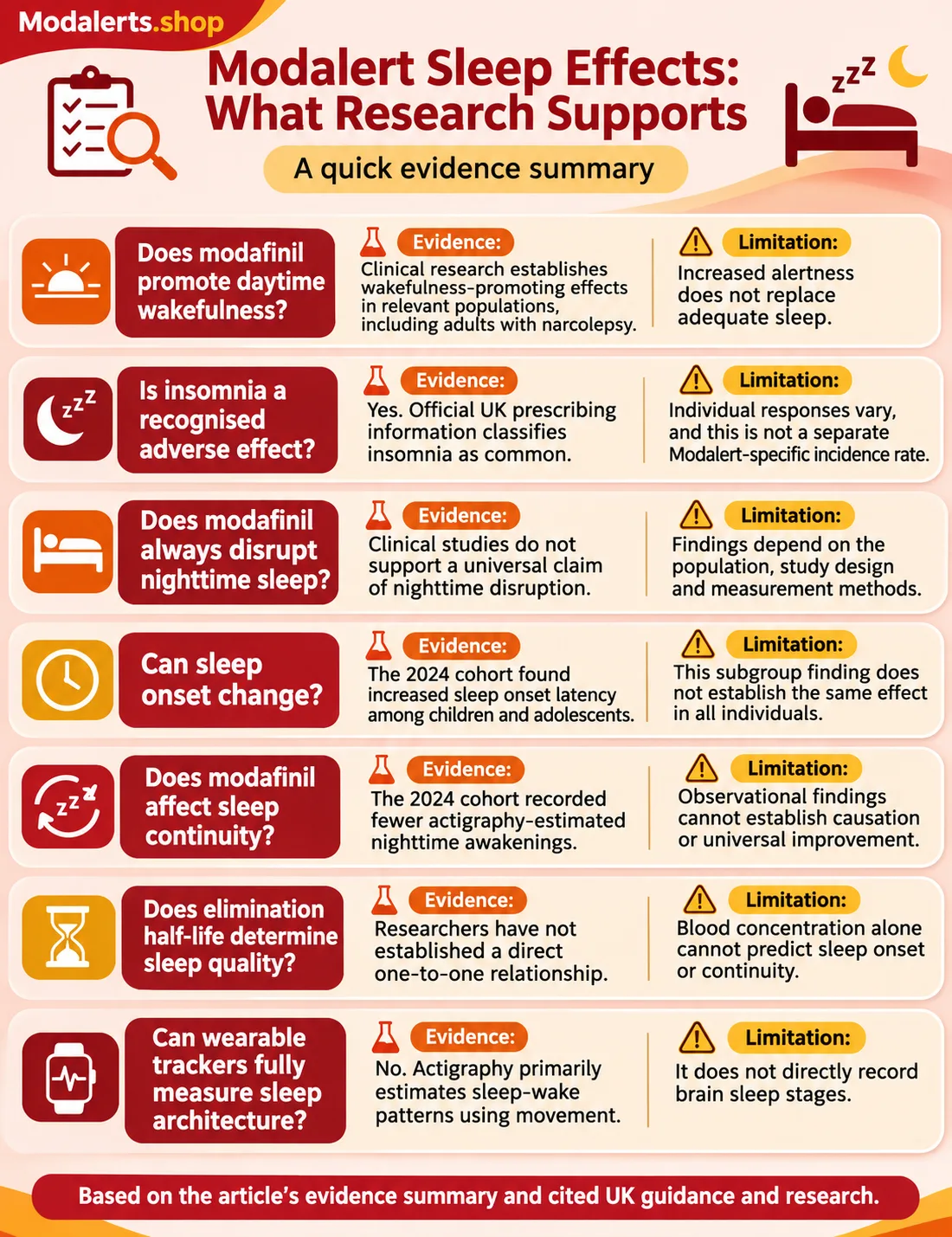
Overall, research provides useful evidence about modafinil and nighttime sleep. However, study populations, individual differences and measurement limitations prevent universal conclusions about Modalert.
Frequently Asked Questions About Modalert and Sleep
Can Modalert Cause Insomnia?
Yes. Modalert contains modafinil, and UK prescribing information identifies insomnia as a common possible adverse effect of this active ingredient. However, not everyone experiences difficulty sleeping. Individual responses may differ because of existing sleep conditions, personal sensitivity and other influences on nighttime rest. The official classification does not establish a separate insomnia rate for Modalert.
Does Modalert Affect Sleep Quality?
Modafinil may influence sleep experiences, but research does not establish a consistent effect on sleep quality across all individuals. Some clinical studies involving patients with narcolepsy found no significant overall deterioration in measured nighttime sleep. However, sleep onset, nighttime awakenings and perceived restfulness can vary. These modalert sleep findings mainly reflect research on modafinil rather than independent brand-specific trials.
Does Modafinil Change the Body's Sleep-Wake Cycle?
Modafinil increases wakefulness through effects on central nervous system activity. However, increased alertness does not mean the medicine directly resets the circadian rhythm. Sleep-wake regulation involves internal biological timing, accumulated sleep pressure and environmental influences. Current research does not establish that modafinil reliably corrects or resets the body’s natural internal clock.
Can Someone Still Feel Tired While Taking Modafinil?
Yes. Modafinil can reduce excessive daytime sleepiness in relevant clinical populations, but it does not remove every possible cause of tiredness. Fatigue and sleepiness are also different experiences. Insufficient sleep, fragmented nighttime rest and underlying health conditions can contribute to ongoing fatigue. Feeling more alert does not necessarily indicate that the body has obtained adequate restorative sleep.
Does Modafinil Replace the Need for Normal Sleep?
No. Modafinil promotes wakefulness but does not remove the biological requirement for sufficient sleep. Official UK prescribing information explicitly states that modafinil is not a replacement for sleep. Normal sleep supports essential physiological processes, and reduced perceived sleepiness does not prove those needs have been met. Adequate sleep remains important regardless of daytime alertness.
References and Further Reading
- UK Summary of Product Characteristics Modafinil
Electronic Medicines Compendium. Modafinil 200 mg Tablets: Summary of Product Characteristics.
- Randomised Clinical Trial 2000
US Modafinil in Narcolepsy Multicenter Study Group. Randomized trial of modafinil as a treatment for the excessive daytime somnolence of narcolepsy. Neurology. 2000;54(5):1166–1175.
- Nocturnal Sleep Cohort Study 2024
Chin WC, et al. Effects of modafinil on nocturnal sleep patterns in patients with narcolepsy: A cohort study. Sleep Medicine. 2024;119:95–102.
- NHS Insomnia
National Health Service. Insomnia: Symptoms, Causes and Sleep Guidance.
- MHRA Modafinil Regulatory Restrictions
Medicines and Healthcare products Regulatory Agency. Modafinil (Provigil): Now Restricted to Narcolepsy. Drug Safety Update.
Final Thoughts: Modalert, Sleep Quality and Timing
Modafinil has established wakefulness-promoting effects in relevant clinical populations, particularly adults with narcolepsy.
However, daytime alertness and nighttime sleep quality represent different physiological outcomes.
Insomnia remains a recognised possible adverse effect. At the same time, clinical studies involving patients with narcolepsy have not consistently found significant overall deterioration in measured nighttime sleep.
These findings are not necessarily contradictory.
Instead, they reflect differences between individual experiences, research populations and the methods used to measure sleep.
The evidence cannot establish that Modalert always disrupts nighttime rest or consistently preserves sleep quality.
For modalert sleep research, the central conclusion is that increased wakefulness does not remove the body’s underlying need for sufficient sleep.