
Educational and Medical Disclaimer
This article examines the question “does modalert improve focus” using published medical and scientific research. The information is for educational purposes only and does not constitute medical advice or recommend cognitive enhancement. Modafinil is a Prescription-Only Medicine in the UK. Decisions concerning its clinical use require assessment by an appropriately qualified healthcare professional.
Does Modalert improve focus, or does it mainly help people stay awake? Scientific evidence suggests that the answer depends on how researchers define focus and the circumstances in which they measure cognitive performance.
Modalert contains modafinil, a medicine with established wakefulness-promoting effects. However, research into attention, memory and executive functioning presents a more complex picture, particularly among people who are not sleep-deprived.
Reducing excessive sleepiness may make concentration easier when tiredness interferes with mental performance. Nevertheless, improved alertness does not automatically mean stronger memory, better reasoning or greater productivity.
Understanding the difference requires examining clinical research, objective cognitive tests and the limitations of claims about Modalert and concentration.
Research into modafinil’s effects on attention and wakefulness should be considered alongside its established clinical uses, safety information and prescription requirements. Our Modalert clinical and safety guide explains this broader context for UK readers.
Does Modalert Improve Focus by Increasing Wakefulness?
Wakefulness and concentration are closely connected, but they describe different mental functions.
Wakefulness means remaining awake rather than unintentionally falling asleep. Someone may feel completely awake while still struggling to understand information.
Attention involves directing mental resources towards relevant information. For example, following a conversation in a noisy environment requires selective attention.
Concentration means maintaining attention on an activity over time, such as reading a detailed report without repeatedly losing track.
Executive functioning includes planning, organising information, switching between tasks and controlling responses.
Consider someone working at a computer for several hours. They may remain awake throughout the session yet still overlook details, make errors or struggle to organise their thoughts.
Therefore, the question of whether Modalert improves focus cannot be answered by measuring wakefulness alone.
Greater alertness may create better conditions for mental activity. However, researchers need separate evidence to establish improvements in memory, reasoning and other cognitive abilities.
Why Staying Awake May Make Concentration Easier
Sleepiness can interfere with several abilities that support everyday mental performance.
When people experience insufficient sleep or excessive daytime sleepiness, they may find it harder to maintain attention. Reaction times can slow, brief lapses in vigilance may occur and errors can become more frequent.
Consequently, reducing sleepiness may improve the conditions under which concentration takes place.
For example, someone experiencing pronounced daytime drowsiness may struggle to follow a meeting because their alertness repeatedly declines. If that sleepiness decreases, maintaining engagement may become easier.
However, this represents a potentially indirect benefit.
The person may concentrate more effectively because sleepiness causes fewer interruptions, rather than because their underlying memory or reasoning abilities have improved independently.
This distinction matters when examining modafinil and focus.
Reducing sleep-related impairment is not necessarily the same as enhancing cognitive ability beyond its usual level.
Does Modalert Improve Focus? What Clinical Research Shows
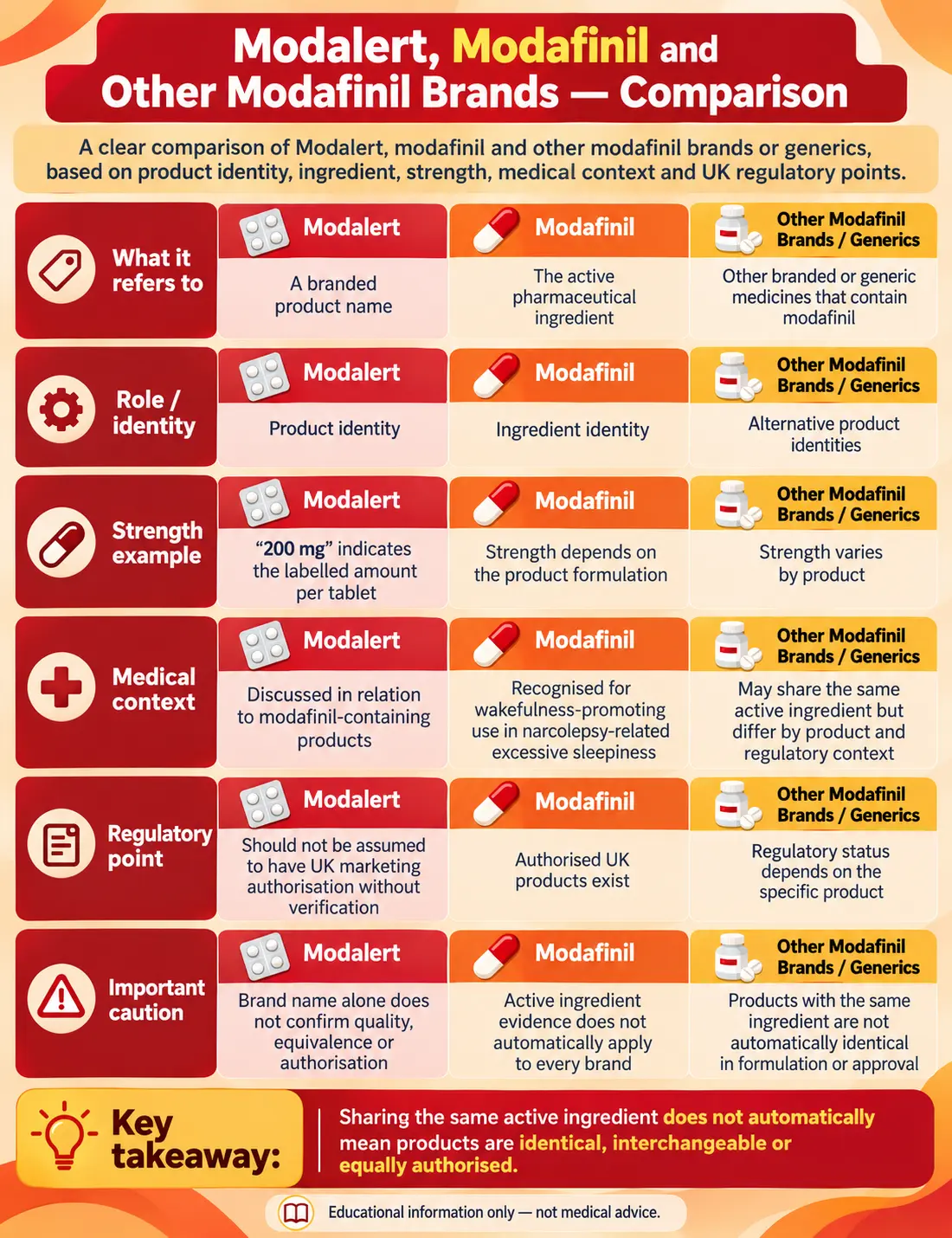
Most clinical studies investigate modafinil as an active ingredient rather than the Modalert brand specifically.
Therefore, findings concerning modafinil should not be interpreted as proof of unique cognitive benefits associated with Modalert.
Researchers have examined three particularly relevant areas: narcolepsy, sleep deprivation and cognitive performance in people who are not sleep-deprived.
Evidence From Adults With Narcolepsy
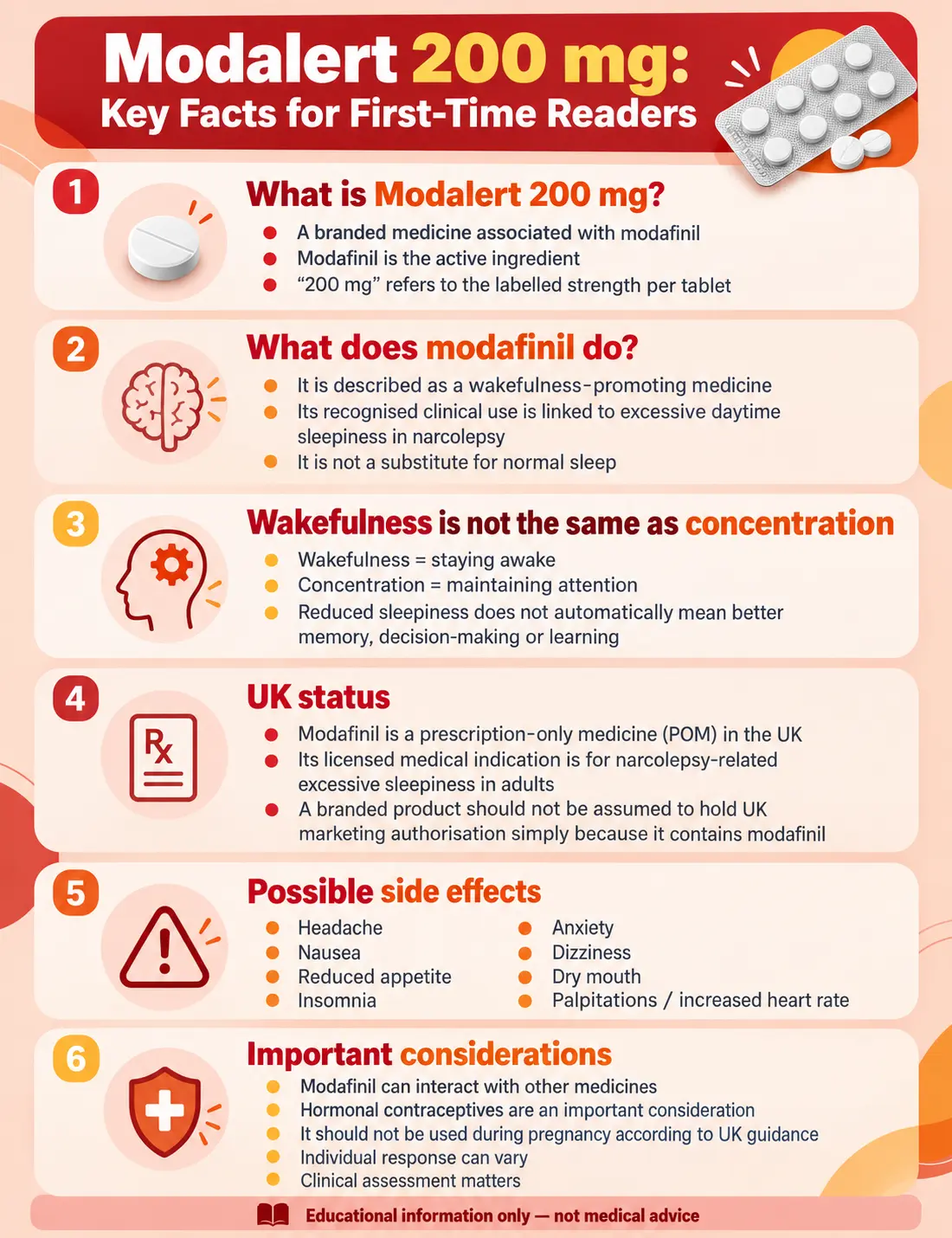
Modafinil has an established clinical role in reducing excessive daytime sleepiness associated with narcolepsy in adults.
The UK Summary of Product Characteristics identifies excessive sleepiness associated with narcolepsy, with or without cataplexy, as its authorised therapeutic indication.
Clinical investigations commonly assess wakefulness using measures such as the Maintenance of Wakefulness Test.
This test evaluates how effectively a person can remain awake under controlled conditions.
Such measurements matter because narcolepsy can substantially disrupt ordinary daytime functioning.
However, greater ability to remain awake does not automatically demonstrate better memory, reasoning, planning or complex decision-making.
Researchers must assess these abilities separately.
Studies Involving Sleep-Deprived Participants
Sleep-deprivation studies provide another perspective on the relationship between modafinil and cognitive performance.
Insufficient sleep can disrupt vigilance, sustained attention and reaction time. Researchers therefore investigate whether wakefulness-promoting medicines influence performance during restricted sleep.
Some studies report favourable results on particular tasks.
However, sleep-deprived participants begin from a different cognitive baseline than people who have slept adequately.
Reducing an impairment associated with sleep loss does not establish that the same medicine will improve cognition to a similar extent in well-rested individuals.
Furthermore, improvements in selected measures do not mean that every consequence of sleep deprivation has disappeared.
Modafinil cannot replace adequate sleep or reproduce all its biological functions.
Does Modalert Improve Focus? Cognitive Research in Non-Sleep-Deprived Adults
Research involving non-sleep-deprived participants offers a more direct way to examine possible cognitive effects beyond the reduction of sleepiness.
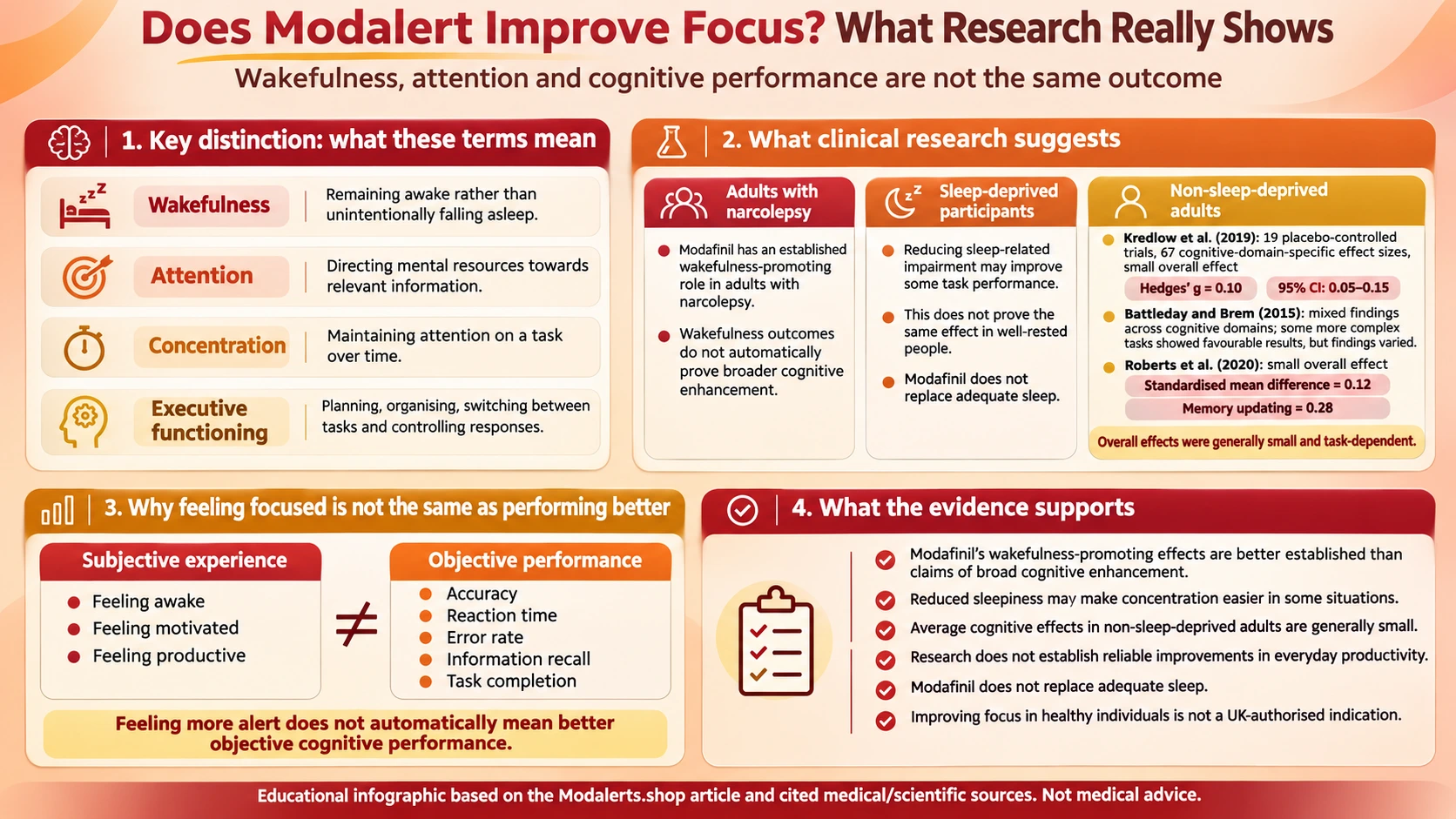
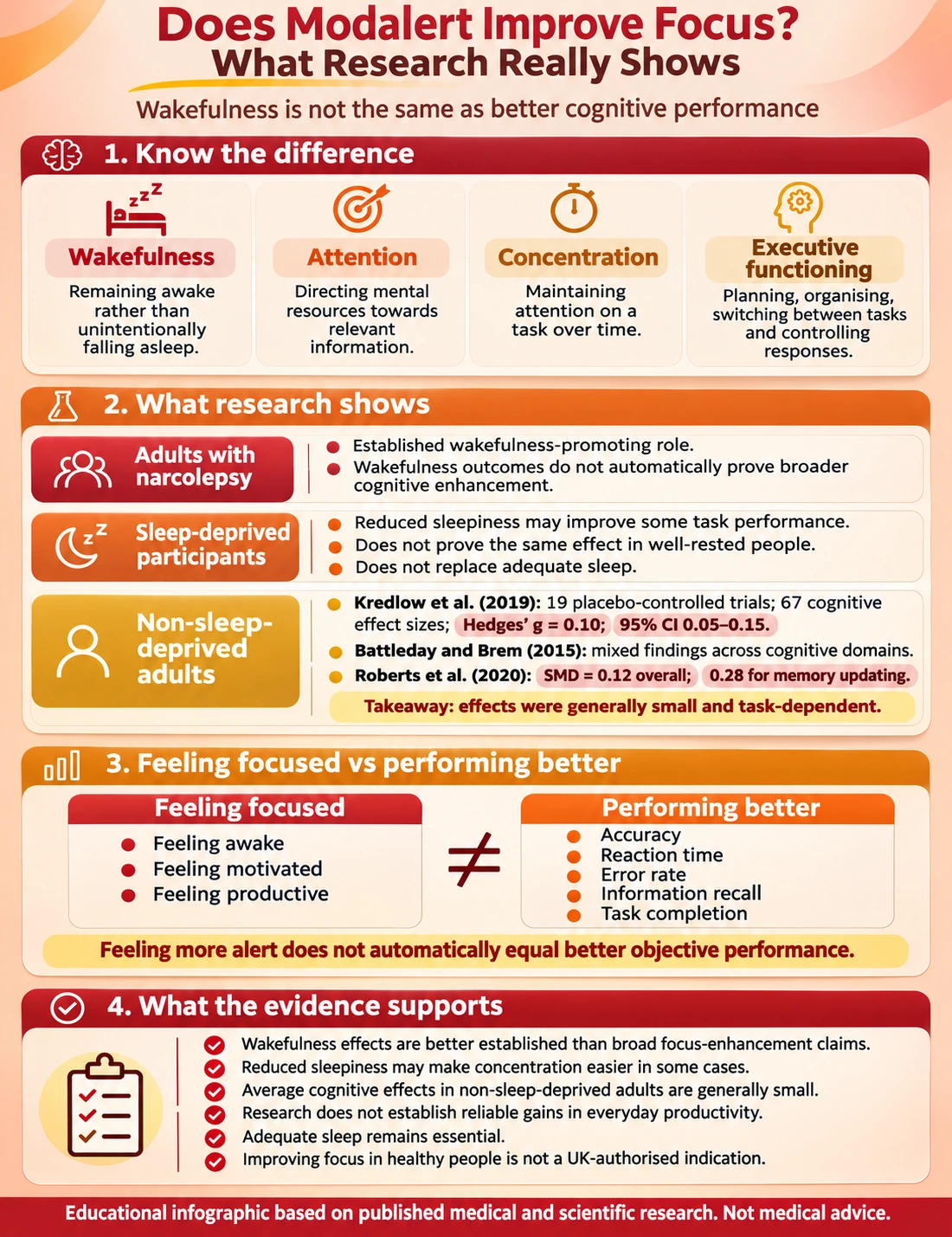
A 2019 systematic review and meta-analysis by Kredlow and colleagues examined 19 placebo-controlled trials involving single-dose modafinil and cognitive performance.
The analysis included non-sleep-deprived adults from both psychiatric and non-psychiatric populations. Therefore, its participants should not all be described as healthy, well-rested adults.
Researchers analysed 67 cognitive-domain-specific effect sizes covering attention, executive functioning, memory and processing speed.
They reported a small overall positive effect:
Hedges’ g = 0.10, with a 95% confidence interval of 0.05–0.15.
Although statistically significant, this result represents a small standardised average difference.
It does not mean that an individual’s concentration improves by 10%. Nor does it establish a noticeable increase in everyday productivity.
The researchers concluded that modafinil showed limited potential for cognitive enhancement outside sleep-deprived populations.
An earlier systematic review by Battleday and Brem in 2015 examined studies involving healthy, non-sleep-deprived participants.
The review identified mixed findings across cognitive domains. Some more complex assessments showed favourable results, while findings on simpler tasks varied.
Additionally, differences in study methods complicated comparisons between experiments.
A 2020 meta-analysis by Roberts and colleagues examined cognitive performance in healthy, non-sleep-deprived adults.
For modafinil, the researchers reported:
- An overall standardised mean difference of 0.12.
- A standardised mean difference of 0.28 for memory updating.
However, the authors emphasised that these relatively small laboratory effects did not support broad claims about substantial cognitive enhancement in everyday settings.
PubMed+2
Together, these reviews suggest that modafinil can influence certain cognitive measures.
Nevertheless, the effects are generally small, vary between tasks and do not establish reliable improvements across every aspect of mental performance.
Does Modalert Improve Focus Across Different Mental Abilities?
When evaluating whether Modalert improves focus, researchers must consider which mental ability an experiment actually measures.
A positive result in one cognitive task does not necessarily demonstrate broader cognitive enhancement.
Sustained Attention and Vigilance
Sustained attention involves maintaining responsiveness over time.
Researchers assess this ability through tasks that require participants to detect signals, monitor information or respond to visual stimuli.
These assessments can reveal lapses in attention and changes in reaction time.
However, detecting signals during a repetitive laboratory experiment differs from writing a complex report or understanding unfamiliar material.
Therefore, stronger vigilance does not automatically establish better performance in demanding everyday activities.
Working Memory and Information Processing
Working memory allows people to temporarily retain and manipulate information.
Mental arithmetic, following multi-step instructions and comparing several pieces of information all involve this ability.
Some modafinil studies report improvements in particular memory-related measures, including memory updating.
Nevertheless, results vary across tasks and participant groups.
An improvement in one component of working memory does not necessarily mean stronger long-term recall or better learning.
This distinction is important when interpreting research on modafinil and memory.
Planning, Decision-Making and Cognitive Flexibility
Executive functioning includes abilities that help people plan activities, manage information and adapt their behaviour.
Researchers investigate these functions through tasks involving rule changes, response control and decision-making.
Some controlled studies identify favourable results with modafinil, particularly in selected executive-function assessments.
However, findings differ between experiments.
Task complexity, individual characteristics and the specific ability under investigation may influence outcomes.
Consequently, evidence of improvement in one executive-function task cannot establish universal benefits for planning or judgement.
Creativity and Complex Problem-Solving
Creativity requires more than sustained attention.
It involves generating ideas, changing perspectives and evaluating possible solutions.
The 2015 review by Battleday and Brem noted that a small number of studies reported impairments in divergent creative thinking.
However, these findings do not establish a consistent negative effect on creativity overall.
Similarly, greater alertness does not necessarily lead to better original ideas or stronger problem-solving ability.
Complex thinking relies on several interacting mental processes that a single attention test cannot fully capture.
Why Feeling Focused Does Not Always Mean Performing Better
A central issue in modafinil cognitive enhancement research concerns the difference between subjective experience and objective performance.
Subjective alertness describes how awake someone feels.
Self-reported motivation reflects their willingness to engage in activities.
Perceived productivity describes how effectively they believe they are working.
In contrast, researchers assess objective cognitive performance through measures such as accuracy, reaction time, errors, information recall and successful task completion.
Consider someone reviewing a demanding document.
They might feel mentally energetic and believe they are working efficiently. However, an objective assessment could show no improvement in reading comprehension or error detection.
The reverse may also occur. A participant might perform slightly better on a narrow laboratory task without noticing a meaningful difference in how focused they feel.
Therefore, does Modalert improve focus simply because someone reports greater mental alertness?
Not necessarily. Subjective feelings cannot independently establish improved cognitive performance.
Researchers must distinguish perceived changes from measurable outcomes.
Does Modalert Improve Focus in People Without Sleep Disorders?
For healthy adults without a diagnosed sleep disorder, available research supports a cautious interpretation.
Controlled studies have identified some positive cognitive effects of modafinil. However, average improvements tend to be small and depend on the abilities researchers measure.
The reviews from 2015, 2019 and 2020 also help explain why individual studies sometimes produce different conclusions.
Different experiments assess different cognitive functions, recruit different populations and use different research methods.
Furthermore, many studies examine short-term performance under controlled conditions.
They do not necessarily establish improvements in examination results, workplace productivity, professional judgement or long-term cognitive ability.
This creates an important gap between laboratory findings and real-world expectations.
There is also a difference between evidence involving modafinil and evidence specific to the Modalert brand.
Most available studies investigate the active ingredient rather than demonstrating distinctive cognitive effects associated with Modalert.
Consequently, claims of reliable cognitive enhancement exceed what the available evidence can establish.
Can Increased Wakefulness Affect Sleep Quality?
Adequate sleep supports attention, memory formation, emotional regulation and wider cognitive functioning.
However, a medicine that promotes wakefulness does not reproduce every biological function of natural sleep.
This matters because reduced feelings of tiredness do not necessarily mean that someone needs less rest.
Additionally, insomnia is a recognised adverse effect of modafinil.
UK prescribing information identifies insomnia among the medicine’s reported adverse reactions and explains that modafinil does not replace sleep.
The same information highlights the continuing importance of good sleep hygiene.
Therefore, discussions about whether Modalert improves focus must also distinguish temporary wakefulness from the broader cognitive benefits of adequate sleep.
Feeling less sleepy does not demonstrate that sleep-related cognitive processes remain unaffected.
4320
What Are the Limitations of Modafinil Cognitive Research?
Several research limitations affect how confidently scientists can apply laboratory findings to everyday life.
First, individual experiments often include relatively small participant groups. As a result, differences between participants may influence the findings.
Second, many investigations examine immediate or short-term outcomes rather than sustained changes over months or years.
Third, studies use different tasks to measure attention, memory and executive functioning. This makes direct comparisons difficult.
Furthermore, findings from sleep-deprived participants cannot automatically apply to adequately rested adults.
Research populations also differ. For example, the 2019 Kredlow analysis included psychiatric and non-psychiatric samples, whereas other reviews focused on healthy volunteers.
Finally, laboratory tasks rarely reproduce the full complexity of studying, professional responsibilities or everyday decisions.
Statistical significance and practical importance are not the same.
A statistically significant result may represent an average effect too small to establish a meaningful improvement in ordinary activities.
The limited availability of Modalert-specific cognitive research adds further uncertainty to brand-level claims.
Does Modalert Improve Focus? Understanding UK Medical Claims
In the United Kingdom, modafinil is classified as a Prescription-Only Medicine.
UK-authorised modafinil products are indicated for excessive sleepiness associated with narcolepsy in adults, with or without cataplexy.
The Medicines and Healthcare products Regulatory Agency (MHRA) explains the restriction of modafinil’s authorised therapeutic indication to narcolepsy following a European review of its benefits and risks.
Improving concentration in otherwise healthy people, supporting examination preparation or increasing workplace productivity are not UK-authorised indications.
Moreover, published evidence about modafinil does not independently establish that the Modalert brand holds UK marketing authorisation.
This distinction matters because research into an active ingredient is not equivalent to regulatory approval of every product containing that ingredient.
Consequently, scientific observations concerning cognitive performance should not be presented as authorised medical claims about Modalert.
Focus vs Wakefulness: Scientific Evidence Summary
The available evidence provides a clearer understanding of wakefulness than of broad cognitive enhancement.
|
Question |
What Research Supports |
Important Limitation |
|
Does modafinil promote wakefulness? |
Established benefit for excessive sleepiness associated with narcolepsy |
Does not establish universal cognitive enhancement |
|
Can reduced sleepiness help attention? |
May make sustained engagement easier when sleepiness interferes with performance |
Depends on the underlying circumstances |
|
Does modafinil improve working memory? |
Some studies identify small or task-specific benefits |
Findings differ across cognitive measures |
|
Does it improve executive functioning? |
Selected controlled studies report favourable outcomes |
Effects are not consistent across every ability |
|
Does it improve everyday productivity? |
Direct evidence remains limited |
Laboratory improvements may not transfer to real-world performance |
|
Does it replace adequate sleep? |
No |
Normal sleep remains essential for health and cognition |

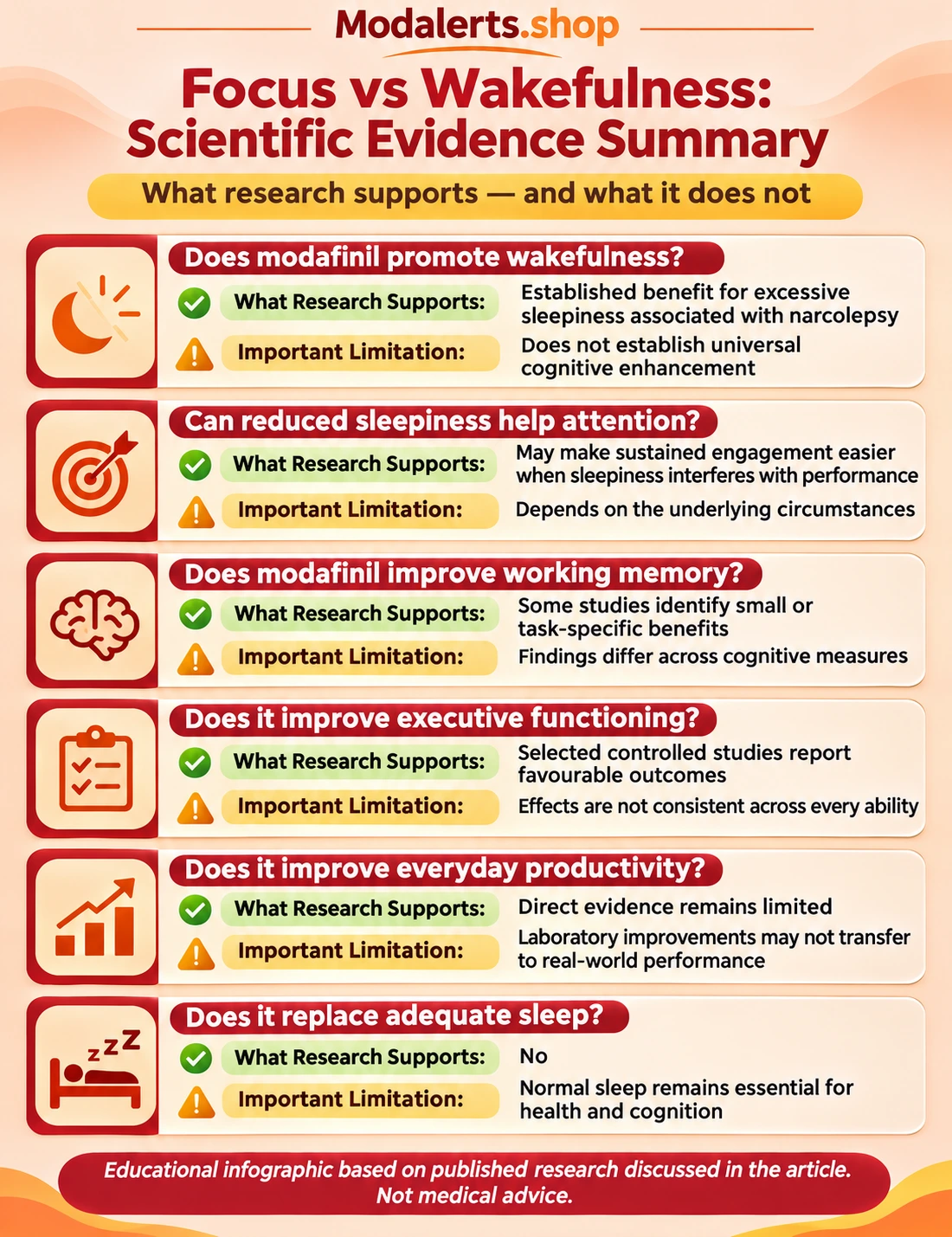
Overall, modafinil’s wakefulness-promoting effects have stronger clinical support than claims of broad improvements in memory, reasoning or everyday productivity.
Frequently Asked Questions Does Modalert Improve Focus or Just Wakefulness?
Does Modalert Improve Focus in Healthy Adults?
Research involving modafinil in healthy, non-sleep-deprived adults has identified small average improvements in selected cognitive measures. However, findings vary depending on the task and research design. These results do not establish that Modalert reliably improves concentration, learning or everyday productivity in healthy individuals. Evidence demonstrating unique cognitive benefits from the Modalert 200mg brand also remains limited.
Is Modalert Mainly Used to Promote Wakefulness?
Modalert contains modafinil, an active ingredient primarily recognised for its wakefulness-promoting effects. In the UK, authorised modafinil medicines are indicated for excessive sleepiness associated with narcolepsy in adults. Although researchers have investigated cognitive performance, improved wakefulness and direct cognitive enhancement represent different outcomes. Evidence of reduced sleepiness should not automatically be interpreted as evidence of better memory or reasoning.
Can Modafinil Improve Memory and Concentration?
Some controlled studies have reported favourable results in particular memory, attention and executive-function tasks. However, systematic reviews indicate that average effects tend to be small and vary across cognitive domains. Improvements in laboratory assessments do not necessarily demonstrate meaningful changes in learning, long-term information retention or everyday concentration. The practical importance of these findings remains uncertain.
Does Modafinil Work Better When Someone Is Sleep-Deprived?
Research involving sleep-deprived participants has examined whether modafinil can reduce certain performance impairments associated with sleep loss. However, these findings depend on the experimental conditions. People experiencing restricted sleep differ from adequately rested adults, and improvements in wakefulness or selected cognitive tasks do not mean that modafinil reverses every consequence of insufficient sleep.
Is Modalert Approved for Improving Focus in the UK?
No. Improving focus or cognitive performance in healthy individuals is not a UK-authorised indication for modafinil. UK-authorised modafinil products are indicated for excessive sleepiness associated with narcolepsy in adults. Additionally, evidence concerning the active ingredient does not establish that the Modalert brand itself holds UK marketing authorisation. Research findings and authorised therapeutic indications must remain clearly distinguished.
References and Further Reading
- Electronic Medicines Compendium (emc).
Modafinil 200mg tablets — Summary of Product Characteristics (SmPC).
Section 4.1 describes authorised therapeutic indications. Sections 4.4 and 4.8 address sleep-related precautions and adverse reactions.
- Medicines and Healthcare products Regulatory Agency (MHRA).
Modafinil (Provigil): now restricted to narcolepsy.
Drug Safety Update, March 2011. GOV.UK publication dated 11 December 2014.
- Kredlow, M. A., Keshishian, A., Oppenheimer, S., & Otto, M. W. (2019).
The Efficacy of Modafinil as a Cognitive Enhancer: A Systematic Review and Meta-Analysis.
Journal of Clinical Psychopharmacology, 39(5), 455–461.
DOI: 10.1097/JCP.0000000000001085
- Battleday, R. M., & Brem, A.-K. (2015).
Modafinil for Cognitive Neuroenhancement in Healthy Non-Sleep-Deprived Subjects: A Systematic Review.
European Neuropsychopharmacology, 25(11), 1865–1881.
DOI: 10.1016/j.euroneuro.2015.07.028
- Roberts, C. A., Jones, A., Sumnall, H., Gage, S. H., & Montgomery, C. (2020).
How Effective Are Pharmaceuticals for Cognitive Enhancement in Healthy Adults? A Series of Meta-Analyses of Cognitive Performance During Acute Administration of Modafinil, Methylphenidate and D-Amphetamine.
European Neuropsychopharmacology, 38, 40–62.
DOI: 10.1016/j.euroneuro.2020.07.002
Final Thoughts: Does Modalert Improve Focus or Just Wakefulness?
Comparing these three medicines illustrates why substances associated with alertness or attention cannot be assessed solely through perceived strength or duration.
Modafinil has an established UK clinical role in managing narcolepsy-associated excessive sleepiness.
Mixed amphetamine salts have recognised American indications, while lisdexamfetamine holds a defined place in UK ADHD treatment through authorised products such as Elvanse.
Their pharmacological mechanisms, research findings, safety profiles and regulatory classifications remain distinct.
Furthermore, evidence of improved wakefulness should not be confused with evidence of comprehensive ADHD symptom management or broad cognitive enhancement.
Understanding these differences provides a stronger foundation for interpreting scientific research and prescription medicine information.