Educational and Medical Disclaimer
Modalert vs Modvigil is discussed in this article for educational and pharmaceutical research purposes only. The information explains differences in brand identity, formulations, scientific evidence and UK regulatory considerations. It does not constitute medical advice, recommend either product or establish therapeutic interchangeability between the two brands.
Modafinil is classified as a Prescription-Only Medicine (POM) in the United Kingdom. Its use requires appropriate medical oversight. Furthermore, the international availability of Modalert or Modvigil does not automatically establish UK marketing authorisation or lawful supply.
Product-specific regulatory information should be checked against current official MHRA records. Individual medical concerns and treatment decisions should be discussed with an appropriately qualified healthcare professional.
Modalert vs Modvigil is a comparison that often arises when researching internationally marketed modafinil medicines. Both brands contain the same stated active ingredient. However, their manufacturer associations, formulations and supporting product documentation may differ.
For UK readers, the important question is not simply whether the brand names differ. Instead, it is whether reliable pharmaceutical evidence establishes meaningful differences in quality, absorption, clinical effects or tolerability.
Although both products are commonly identified as modafinil tablets, sharing an active ingredient does not automatically establish bioequivalence or interchangeability.
This guide examines the available brand information, explains the scientific principles behind medicine equivalence and considers what the evidence can reasonably tell us about Modalert and Modvigil.
For a broader understanding of modafinil’s clinical uses, safety considerations and UK prescription rules, see our complete Modalert guide.
Modalert vs Modvigil: What Is the Main Difference?
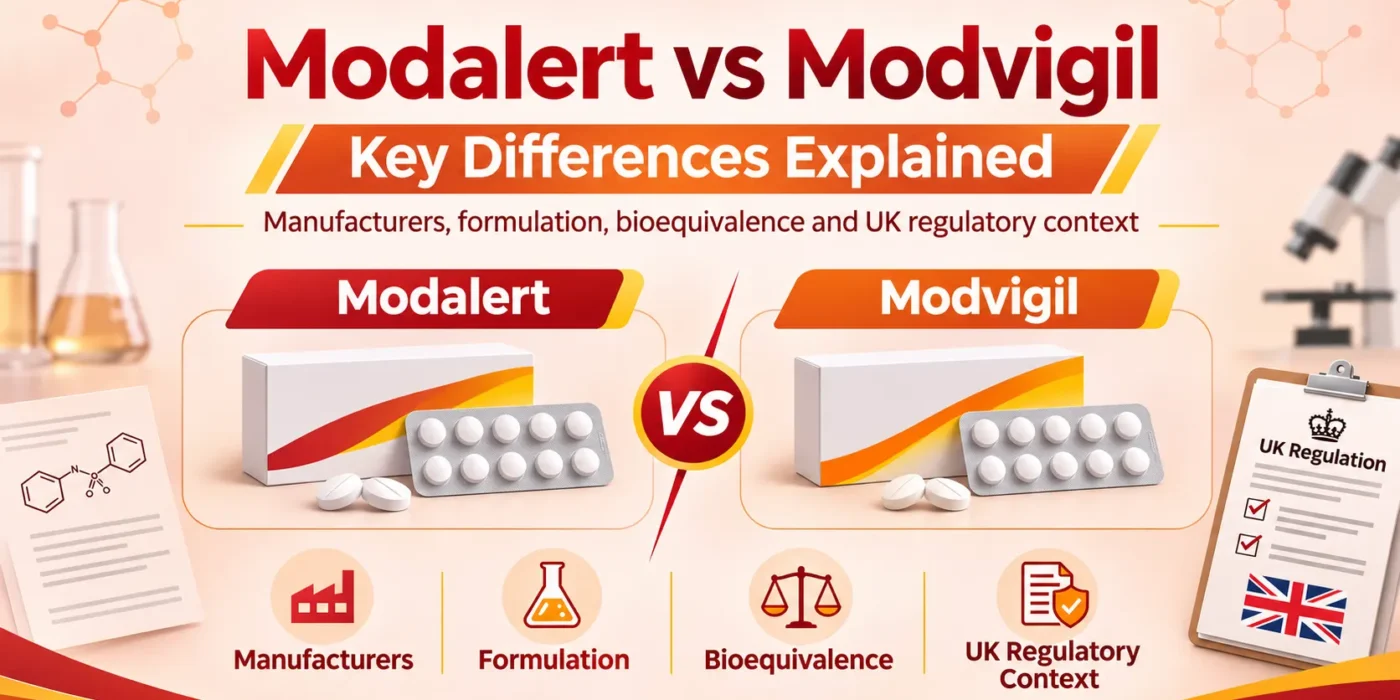
The main identifiable difference between Modalert and Modvigil concerns their brand identities and associated pharmaceutical companies.
Modalert appears in the official Indian product portfolio of Sun Pharmaceutical Industries. Meanwhile, available Modvigil packaging has been associated with HAB Pharmaceuticals & Research Limited.
Both brands are marketed internationally as modafinil-containing tablets, including products labelled 200 mg.
However, several distinctions matter:
- Manufacturer identity: Different pharmaceutical companies are associated with the two brands.
- Product formulation: Inactive ingredients and manufacturing specifications may differ.
- Supporting evidence: Clinical research, quality documentation and bioequivalence evidence require product-specific assessment.
- Regulatory status: Authorisation in one country does not automatically establish authorisation elsewhere.
These differences do not demonstrate that one brand produces stronger, faster or longer-lasting effects.
Therefore, a meaningful comparison requires more than brand descriptions, customer reviews or individual experiences.
Modalert vs Modvigil: Brands and Manufacturers
Manufacturer identity is an important starting point when comparing pharmaceutical products. However, identifying the company associated with a brand does not establish every detail of its manufacturing arrangements or quality controls.
Who Makes Modalert?
Modalert is associated with Sun Pharmaceutical Industries, an Indian pharmaceutical company.
Sun Pharma’s official Indian product listings identify Modalert tablets containing modafinil in 100 mg and 200 mg strengths. This provides direct company-level evidence connecting the brand with Sun Pharma’s product portfolio.
However, a company catalogue does not necessarily identify the facility responsible for manufacturing every batch.
The precise legal manufacturer, marketing entity and production location depend on the relevant packaging, product records and regulatory documentation.
Consequently, the available manufacturer association should not be treated as independent verification of every product supplied under the Modalert name.
Who Makes Modvigil?
Modvigil is commonly associated with HAB Pharmaceuticals & Research Limited, an Indian pharmaceutical company.
Available third-party packaging evidence for Modvigil-200 identifies HAB Pharmaceuticals & Research Limited and declares modafinil USP 200 mg as the active ingredient.
However, this packaging evidence does not provide a complete, independently verified regulatory dossier covering every product batch or market.
It also does not establish the full excipient composition, current manufacturing arrangements or all applicable product authorisations.
Therefore, HAB Pharmaceuticals remains the commonly reported company associated with Modvigil, rather than an independently confirmed legal manufacturer for every marketed presentation.
Why Does Manufacturer Identity Matter?
Pharmaceutical production involves several distinct responsibilities.
A manufacturer carries out medicine production or specified manufacturing operations. Meanwhile, a marketing company handles commercial activities, and a marketing authorisation holder carries legal responsibility for an authorised medicinal product within a particular regulatory jurisdiction.
The manufacturing site is the physical facility involved in production. Quality documentation, in contrast, contains records relating to specifications, testing, stability and manufacturing controls.
Different legal organisations may perform these roles.
Importantly, a large international company does not automatically produce a superior pharmaceutical product. Equally, a less familiar manufacturer should not be presumed inferior.
Reliable quality assessments depend on product-specific evidence, manufacturing standards and regulatory oversight rather than corporate reputation alone.
Modalert vs Modvigil: Active Ingredients and Strengths
Both brands are associated with modafinil, a wakefulness-promoting medicine.
Sun Pharma’s catalogue identifies Modalert tablets containing 100 mg and 200 mg of modafinil. Meanwhile, available Modvigil-200 packaging declares modafinil 200 mg.
When comparing Modalert 200 mg vs Modvigil 200 mg, the declared quantity of the active ingredient is therefore the same.
However, a strength declaration only describes how much active ingredient a tablet is intended to contain. It does not establish that two finished pharmaceutical products have identical characteristics.
For example, medicines can share an active ingredient and declared strength while differing in:
- Inactive ingredients.
- Tablet manufacturing processes.
- Dissolution characteristics.
- Stability specifications.
- Supporting pharmaceutical quality documentation.
These distinctions explain why active-ingredient identity and pharmaceutical interchangeability are not the same question.
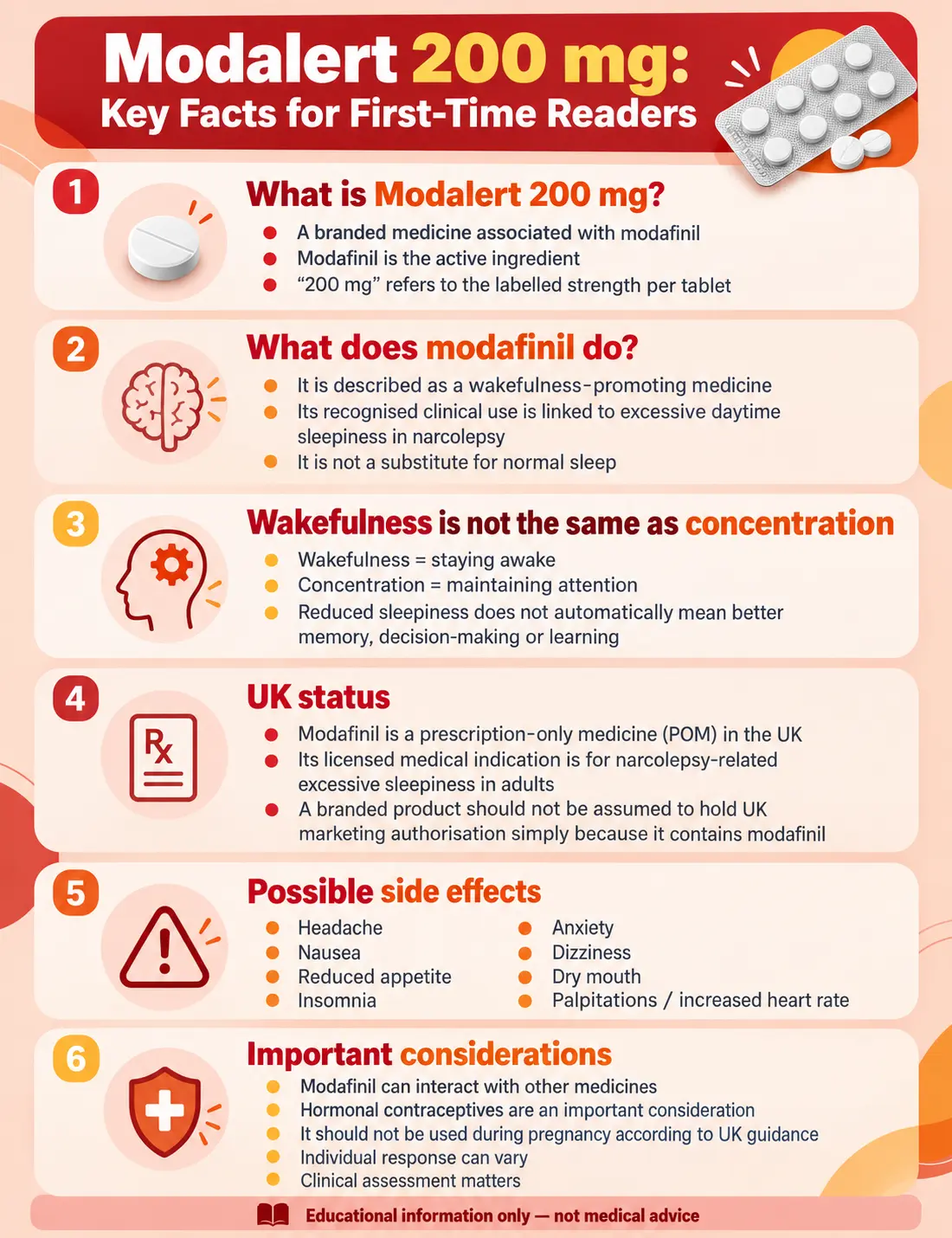
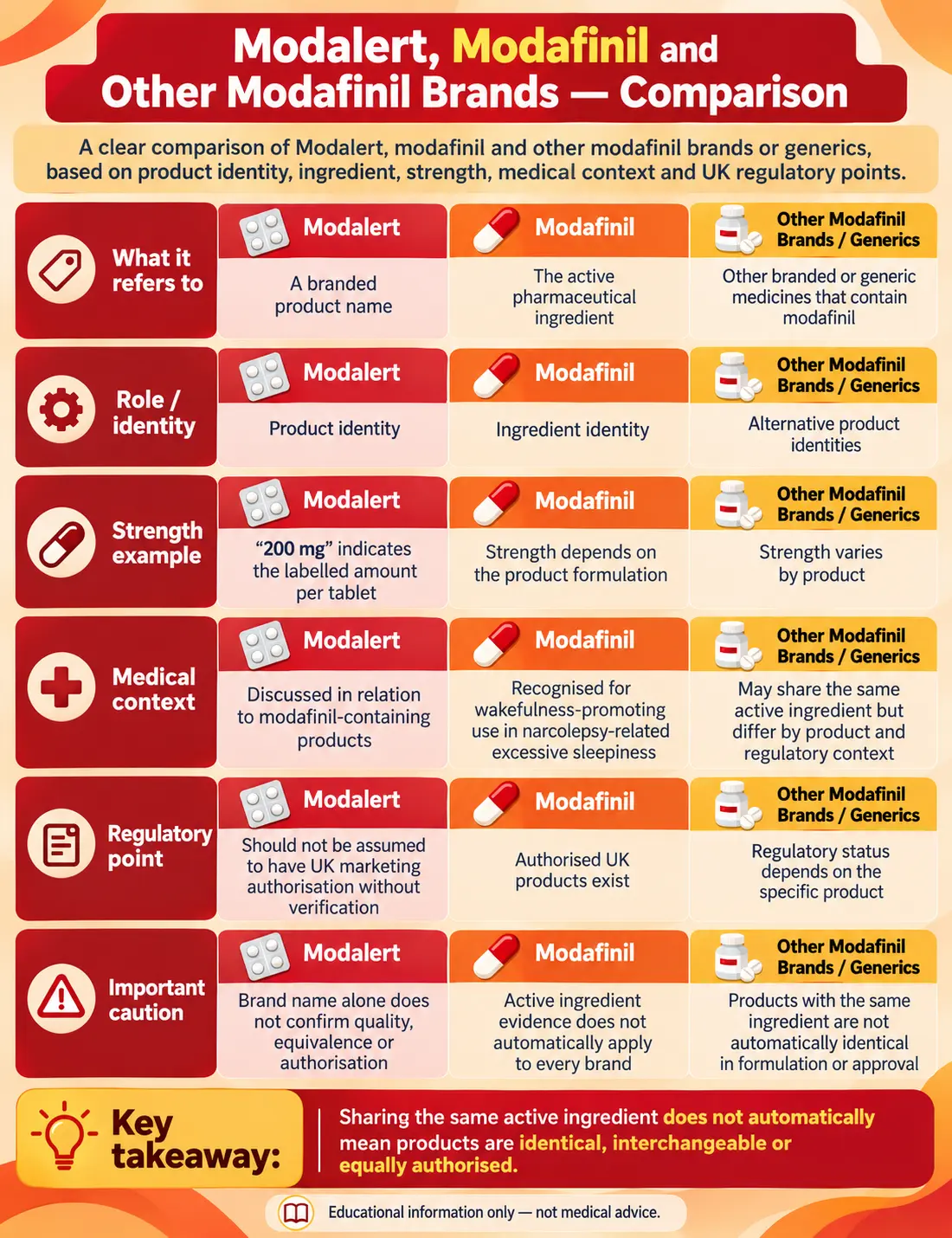
For additional background on strength terminology and product labelling, see Modalert 200 mg: What First-Time Users Should Know.
Modalert vs Modvigil: Formulation Differences
Formulation describes how manufacturers combine the active pharmaceutical ingredient with other substances to produce a finished medicine.
Although Modalert and Modvigil declare the same active ingredient, this does not mean their complete tablet formulations are identical.
What Are Excipients?
Excipients are ingredients included in a medicine alongside its active pharmaceutical ingredient.
They perform various pharmaceutical functions. For example, they may help bind ingredients together, provide tablet structure, support manufacturing or influence how a tablet breaks down.
Common categories include:
- Fillers: Provide the required tablet volume and structure.
- Binders: Help hold tablet ingredients together.
- Disintegrants: Support the breakdown of tablets under appropriate conditions.
- Lubricants: Reduce friction during manufacturing.
Although excipients do not provide the medicine’s principal intended therapeutic action, they can affect important pharmaceutical properties.
For example, certain ingredients influence tablet disintegration or formulation stability throughout the declared shelf life.
However, the complete excipient lists for Modalert and Modvigil require confirmation through authenticated product documentation.
General modafinil formulations cannot establish the exact ingredients present in either branded product.
Can Formulation Differences Affect a Medicine?
Potentially, although different formulations do not automatically produce meaningful clinical differences.
A tablet must release its active ingredient in a way that meets relevant pharmaceutical specifications.
Manufacturers assess this through quality tests, including dissolution testing, content uniformity, impurity analysis and stability testing.
Dissolution testing examines how an active ingredient enters a test solution under defined laboratory conditions.
These results help describe a formulation’s pharmaceutical behaviour.
However, laboratory dissolution findings do not necessarily establish how two products compare in the human body.
Furthermore, acceptable differences in tablet properties are not automatically evidence of different clinical outcomes.
This distinction leads to two important scientific concepts: pharmaceutical equivalence and bioequivalence.
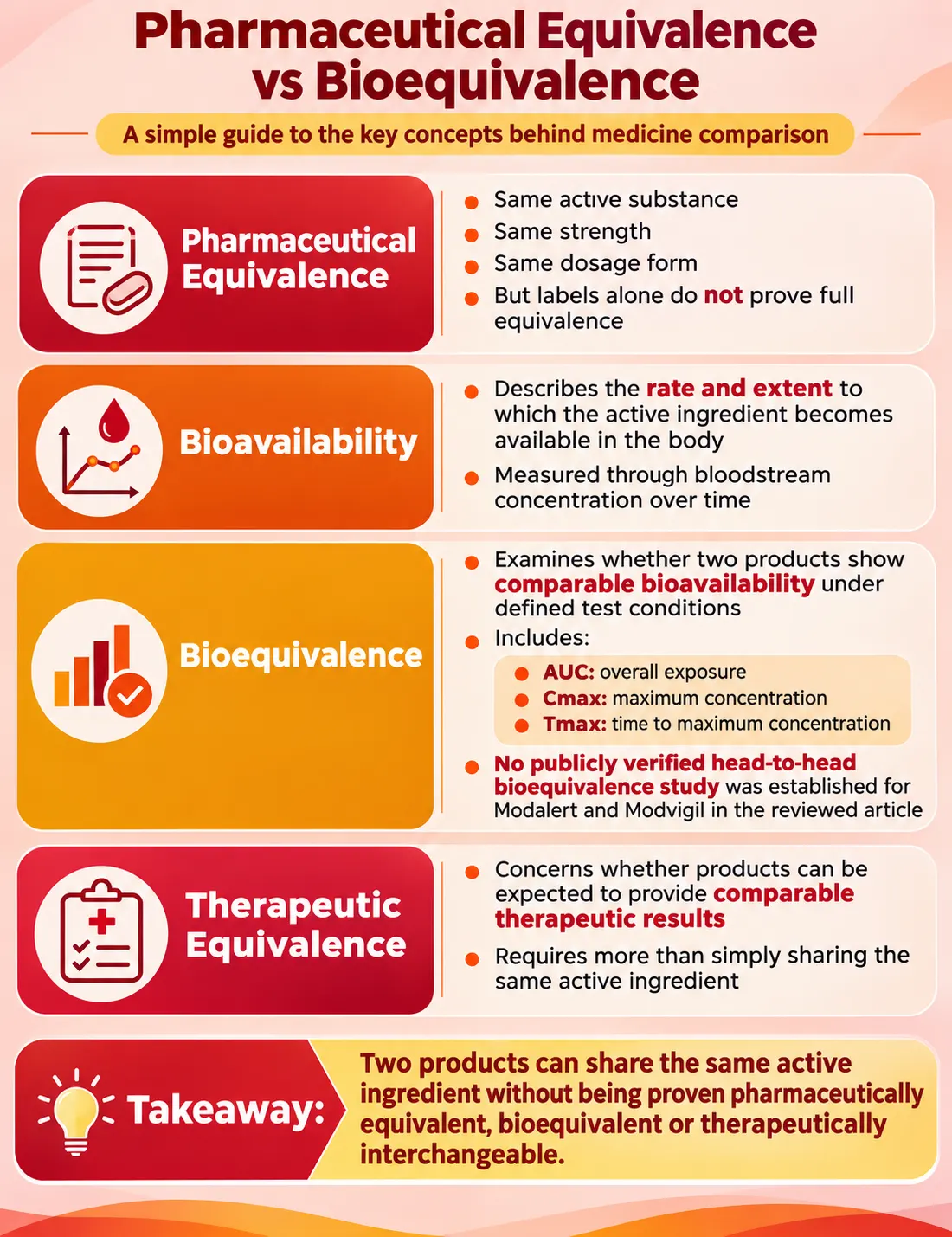
Pharmaceutical Equivalence vs Bioequivalence
Understanding pharmaceutical equivalence and bioequivalence is essential to interpreting the Modalert vs Modvigil comparison.
Although these terms are closely related, they describe different aspects of medicine assessment.
Pharmaceutical Equivalence
Pharmaceutical equivalence concerns whether medicines meet applicable requirements relating to the same active substance, amount, dosage form and pharmaceutical standards.
Two pharmaceutically equivalent products do not necessarily contain identical inactive ingredients.
For example, two tablets labelled as containing 200 mg of modafinil share the same declared active ingredient and strength.
However, the labels alone do not establish formal pharmaceutical equivalence.
Such a determination requires appropriate product specifications and supporting evidence.
Therefore, identical strength declarations represent a useful starting point rather than a complete equivalence assessment.
Bioavailability
Bioavailability describes the rate and extent to which an active pharmaceutical ingredient becomes available in the body.
Researchers commonly examine how the concentration of a medicine changes in the bloodstream over time.
These measurements help explain the amount and pattern of systemic exposure following administration.
Two products containing the same active ingredient may demonstrate similar bioavailability.
However, suitable scientific evidence must support that conclusion.
Bioequivalence
Bioequivalence concerns whether two pharmaceutical products demonstrate sufficiently comparable bioavailability under defined testing conditions.
Regulatory assessments commonly examine several pharmacokinetic measurements:
- AUC (Area Under the Curve): Represents overall systemic exposure over a defined period.
- Cmax: Describes the maximum observed concentration of the medicine in the bloodstream.
- Tmax: Describes the time taken to reach that maximum concentration.
The European Medicines Agency’s ICH M13A guidance explains how researchers assess bioequivalence using established statistical methods and predefined acceptance criteria.
This guidance took effect on 25 January 2025 and addresses bioequivalence assessment for immediate-release solid oral dosage forms.
However, general regulatory guidance does not establish equivalence between two particular brands.
Generic medicines commonly require suitable bioequivalence evidence against an appropriate reference product. Nevertheless, that does not mean every generic brand has undergone direct comparison with every other brand.
For Modalert and Modvigil specifically, this review has not established a publicly verified head-to-head bioequivalence study.
Consequently, describing the two brands as proven bioequivalent to one another would go beyond the available evidence.
Therapeutic Equivalence
Therapeutic equivalence concerns whether pharmaceutical products can be expected to provide comparable therapeutic results under appropriate conditions.
Depending on the regulatory framework, this assessment may involve pharmaceutical equivalence, bioequivalence and other applicable requirements.
Although sharing an active ingredient is important, that similarity alone does not establish a formal therapeutic-equivalence determination.
Moreover, bioequivalence evidence and therapeutic equivalence are not interchangeable terms in every regulatory context.
A reliable conclusion must therefore reflect the specific products, available research and relevant regulatory standards.

While Modalert and Modvigil are both associated with modafinil, Waklert contains the related ingredient armodafinil. Our Modalert vs Waklert comparison explains the scientific differences and limitations of the available evidence.
Do Modalert and Modvigil Work Differently?
Research on modafinil provides substantial information about its wakefulness-promoting properties.
However, studies examining modafinil as an active ingredient do not necessarily demonstrate clinical differences between particular commercial formulations.
When assessing Modalert vs Modvigil effectiveness, four categories of evidence should be considered.
General clinical research examines modafinil’s pharmacology, clinical effects and safety characteristics. This evidence primarily concerns the active ingredient rather than the comparative performance of the two brands.
Brand-specific research investigates a particular marketed formulation. Such studies may provide information about its pharmaceutical characteristics or clinical performance.
Head-to-head comparative research directly investigates specified products under controlled conditions. This type of evidence is particularly relevant when evaluating claims that one brand differs from another.
Consumer experiences describe individual perceptions. However, they rarely control for differences in physiology, other medicines, sleep patterns or product provenance.
Consequently, anecdotal comparisons cannot reliably establish pharmaceutical superiority.
The strongest evidence for a meaningful brand-specific difference would come from appropriately designed studies using clearly identified products.
A related but different comparison involves armodafinil, rather than two brands containing modafinil. Our Modalert vs Waklert comparison explains the differences between these active ingredients and the limits of the available clinical evidence.
This review has not identified reliable comparative evidence showing that Modalert is clinically stronger or more effective than Modvigil, or vice versa.
That does not prove the formulations are identical. Instead, it means the available evidence does not justify a claim of clinical superiority.
Modalert vs Modvigil: Onset and Duration
Modafinil’s general pharmacokinetic characteristics appear in authorised UK product information.
For example, a UK Summary of Product Characteristics describes modafinil absorption, peak plasma concentrations and elimination characteristics.
These measurements help researchers understand how the active ingredient behaves in the body.
However, pharmacokinetic information from one authorised formulation should not automatically be treated as independently verified data for every other medicine containing modafinil.
Claims that Modalert starts working faster, Modvigil lasts longer or either brand produces more consistent effects would require credible comparative evidence.
Furthermore, pharmacokinetic measurements do not translate directly into identical subjective experiences for everyone.
For example, a reported difference in perceived duration may reflect individual circumstances rather than a measurable difference between formulations.
Similarly, subjective impressions cannot independently establish differences in bioavailability or pharmaceutical quality.
Without suitable brand-specific research, neither medicine has a scientifically established comparative advantage in onset or duration.
Modalert vs Modvigil: Side Effects and Tolerability
Because both brands contain the same stated active ingredient, the established safety considerations associated with modafinil are relevant to each.
These include documented adverse reactions, medicine interactions and differences in individual tolerability.
However, evidence concerning modafinil generally should not automatically be interpreted as direct evidence comparing the safety profiles of Modalert and Modvigil.
Inactive ingredients may also matter, particularly where a person has a recognised sensitivity to a specific component.
Nevertheless, the possibility of formulation-related differences does not establish that one brand has a better overall tolerability profile.
This comparison has not identified reliable evidence demonstrating fewer adverse reactions with either brand.
Therefore, claims that one formulation is inherently safer or easier to tolerate require more evidence than consumer reviews or general brand descriptions.
For a fuller discussion of established modafinil-related risks, see Modalert Side Effects: What to Know About Safety & Risks.
Modalert vs Modvigil: UK Regulatory Status
In the United Kingdom, modafinil is classified as a Prescription-Only Medicine (POM).
However, the regulatory classification of an active ingredient differs from the marketing-authorisation status of an individual branded product.
The Medicines and Healthcare products Regulatory Agency (MHRA) regulates medicines in the UK and provides access to authorised product information.
The UK has authorised medicines containing modafinil. Nevertheless, an authorisation for one formulation does not automatically extend to every internationally marketed brand containing the same substance.
A marketing authorisation applies to a specified medicinal product and its approved characteristics, including the responsible authorisation holder.
The records reviewed for this article did not establish current UK marketing authorisations specifically under the Modalert or Modvigil brand names.
However, this finding is not a definitive determination of either brand’s current regulatory status. Product-specific authorisation requires confirmation against the latest official MHRA records.
Furthermore, overseas product availability does not itself establish permission for UK marketing, advertising or supply.
UK prescription-medicine supply must comply with applicable legislation, including lawful prescription and supplier requirements.
For a more detailed explanation, see Is Modalert Legal in the UK? Prescription Rules & Regulations Explained.
How to Evaluate Modalert and Modvigil Product Information
When researching pharmaceutical products, reliable documentation matters more than brand popularity.
Several types of information help distinguish verifiable product characteristics from unsupported claims.
Product identification: The exact brand name, strength, dosage form and presentation should be clear. Similar packaging or product names do not independently establish identity.
Manufacturer information: Packaging and regulatory records should identify the responsible pharmaceutical companies and relevant manufacturing arrangements.
Batch and expiry information: These details support product traceability and form part of established pharmaceutical quality systems.
Regulatory documentation: Marketing authorisation records, approved product information and official regulatory documents provide stronger evidence than general marketplace descriptions.
Ingredient declarations: Information about active and inactive ingredients supports meaningful formulation comparisons and helps identify documented ingredient differences.
Supplier and prescription arrangements: Where prescription medicines may lawfully be supplied, relevant licensing, registration and prescription requirements remain essential.
In addition, commercial information requires careful interpretation.
A familiar brand does not establish pharmaceutical superiority. Likewise, customer ratings cannot replace clinical research or regulatory documentation.
Price differences also provide no reliable evidence of bioequivalence, manufacturing quality or product authenticity.
Ultimately, the most meaningful Modalert and Modvigil differences are those supported by identifiable pharmaceutical records rather than general impressions.
Modalert vs Modvigil: Comparison Summary
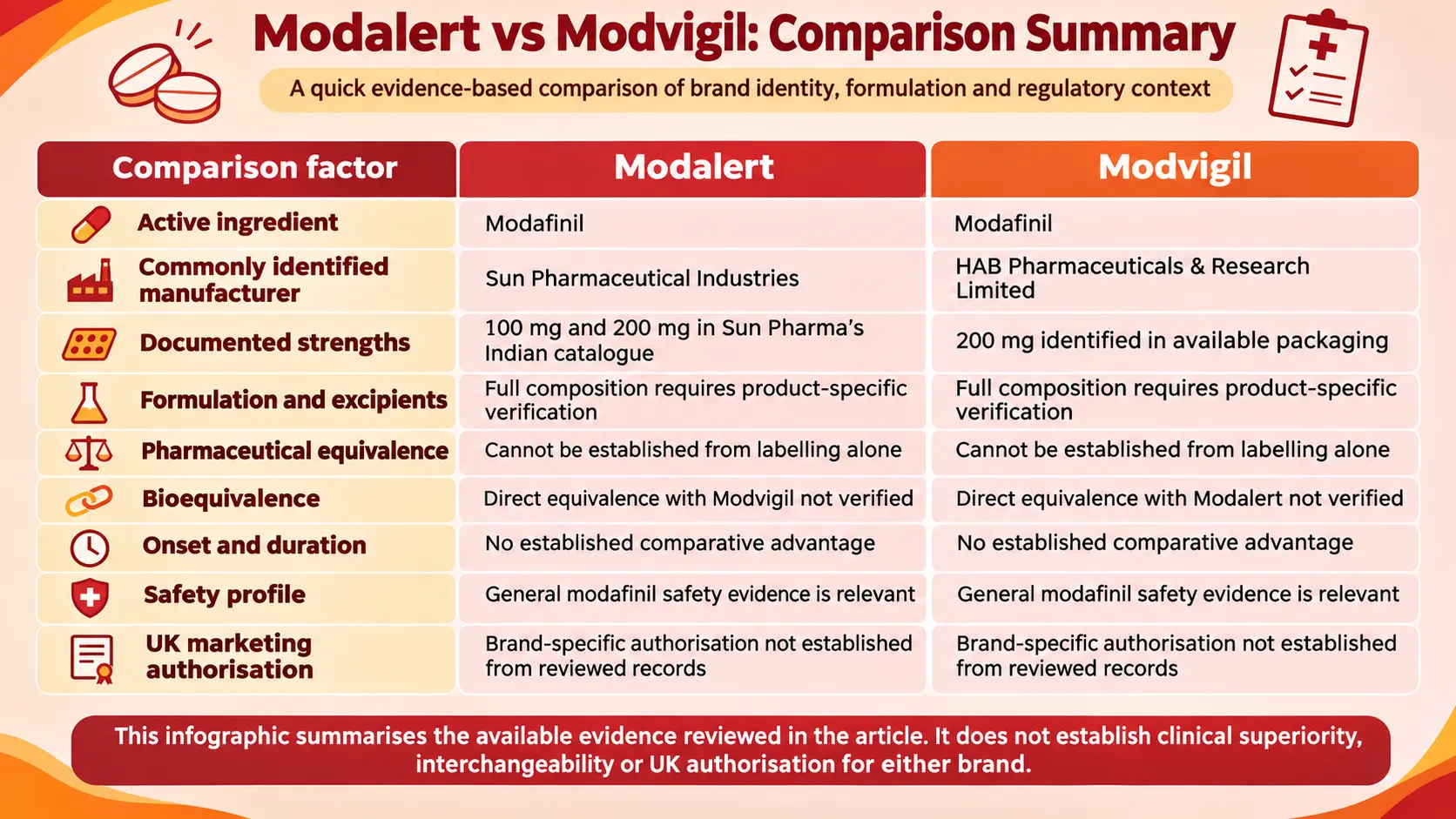
The following table summarises the principal similarities, manufacturer associations and evidence limitations.
Comparison factor | Modalert | Modvigil |
Active ingredient | Modafinil | Modafinil |
Commonly identified manufacturer | Sun Pharmaceutical Industries | HAB Pharmaceuticals & Research Limited |
Documented strengths | 100 mg and 200 mg in Sun Pharma’s Indian catalogue | 200 mg identified in available packaging |
Formulation and excipients | Full composition requires product-specific verification | Full composition requires product-specific verification |
Pharmaceutical equivalence | Cannot be established from labelling alone | Cannot be established from labelling alone |
Bioequivalence | Direct equivalence with Modvigil not verified | Direct equivalence with Modalert not verified |
Onset and duration | No established comparative advantage | No established comparative advantage |
Safety profile | General modafinil safety evidence is relevant | General modafinil safety evidence is relevant |
UK marketing authorisation | Brand-specific authorisation not established from reviewed records | Brand-specific authorisation not established from reviewed records |
The manufacturer associations and strengths reflect the documentation reviewed. Importantly, this table does not establish direct clinical equivalence, regulatory interchangeability or superiority for either brand.
Key Takeaways: Modalert vs Modvigil
Modalert and Modvigil are two internationally marketed brands associated with the active ingredient modafinil.
Their clearest identifiable differences concern branding, commonly reported pharmaceutical companies and available product documentation.
Although both brands include tablets labelled as containing 200 mg of modafinil, that similarity does not independently establish pharmaceutical equivalence, bioequivalence or therapeutic interchangeability.
Formulation differences may be scientifically relevant. However, their clinical significance cannot be determined without appropriate evidence.
Likewise, claims that one brand is stronger, faster, longer-lasting or better tolerated remain unsupported without credible comparative studies.
For UK readers, product-specific regulatory status represents another essential distinction. The authorisation of modafinil-containing medicines does not establish that every internationally marketed brand has UK marketing authorisation.
Ultimately, a reliable brand comparison depends on verified specifications, regulatory records and scientific evidence rather than reputation, pricing or anecdotal experience.
Frequently Asked Questions About Modalert vs Modvigil
Are Modalert and Modvigil the Same Medicine?
Modalert and Modvigil are separate brands associated with the same active ingredient, modafinil. However, they are not necessarily identical finished pharmaceutical products. Their manufacturer arrangements, excipients and manufacturing specifications may differ. Sharing an active ingredient and declared strength does not automatically establish bioequivalence or interchangeability. A formal comparison requires suitable product-specific evidence.
Is Modalert Stronger Than Modvigil?
This Modalert vs Modvigil comparison has not established reliable clinical evidence demonstrating that one brand is stronger than the other. Products labelled as containing 200 mg of modafinil declare the same quantity of active ingredient. However, matching strength declarations do not independently confirm identical absorption characteristics. Claims of greater potency require credible, appropriately designed comparative research.
Do Modalert and Modvigil Have the Same Active Ingredient?
Yes. Sun Pharma’s Indian product catalogue identifies modafinil as the active ingredient in Modalert tablets. Available Modvigil-200 packaging also declares modafinil. However, a finished tablet contains additional ingredients alongside its active substance. These excipients, together with manufacturing specifications, may differ between products. Ingredient identity alone does not confirm complete pharmaceutical equivalence.
Is There Evidence That One Brand Lasts Longer?
This review has not established reliable head-to-head clinical evidence demonstrating a longer duration for either Modalert or Modvigil. Although researchers have documented modafinil’s general pharmacokinetic characteristics, those findings do not automatically establish differences between specific brands. Individual experiences and informal comparisons cannot reliably demonstrate a consistent difference in clinical duration or bioavailability.
Are Modalert and Modvigil Approved in the UK?
Current UK marketing authorisations specifically under the Modalert and Modvigil brand names were not established from the regulatory records reviewed. The MHRA maintains information about authorised modafinil-containing medicines, but authorisation applies to individual products rather than every brand containing the same ingredient. The latest official MHRA records remain the appropriate source for confirming product-specific authorisation.
References and Further Reading
- Sun Pharmaceutical Industries Indian Product Portfolio. Official product catalogue identifying Modalert tablets containing modafinil in 100 mg and 200 mg strengths.
Sun Pharma Indian product catalogue
- European Medicines Agency ICH M13A Guideline on Bioequivalence. Scientific guidance on bioequivalence assessment for immediate-release solid oral dosage forms, effective 25 January 2025.
EMA ICH M13A bioequivalence guideline
- Electronic Medicines Compendium Modafinil 200 mg Tablets, Summary of Product Characteristics. UK product information describing pharmacokinetics, established safety characteristics and pharmaceutical details.
Modafinil 200 mg Summary of Product Characteristics
- Medicines and Healthcare products Regulatory Agency Find Product Information About Medicines. Official guidance explaining access to UK medicine product information and regulatory documents.
MHRA medicine product information guidance
- MHRA Modafinil Product Records. Official regulatory search destination for modafinil-containing medicinal products. Individual product authorisations require verification within the current database.
Additional manufacturer evidence: Third-party packaging material identifies HAB Pharmaceuticals & Research Limited in association with Modvigil-200. However, this evidence does not independently establish the complete manufacturing dossier, regulatory status or provenance of every marketed product batch.
Final Thoughts: Modalert vs Modvigil
Modalert vs Modvigil is ultimately a comparison of two internationally marketed modafinil brands that share the same stated active ingredient but differ in brand identity, manufacturer associations and available pharmaceutical documentation.
Although both brands offer tablets labelled as containing 200 mg of modafinil, this similarity does not automatically establish identical formulations, bioequivalence or therapeutic interchangeability.
Importantly, the available evidence does not establish that either brand is stronger, faster-acting, longer-lasting or better tolerated than the other. Such conclusions would require reliable product-specific comparative research.
For UK readers, regulatory status remains equally important. Modafinil is a Prescription-Only Medicine, and the availability of these brands internationally does not establish their authorisation for UK marketing or supply.
Ultimately, the most meaningful Modalert and Modvigil differences are those supported by verified pharmaceutical specifications, regulatory records and scientific evidence, rather than brand reputation or individual experiences.