

Educational Disclaimer
This information about Modalert side effects is provided for general educational purposes only. It does not replace professional medical advice, diagnosis or treatment. Medicine suitability and suspected adverse reactions require assessment by an appropriately qualified healthcare professional.
Modalert side effects can range from relatively common symptoms, such as headaches and nausea, to less frequently reported but potentially serious reactions affecting the skin, mental health or cardiovascular system. Understanding these differences is an important part of evaluating the safety of medicines containing modafinil.
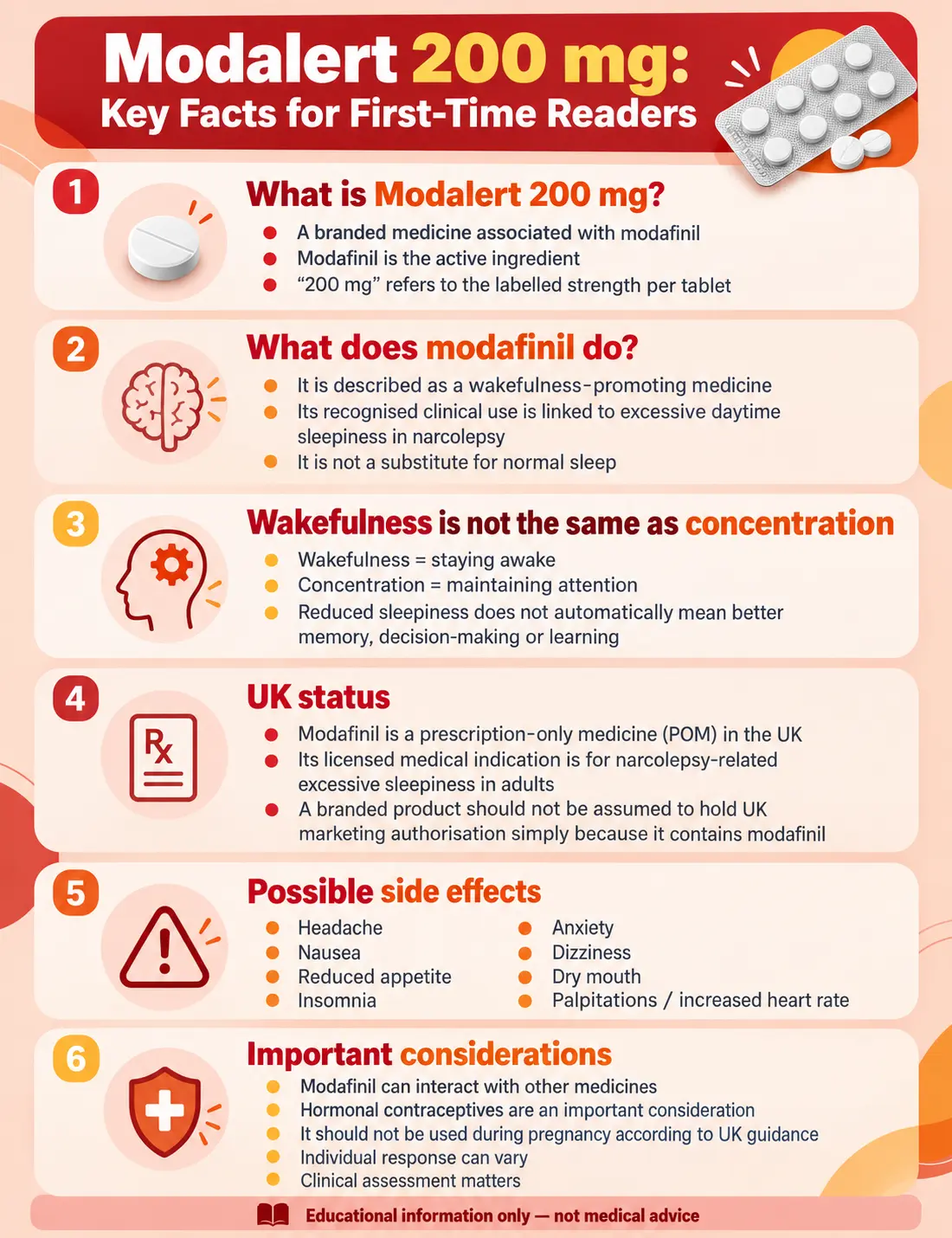
Modalert is a branded formulation of modafinil, a prescription medicine that promotes wakefulness. In the UK, modafinil is licensed for treating excessive sleepiness associated with narcolepsy in adults. Clinical studies, regulatory reviews and reports collected after medicines enter clinical use help establish its safety profile.
However, most published safety evidence concerns modafinil as an active ingredient rather than clinical trials conducted specifically on the Modalert brand. This distinction matters when interpreting reported adverse effects.
This guide examines common reactions, serious safety concerns, medicine interactions, long-term uncertainties and relevant UK regulatory information.
For a broader explanation of modafinil’s clinical uses, safety considerations and UK prescription requirements, see our complete Modalert guide.
What Are the Most Common Modalert Side Effects?
The most common adverse reactions associated with modafinil appear in official UK Summary of Product Characteristics (SmPC) documents.
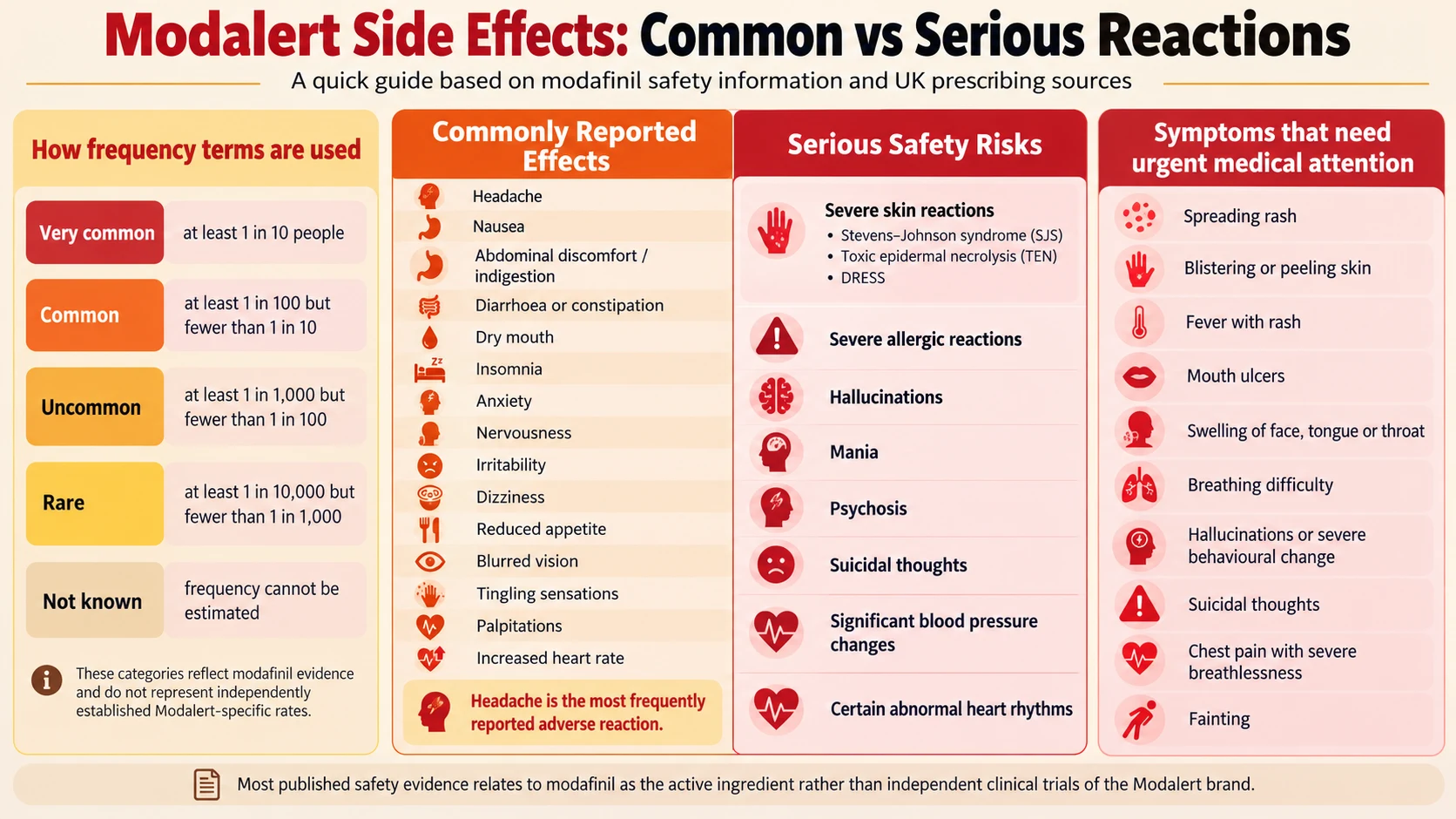
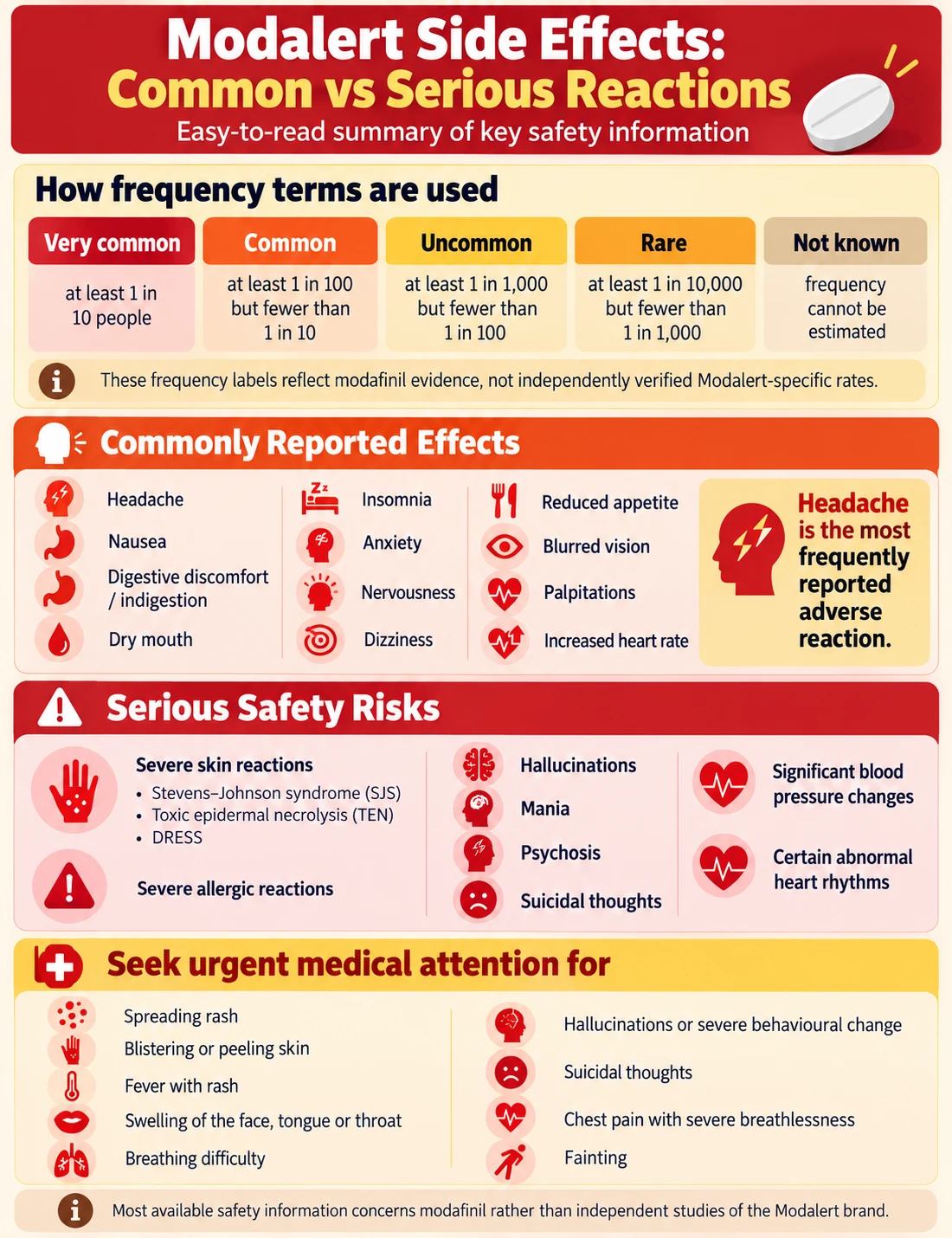
These documents classify adverse reactions according to their reported frequency:
- Very common: Affecting at least 1 in 10 people.
- Common: Affecting at least 1 in 100 but fewer than 1 in 10 people.
- Uncommon: Affecting at least 1 in 1,000 but fewer than 1 in 100 people.
- Rare: Affecting at least 1 in 10,000 but fewer than 1 in 1,000 people.
- Not known: Frequency cannot be estimated from available information.
These categories describe findings from modafinil clinical trials and post-marketing evidence. They do not represent independently established Modalert-specific incidence rates.
Although many reactions are mild or moderate, their severity and duration can differ between individuals
Headaches, Nausea and Digestive Discomfort
Headache is the most frequently reported adverse reaction associated with modafinil.
According to UK prescribing information, approximately 21% of patients receiving modafinil in the clinical safety dataset experienced headaches. These were generally mild or moderate and often resolved within several days.
Several digestive symptoms also fall into the common category. They include nausea, abdominal discomfort, indigestion, diarrhoea, constipation and dry mouth.
Although these symptoms can be uncomfortable, they do not necessarily indicate a serious complication. Their duration, severity and clinical importance may vary.
However, persistent or worsening symptoms warrant professional assessment rather than assumptions about their cause.
Insomnia, Anxiety and Nervousness
Modafinil promotes wakefulness. Therefore, changes in sleep and psychological wellbeing are particularly relevant to its safety profile.
UK prescribing information lists insomnia, anxiety, nervousness and irritability as common adverse reactions. Depression, confusion and changes in thinking also appear in this category.
Insomnia may involve difficulty falling asleep, staying asleep or achieving satisfactory rest.
Meanwhile, anxiety-related symptoms can include heightened nervousness, restlessness or a sense of unease.
These experiences differ between individuals. Existing psychological conditions may also influence their clinical significance.
More severe psychiatric reactions require separate consideration because their consequences differ from ordinary nervousness or temporary sleep disturbance.
Dizziness, Appetite Changes and Other Reported Effects
Other common adverse reactions include dizziness, reduced appetite, blurred vision, tingling sensations and feelings of sleepiness.
Some cardiovascular symptoms, including palpitations and increased heart rate, also fall into the common category.
However, not every symptom that appears during treatment necessarily results from the medicine.
Existing health conditions, other medicines and unrelated medical problems can produce similar effects.
Consequently, recognising the documented adverse-reaction profile helps place unexpected symptoms into a more accurate clinical context.
Serious Modalert Side Effects and Safety Risks
Serious adverse reactions associated with modafinil differ substantially from common complaints such as mild headaches or digestive discomfort.
These outcomes are not inevitable. Furthermore, some occur too infrequently for researchers to establish reliable incidence rates.
Nevertheless, their potential consequences make them important considerations when examining medicine safety.
Severe Skin and Allergic Reactions
Worldwide post-marketing reports have linked modafinil with potentially life-threatening skin and hypersensitivity reactions.
Hypersensitivity describes an excessive immune response that can affect the skin or other organs.
Reported serious reactions include:
- Stevens–Johnson syndrome (SJS): A serious reaction affecting the skin and mucous membranes, such as those lining the mouth.
- Toxic epidermal necrolysis (TEN): A severe condition involving widespread skin damage and detachment.
- Drug reaction with eosinophilia and systemic symptoms (DRESS): A serious reaction that may affect the skin and internal organs.
Possible warning signs include a spreading rash, blistering, peeling skin, fever, mouth ulcers or swelling of the face or throat.
Sudden breathing difficulties or swelling involving the tongue or throat may indicate a medical emergency. Such symptoms require urgent medical attention.
UK prescribing information reports that serious rashes have occurred within the first several weeks after treatment began. However, later cases have also appeared.
Notably, clinical trials involving 4,264 adults reported no serious skin rashes associated with modafinil. Subsequent post-marketing reports nevertheless identified serious cases.
The frequency of serious skin reactions cannot be reliably estimated from the available reports.
This distinction matters because the absence of a reaction in clinical trials does not establish that it cannot occur.
Psychiatric and Mood-Related Reactions
Modafinil has also been associated with psychiatric adverse reactions.
While anxiety and nervousness are relatively common, more serious reported effects include agitation, aggressive behaviour, hallucinations, mania and psychosis.
Psychosis may involve difficulty distinguishing reality from imagined experiences.
Meanwhile, mania can involve an unusually elevated or irritable mood, excessive energy, impulsive behaviour or significant changes in judgement.
UK prescribing information classifies hallucinations, mania and psychosis as rare adverse reactions. It lists agitation, aggression and suicidal thoughts as uncommon.
Other suicide-related behaviours have also appeared in safety surveillance reports.
A history of depression, bipolar disorder, psychosis or significant anxiety is particularly relevant when clinicians assess treatment suitability.
Although these reactions do not affect everyone, severe behavioural changes, hallucinations or suicidal thoughts require prompt professional assessment. Immediate danger requires emergency assistance.
Cardiovascular Concerns
Cardiovascular effects represent another important aspect of modafinil safety.
Palpitations and tachycardia, meaning an unusually rapid heart rate, are common adverse reactions in UK prescribing information.
Blood pressure changes, including hypertension (high blood pressure) and hypotension (low blood pressure), are uncommon. Certain abnormal heart rhythms also occur less frequently.
These effects should not be presented as equally likely.
The UK SmPC identifies uncontrolled moderate-to-severe hypertension and cardiac arrhythmias as contraindications. A contraindication is a condition in which a medicine should not be used.
Additionally, the document identifies particular structural heart conditions that require caution.
Because cardiovascular risks vary between individuals, UK prescribing information describes clinical assessment and appropriate monitoring as important safety measures.
Chest pain accompanied by severe breathlessness, fainting or other concerning symptoms requires urgent medical evaluation.
Why Do Modalert Side Effects Vary Between Individuals?
Not everyone taking a medicine containing modafinil experiences the same reactions.
Several factors may help explain why individual responses differ.
- Individual sensitivity: Differences in metabolism, physiology and susceptibility can influence how people respond to the same active ingredient.
- Existing medical conditions: Cardiovascular disorders, psychiatric conditions and other health problems may affect the overall risk profile.
- Concurrent medicines: Modafinil can influence enzymes that process other medicines, potentially changing their levels and effects.
- Sleep patterns: Existing sleep disruption may complicate the interpretation of insomnia, tiredness and changes in alertness.
- Medical history: Previous allergic reactions, significant anxiety or a history of substance misuse may be relevant to clinical decisions.
These factors can overlap. For example, pre-existing anxiety and poor sleep may make it harder to establish why new symptoms have developed.
Furthermore, a symptom that appears during treatment does not automatically prove that modafinil caused it.
For readers exploring the formulation in greater detail, the related guide Modalert 200 mg: What First-Time Users Should Know provides broader background information. This article focuses specifically on adverse reactions and safety considerations.
Modalert Side Effects and Sleep Quality
Insomnia is among the recognised common adverse reactions associated with modafinil.
The medicine acts on pathways involved in regulating wakefulness. However, feeling alert does not mean that the body has received enough restorative sleep.
Sleep supports memory processing, emotional regulation, physical recovery and other essential functions.
A person may therefore experience increased wakefulness while still having an underlying sleep deficit.
Additionally, disrupted sleep can affect concentration, mood and perceived anxiety.
This creates an important distinction between wakefulness and healthy sleep quality.
UK prescribing information explicitly states that modafinil is not a replacement for sleep.
Consequently, greater alertness should not be interpreted as evidence that normal sleep requirements have disappeared.
For a closer examination of insomnia, sleep quality and clinical research, see our Modalert and Sleep guide.
When examining Modalert side effects, sleep quality remains relevant because tiredness, insomnia and changes in mood can overlap.
Modalert Side Effects and Medicine Interactions
Medicine interactions are an important part of understanding the safety risks associated with modafinil.
The active ingredient can influence liver enzymes that help the body process certain medicines.
As a result, modafinil may increase or decrease exposure to another treatment, depending on the substance involved.
However, an interaction does not automatically mean that every combination will cause harm. Its importance depends on the medicines and individual circumstances.
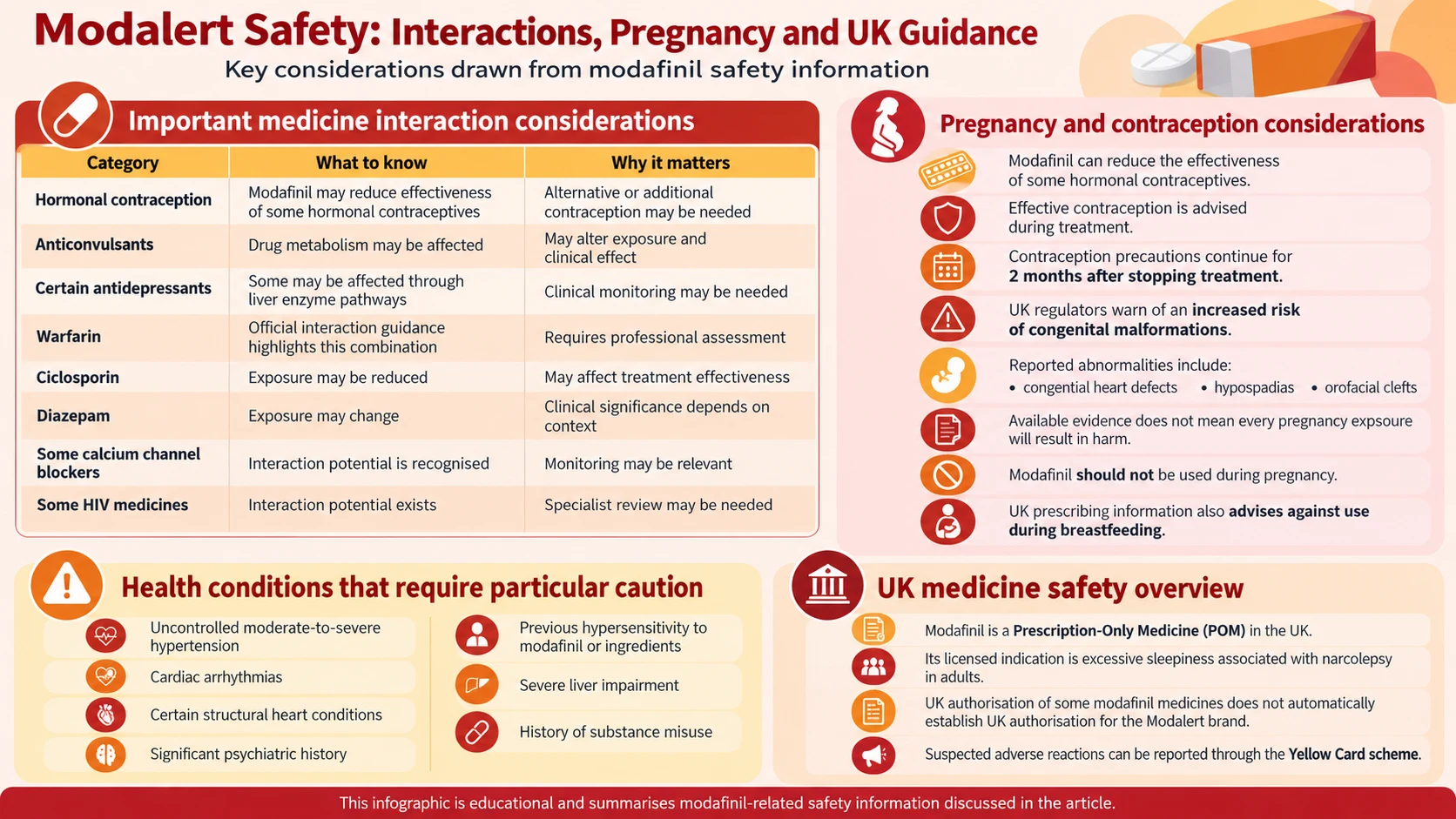
Hormonal Contraception and Pregnancy Considerations
One of the most significant documented interactions involves hormonal contraception.
Modafinil can increase activity in the CYP3A4/5 enzyme pathway, which helps the body process certain medicines.
Consequently, it may reduce the effectiveness of some hormonal contraceptives, including oral contraceptives and other hormone-based methods.
The Medicines and Healthcare products Regulatory Agency (MHRA) states that effective contraception is required during modafinil treatment and for two months after stopping treatment. Its guidance also explains the need for alternative or additional contraception because of this interaction.
The MHRA has warned of an increased risk of congenital malformations associated with modafinil exposure during pregnancy.
Congenital malformations are structural abnormalities that develop before birth.
Reported abnormalities include congenital heart defects, hypospadias and orofacial clefts, which affect the lip or palate.
However, the available evidence does not establish that every pregnancy exposure will result in harm. The UK Teratology Information Service (UKTIS) explains that studies have produced differing findings and that further research is needed to understand the risks more fully.
Nevertheless, the available evidence supports the UK recommendation that modafinil should not be used during pregnancy.
UK prescribing information also states that modafinil should not be used during breastfeeding.
These considerations matter because hormonal contraceptive interactions may occur without producing immediately noticeable symptoms.
Interactions With Other Prescription Medicines
The UK SmPC identifies several groups of medicines with potential interactions.
For example, modafinil may affect the metabolism of certain anticonvulsants, including phenytoin, which clinicians use to manage seizures.
Some antidepressants may also be affected, particularly when their breakdown depends on specific liver enzyme pathways.
Warfarin, an anticoagulant that helps prevent blood clots, appears in official interaction guidance.
Other potentially affected medicines include ciclosporin, diazepam, certain calcium channel blockers and some medicines used in HIV treatment.
However, these interactions differ in their mechanisms and clinical importance.
Modafinil may reduce exposure to some medicines while increasing exposure to others.
Therefore, a listed interaction indicates a potential need for professional assessment rather than certainty that harm will occur.
Health Conditions That Require Particular Caution
UK modafinil prescribing information identifies several conditions that either require particular caution or exclude treatment.
These include uncontrolled moderate-to-severe hypertension, cardiac arrhythmias, significant psychiatric history and previous hypersensitivity to modafinil or formulation ingredients.
Additional precautions concern certain structural heart conditions and histories of substance misuse.
Severe liver impairment also matters because it can affect how the body processes modafinil.
Furthermore, an individual’s overall medical history may change how clinicians interpret an adverse reaction.
These distinctions explain why medicine safety cannot be assessed solely through experiences reported by otherwise healthy individuals.

What Is Known About Long-Term Modalert Safety?
Long-term safety requires a distinction between established findings and remaining uncertainties.
Clinicians have used modafinil for many years, and regulatory documents describe its recognised adverse reactions.
However, clinical experience does not establish that researchers fully understand every possible consequence of prolonged exposure.
Some effects may also depend on underlying health conditions, other medicines or changes in sleep patterns.
Questions about tolerance and dependence are particularly relevant.
UK prescribing information acknowledges a potential for dependence and states that clinicians cannot exclude this possibility during long-term use.
Tolerance refers to a reduced response to a substance after repeated exposure.
Dependence, by contrast, involves adaptation to a substance and may include difficulty stopping its use.
Our Modalert tolerance and long-term use guide examines the available evidence on sustained effectiveness, tolerance and dependence.
These concepts are related but not interchangeable.
Importantly, the available evidence does not justify broad claims that Modalert inevitably causes tolerance, permanent neurological changes or dependence in every individual.
Equally, limited brand-specific long-term research does not prove that prolonged exposure carries no risks.
The distinction between documented modafinil safety information and uncertainties about the Modalert formulation therefore remains important.
Modalert Side Effects and UK Medicine Safety Regulations
In the UK, modafinil is classified as a Prescription-Only Medicine (POM).
Its licensed indication covers the treatment of excessive sleepiness associated with narcolepsy in adults, with or without cataplexy.
Cataplexy involves sudden episodes of muscle weakness, often triggered by emotions.
This licensed use is narrower than the circumstances in which people may encounter online discussions about wakefulness medicines.
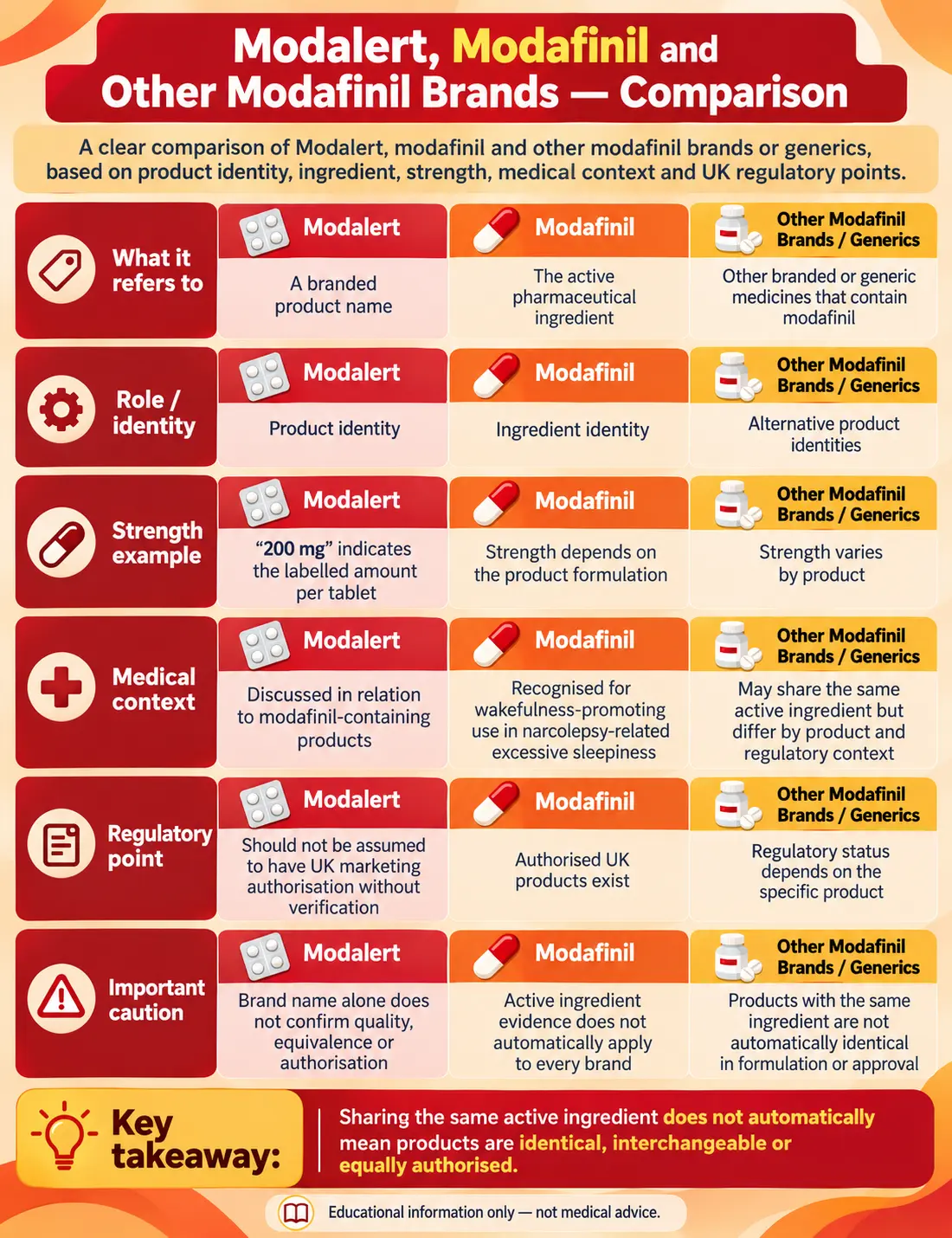
It is also important to distinguish between modafinil as an active ingredient and Modalert as a particular branded formulation.
UK marketing authorisation for one modafinil medicine does not automatically establish that another brand holds equivalent authorisation.
Therefore, Modalert’s own UK marketing authorisation status cannot be inferred from the existence of other licensed modafinil products. Independent confirmation would require official MHRA product records.
Similarly, online availability does not independently establish a medicine’s regulatory status, manufacturing quality or authenticity.
Although EU regulatory assessments have informed aspects of UK modafinil safety guidance, UK classification, licensing and reporting arrangements remain important for readers in the United Kingdom.
Reporting Suspected Adverse Reactions in the UK
The MHRA operates the Yellow Card scheme to collect reports of suspected adverse reactions and other medicine safety concerns.
Patients, members of the public and healthcare professionals can submit reports.
Importantly, a suspected adverse reaction does not need conclusive proof of causation before someone reports it.
These reports help regulators identify potential safety signals that may require further investigation.
However, spontaneous reporting systems cannot establish precise adverse-reaction rates on their own.
Reporting patterns, incomplete information and limited data about the total number of people exposed to a medicine can affect interpretation.
Consequently, Yellow Card reports contribute to ongoing medicine safety monitoring but do not replace formal clinical research.
Frequently Asked Questions About Modalert 200 mg
Which Modalert Side Effects Are Most Common?
Headache is the most frequently documented adverse reaction associated with modafinil, affecting approximately 21% of patients in the clinical safety dataset cited by UK prescribing information. Other common reactions include nausea, dry mouth, insomnia, anxiety, dizziness and reduced appetite. However, these figures primarily describe modafinil research rather than independently verified adverse-reaction rates for the Modalert brand.
Can Modafinil Affect Sleep or Anxiety?
Yes. Insomnia, anxiety and nervousness are recognised common adverse reactions associated with modafinil. Although the medicine promotes wakefulness, it does not replace the body’s need for restorative sleep. Psychological responses may differ between individuals, particularly where an existing anxiety disorder or another psychiatric condition is present. Significant or persistent symptoms warrant professional assessment.
Which Symptoms May Indicate a Serious Reaction?
Potential warning signs include severe or spreading skin rashes, blistering, swelling of the face or throat, breathing difficulties, hallucinations, suicidal thoughts and serious cardiovascular symptoms. Some reactions may require emergency medical attention. Although these outcomes are not typical, UK prescribing information identifies them as clinically important. Their seriousness should not be confused with the greater frequency of milder adverse reactions.
What UK Medicine Safety Information Applies to Modalert?
Modafinil is a Prescription-Only Medicine in the UK, licensed for adults with excessive sleepiness associated with narcolepsy. Official safety information appears in authorised modafinil product documents and MHRA communications. However, authorisation of other modafinil medicines does not establish Modalert’s own UK licensing status. The MHRA also collects suspected medicine-related adverse reactions through its Yellow Card reporting system.
References and Further Reading
The following sources provide the regulatory and clinical background for this article.
- Electronic Medicines Compendium (emc). Modafinil 100 mg Tablets — Summary of Product Characteristics. Sections 4.3–4.8 cover contraindications, precautions, interactions, pregnancy and adverse reactions.
- Medicines and Healthcare products Regulatory Agency (MHRA). Modafinil (Provigil): Increased Risk of Congenital Malformations if Used During Pregnancy. Drug Safety Update, 16 November 2020.
- MHRA. Modafinil (Provigil): Now Restricted to Narcolepsy. Drug Safety Update, March 2011. GOV.UK page published 11 December 2014.
- MHRA. The Yellow Card Scheme: Guidance for Healthcare Professionals, Patients and the Public.
- UK Teratology Information Service (UKTIS). Modafinil. Medicines in Pregnancy patient information leaflet, Version 2.0, May 2025.
- MHRA Products. Medicines Product Information and Marketing Authorisation Records. Official UK product records provide information about individual medicines and their authorisation status.
These references primarily support modafinil-level safety and UK regulatory information. They do not independently establish a UK marketing authorisation or separate clinical safety incidence rates for the Modalert brand.
Final Thoughts: Understanding Modalert Side Effects and Safety
Understanding Modalert side effects involves more than identifying a list of possible symptoms. It also requires recognising how frequently reactions occur, which complications may be serious and where clinical evidence remains limited.
Headaches, nausea, insomnia and anxiety are among the recognised adverse reactions associated with modafinil. However, less frequent reactions involving the skin, mental health or cardiovascular system can carry greater clinical significance.
Medicine interactions, pregnancy-related risks and existing health conditions add further considerations. Additionally, UK prescribing information provides an important framework for interpreting these risks.
The central distinction is between what researchers know about modafinil and what they have independently established about the Modalert brand. Evidence relating to the active ingredient provides useful safety information, but it does not establish brand-specific outcomes or confirm UK marketing authorisation.
Ultimately, a balanced understanding of medicine safety depends on reliable clinical evidence, accurate regulatory information and appropriate professional assessment rather than assumptions about individual experiences.